Perforated roller shutters give Cupar premises out-of-hours protection while light and the display still show through. We look first at whether the shutter should sit inside the glass, since that often gives a better frontage.
We measure your Cupar opening in person, at a time agreed with you first, so the visit fits around your trading.
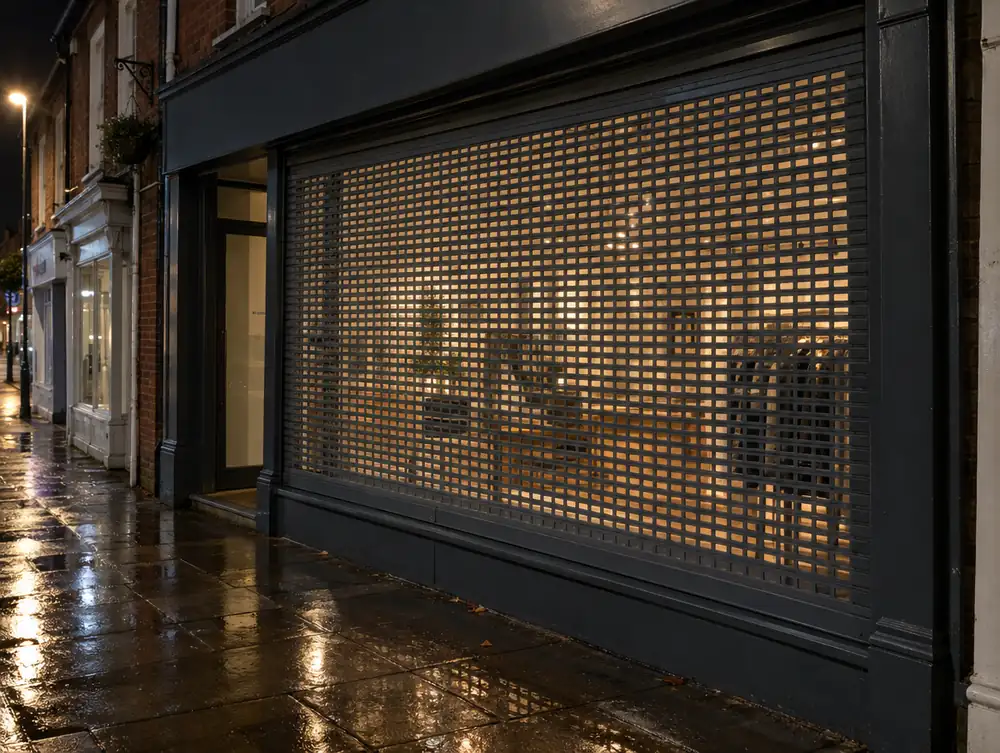
What goes into getting perforated roller shutters right in Cupar?
If the display goes dark overnight, the shutter will read as plain metal from the street. A low-level timer on the window lighting costs very little and keeps your Cupar frontage looking open.
If your Cupar shopfront has a suspended ceiling behind it, an internal box can often hide above the tiles. Where the ceiling is solid or very low, we would look at a slim box in a painted bulkhead.
Where the footway outside your Cupar premises is narrow, a recessed entrance earns its keep. It gives people a dry place to pause out of the walkway, and it adds a longer run of display glass either side of the door.
How much could perforated roller shutters in Cupar cost you?
A sensible starting budget is £1,695 to £4,495 plus VAT per shutter. What shifts the figure is whatever can't be seen yet, such as the condition behind the old frontage or the services running through it.
Which applications might perforated roller shutters in Cupar involve?
Section 26 of the Town and Country Planning (Scotland) Act 1997 sets the test: work that doesn't materially affect the external appearance isn't development. For perforated roller shutters at premises in the Cupar area, anything that does needs planning permission, and a true like-for-like replacement usually doesn't. The council confirms how that applies to each site.
Planning and advert applications for Cupar premises normally go to Fife Council. We check the position for your address at survey.
| Town | Cupar |
|---|---|
| Area | Fife |
| Postcode districts | KY15 |
| Planning authority | Fife Council |
| Building approval | Building warrant (Technical Handbook) |
| Distance from Great Barr | About 264 miles |
| Survey | Free for new work |
Does Fife Council publish shopfront guidance?
Yes, Shop Front Design Guidelines (2016). It tells applicants what the council expects from new and altered shopfronts. A few of the things it asks for:
- Solid security shutters are discouraged, and shutter boxes may not project in front of the shop front.
- Internal lattice shutters and reinforced laminated glass are encouraged in town centres, with demountable mesh grilles preferred on traditional shop fronts.
- Each shop normally gets one fascia sign and one projecting sign, and only one of them may be lit.
Questions about perforated roller shutters in Cupar
Can you fit an internal shutter on my Cupar premises?
Usually, yes. We check for ceiling space, a clear path behind the window and a solid fixing for the guides. Where space is tight, a slim box or a smaller display can make it work.
Can I keep my window display lit behind a shutter in Cupar?
Yes, and we recommend it. A low-level light on a timer costs very little and lets the display read through the perforations overnight.
Can a perforated shutter match my other sites in Fife?
Yes. Send us the colour reference and curtain type from an existing site, and we match them on the new one. The box and guides may differ, because each frontage has its own structure.
Do I need listed building consent for a shopfront in the Cupar area?
Almost certainly, if the building is listed and windows or doors are changing, according to Historic Environment Scotland. The planning authority decides, and Historic Environment Scotland is consulted on some applications. Scottish Ministers are notified if it objects.
Which way must a fire exit door open on a shop in the Cupar area?
In the direction of escape. Regulation 13(2) of the Fire Safety (Scotland) Regulations 2006 also rules out sliding and revolving doors on a dedicated fire exit and says fire exit doors can't be locked against immediate use. Duties sit with dutyholders under Part 3 of the Fire (Scotland) Act 2005, meaning the employer and any person with control of the premises.