The brief for a bi-fold is simple: an open front in summer and a warm room in winter. For Cupar premises in Fife, that comes down to panel count, thermal section and a threshold that drains properly.
Nothing gets ordered off the back of a survey in Cupar, because its job is to give us the numbers to draw and price from.
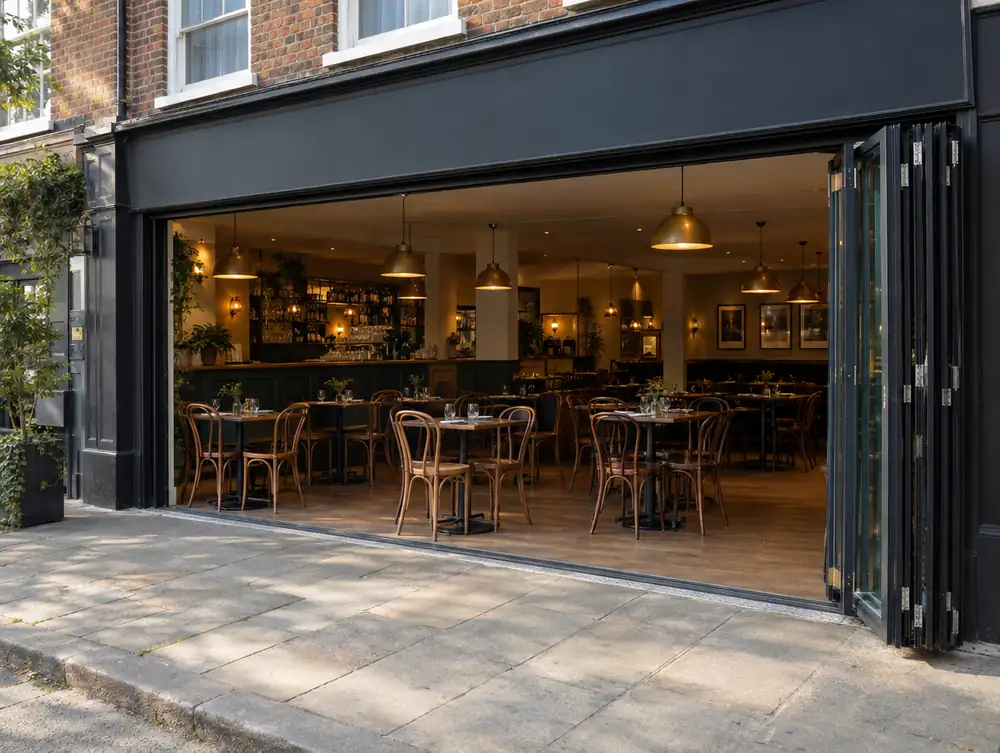
What makes bi-folding shopfronts work well on Cupar premises?
In a parade in Cupar, a bi-fold has to sit politely when closed. We'd match the fascia line and keep a short fixed return at one end, so the set reads as part of the row instead of a gap in it.
Bi-folds suit a two-stage fit at Cupar premises that trade late. We'd take the old front out and fix the frame during closed hours, then hang and adjust the panels the following night, with temporary boarding in between.
Where the building has good brick or stone around the opening, set the frame back in the reveal so the masonry can be seen. On Cupar premises with a flat elevation, that deep reveal throws a shadow line that adds real depth in low sun.
Could bi-folding shopfronts in Cupar need planning permission?
Class 9A, Scotland's shop permitted development right, gives no route for a shopfront change. It covers Class 1A premises, but not work that alters or extends beyond the existing front, and it doesn't apply in conservation areas, National Parks or World Heritage Sites. For bi-folding shopfronts at premises in the Cupar area, that generally means a planning application unless the external appearance isn't materially affected.
Cupar applications for planning permission or advertisement consent are normally handled by Fife Council. Our survey includes a check of the position for your address.
How much should you set aside for bi-folding shopfronts in Cupar?
Until the survey is done, plan on £5,195 to £13,995 plus VAT for a typical opening. Unusual sizes, fine detail and phased working push the figure up, while a simple brief and clear access keep it toward the lower end.
| Town | Cupar |
|---|---|
| Area | Fife |
| Postcode districts | KY15 |
| Planning authority | Fife Council |
| Building approval | Building warrant (Technical Handbook) |
| Distance from Great Barr | About 264 miles |
| Survey | Free for new work |
Does Fife Council publish shopfront guidance?
Yes, Shop Front Design Guidelines (2016). It tells applicants what the council expects from new and altered shopfronts. A few of the things it asks for:
- Solid security shutters are discouraged, and shutter boxes may not project in front of the shop front.
- Internal lattice shutters and reinforced laminated glass are encouraged in town centres, with demountable mesh grilles preferred on traditional shop fronts.
- Each shop normally gets one fascia sign and one projecting sign, and only one of them may be lit.
Questions about bi-folding shopfronts in Cupar
Who do I speak to about a bi-fold in Cupar?
Your named contact stays the same from the first visit to the final adjustment. Fitting is carried out by vetted teams working under S&K Glazing, travelling from Great Barr.
Can I have a timber bi-fold on my Cupar frontage?
Yes. Painted hardwood sets suit older premises across Fife, though the panels are heavier and need a stiffer head than aluminium.
Can the threshold be level at my Cupar premises?
It can be close to level, depending on the floor and drainage. We'd check the levels at survey, because a track sitting flush with the pavement still needs somewhere for water to go.
Do I need a building warrant for a shopfront in the Cupar area?
Usually yes in Scotland, if the work alters a wall or structure. Schedule 3 of the Building (Scotland) Regulations 2004 lists some work that needs no warrant, such as replacing a door or window with its frame, but the standards still apply. Shopfronts aren't named there, so ask the council before relying on it.
Do I need planning permission to alter a shopfront in the Cupar area?
Usually yes, if the work materially affects the external appearance. Class 9A, Scotland's shop permitted development right, doesn't cover work that alters or extends beyond the existing front. A true like-for-like replacement usually needs no permission, and the council confirms the position.