We travel from Great Barr to survey and restore period shopfronts for Cupar premises, with drawings detailed enough for a specialist to read. One named contact stays with the job throughout.
Your survey is where the price gets real, because widths, heights, levels and access are all taken on site in Cupar.
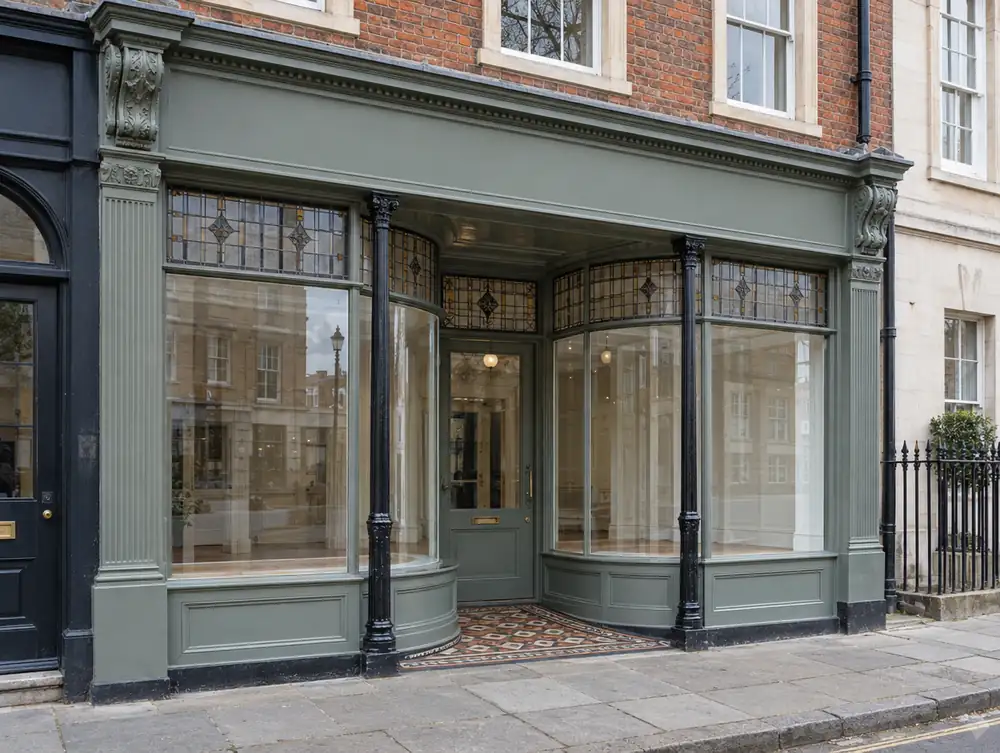
What makes heritage shopfronts work well on Cupar premises?
Sun is hard on old paintwork and putty. For a south-facing period front in Cupar, we'd look at a traditional retractable blind, which shades the glass, protects the stock and brings back a useful feature.
Deep recessed lobbies are among the first things to go in a refit. If your Cupar premises still have one, especially with a tiled floor, we'd protect it, repair the floor and reuse the returns as display.
Where the footway outside your Cupar premises is narrow, a recessed entrance earns its keep. It gives people a dry place to pause out of the walkway, and it adds a longer run of display glass either side of the door.
Could heritage shopfronts in Cupar need planning permission?
Class 9A, Scotland's shop permitted development right, gives no route for a shopfront change. It covers Class 1A premises, but not work that alters or extends beyond the existing front, and it doesn't apply in conservation areas, National Parks or World Heritage Sites. For heritage shopfronts at premises in the Cupar area, that generally means a planning application unless the external appearance isn't materially affected.
We confirm the position at survey, because a boundary or a special designation can change who handles the file, but applications from Cupar premises normally go to Fife Council.
How much should you set aside for heritage shopfronts in Cupar?
The guide for heritage shopfronts is £8,495 to £24,995 plus VAT for a typical frontage. Expect the lower end for simple work with clear access, and the upper end where detail, finish or awkward conditions add hours.
| Town | Cupar |
|---|---|
| Area | Fife |
| Postcode districts | KY15 |
| Planning authority | Fife Council |
| Building approval | Building warrant (Technical Handbook) |
| Distance from Great Barr | About 264 miles |
| Survey | Free for new work |
Does Fife Council publish shopfront guidance?
Yes, Shop Front Design Guidelines (2016). It tells applicants what the council expects from new and altered shopfronts. A few of the things it asks for:
- Solid security shutters are discouraged, and shutter boxes may not project in front of the shop front.
- Internal lattice shutters and reinforced laminated glass are encouraged in town centres, with demountable mesh grilles preferred on traditional shop fronts.
- Each shop normally gets one fascia sign and one projecting sign, and only one of them may be lit.
Questions about heritage shopfronts in Cupar
Can a new sign go on my old Cupar shopfront?
Yes, and traditional sign writing often looks right on a painted fascia. We'd draw the lettering to suit the fascia, then fix anything raised so it does no harm to the original timber.
Who makes the joinery for Cupar premises?
Specialist joiners vetted by us and working under S&K Glazing make and fit it. You deal with one named contact, and the contract is with S&K Glazing Limited.
What does a period survey of my Cupar shop involve?
We measure the front, photograph every detail and check the condition of timber, paint and glass. With your agreement, we may lift a small piece of later boarding to see what survives behind it.
Do I need a building warrant for a shopfront in the Cupar area?
Usually yes in Scotland, if the work alters a wall or structure. Schedule 3 of the Building (Scotland) Regulations 2004 lists some work that needs no warrant, such as replacing a door or window with its frame, but the standards still apply. Shopfronts aren't named there, so ask the council before relying on it.
Which way must a fire exit door open on a shop in the Cupar area?
In the direction of escape. Regulation 13(2) of the Fire Safety (Scotland) Regulations 2006 also rules out sliding and revolving doors on a dedicated fire exit and says fire exit doors can't be locked against immediate use. Duties sit with dutyholders under Part 3 of the Fire (Scotland) Act 2005, meaning the employer and any person with control of the premises.