Seen a frontage you admire? Bring the picture to our first talk about heritage shopfronts in Fife, and we will work out what makes it succeed, from fascia depth to glass line, and what that means for your building.
Daylight is only half the brief for heritage shopfronts, because a frontage keeps working after dark. Think about how the glass, the sign and the view inside will read to someone walking past at six o'clock on a winter evening.
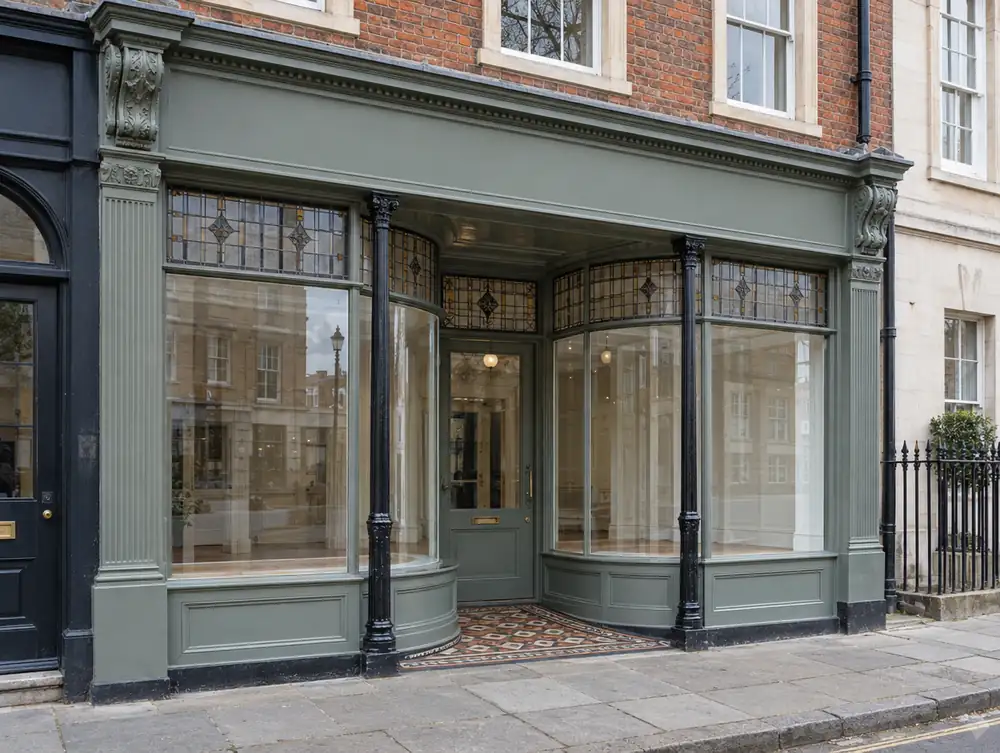
What makes heritage shopfronts work well for premises in Fife?
If your premises in Fife have an older frontage, it may hide more than it shows. We begin by looking for evidence behind later fascias and cladding, because one surviving bracket can set the proportions of the whole front.
A period front still has to work as a modern shop. For premises in Fife, we look at how door gear, lighting, alarm contacts and a cleaner threshold can be added without any of it showing from the street.
What consents apply to heritage shopfronts in Fife?
Shutters aren't named in Class 9A, so in Scotland they usually fall to the appearance test. The same goes for heritage shopfronts at premises in the Fife area: building work that materially affects the external appearance needs planning permission, and a true like-for-like usually doesn't. Ask the council to confirm the position for your site.
How much do heritage shopfronts cost in Fife?
Until the survey is done, plan on £8,495 to £24,995 plus VAT for a typical frontage. Unusual sizes, fine detail and phased working push the figure up, while a simple brief and clear access keep it toward the lower end.
| Area | Fife |
|---|---|
| Nation | Scotland |
| Towns covered | 9 |
| Main town | Dunfermline |
| Planning regime | Scotland: 1997 Planning Act and the 1984 Advertisement Regulations |
| Building approval | Building warrant (Technical Handbook) |
| Survey | Free for new work, from our Great Barr base |
Does Fife Council publish shopfront guidance?
Yes, Shop Front Design Guidelines (2016). It tells applicants what the council expects from new and altered shopfronts. A few of the things it asks for:
- Solid security shutters are discouraged, and shutter boxes may not project in front of the shop front.
- Internal lattice shutters and reinforced laminated glass are encouraged in town centres, with demountable mesh grilles preferred on traditional shop fronts.
- Each shop normally gets one fascia sign and one projecting sign, and only one of them may be lit.
Questions about heritage shopfronts in Fife
Can you match old glass at premises in Fife?
Often. Reclaimed or drawn glass with a slight ripple can be sourced for small panes, and leaded lights can be repaired to the same pattern.
How long does period joinery take for premises in Fife?
Typically 8 to 14 weeks to make, then 1 to 3 weeks on site. Repairs in place can take less, depending on what the survey finds.
Can my old shopfront in Dunfermline be repaired instead of replaced?
Often, yes. Rot usually stays at the feet of posts, cills and door bottoms, and those can be cut out and spliced while the rest stays in place.
Do I need listed building consent for a shopfront in the Fife area?
Almost certainly, if the building is listed and windows or doors are changing, according to Historic Environment Scotland. The planning authority decides, and Historic Environment Scotland is consulted on some applications. Scottish Ministers are notified if it objects.
Does the Equality Act cover a shop entrance in the Fife area?
Yes. The Equality Act 2010 applies in Scotland as part of Great Britain, and its anticipatory duty expects reasonable steps to remove, alter or avoid physical features that disadvantage disabled people generally. BS 8300-2:2018 is the current British Standard for accessible buildings.