Slim frames and low upkeep make aluminium a sound choice for retailers, restaurants and landlords in Cupar. Each front is designed, made and fitted to the measured opening, with one contract covering glass, frame, sign and shutter.
Surveys for Cupar are booked with you directly. Tell us your quieter days and we'll work around them.
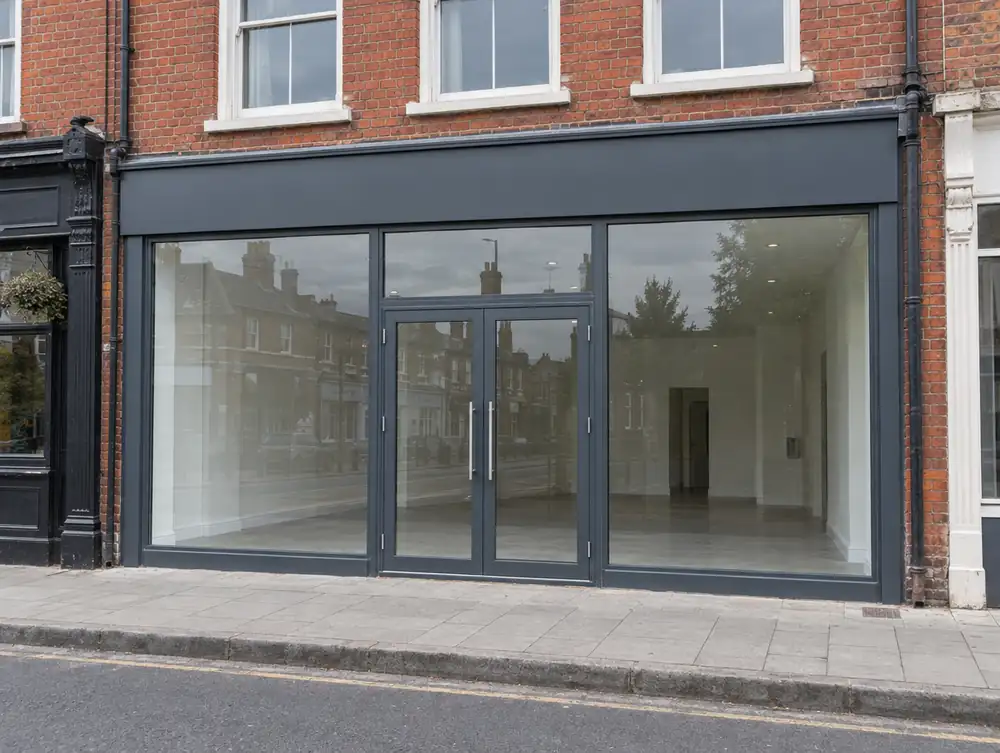
How do you design around the building when planning aluminium shopfronts in Cupar?
Where Cupar premises have a deep recessed entrance, it's usually worth keeping. The angled returns add display length and shelter, and a slim frame with soffit lighting turns a dark corner into the brightest part of the front in the evening.
Some Cupar landlords issue a shopfront specification, and we'd draw to it from the start. Where your brand needs something different, we mark each departure on the drawing so the landlord can approve the front without a round of guesswork.
Where the building has good brick or stone around the opening, set the frame back in the reveal so the masonry can be seen. On Cupar premises with a flat elevation, that deep reveal throws a shadow line that adds real depth in low sun.
What permissions should you check for aluminium shopfronts in Cupar?
Shutters aren't named in Class 9A, so in Scotland they usually fall to the appearance test. The same goes for aluminium shopfronts at premises in the Cupar area: building work that materially affects the external appearance needs planning permission, and a true like-for-like usually doesn't. Ask the council to confirm the position for your site.
At survey we check how things stand for your building, although applications for planning permission or advertisement consent here normally go to Fife Council.
What might aluminium shopfronts cost in Cupar?
Our guide band is £2,495 to £11,995 plus VAT for a typical 3 to 7 m frontage. Scope is the biggest lever, so a tighter brief for aluminium shopfronts brings the figure down faster than any change of detail.
| Town | Cupar |
|---|---|
| Area | Fife |
| Postcode districts | KY15 |
| Planning authority | Fife Council |
| Building approval | Building warrant (Technical Handbook) |
| Distance from Great Barr | About 264 miles |
| Survey | Free for new work |
Does Fife Council publish shopfront guidance?
Yes, Shop Front Design Guidelines (2016). It tells applicants what the council expects from new and altered shopfronts. A few of the things it asks for:
- Solid security shutters are discouraged, and shutter boxes may not project in front of the shop front.
- Internal lattice shutters and reinforced laminated glass are encouraged in town centres, with demountable mesh grilles preferred on traditional shop fronts.
- Each shop normally gets one fascia sign and one projecting sign, and only one of them may be lit.
Questions about aluminium shopfronts in Cupar
Will an aluminium front make my Cupar shop warmer?
It can, though the glass matters more than the frame. A thermally broken section with double-glazed units loses less heat than single glazing, and a well-sealed door is often the change you notice most on a cold day.
Can I keep trading while my Cupar shopfront is replaced?
Often, yes. The front can usually be replaced a section at a time, with temporary screens keeping the shop secure, and a closed-day or out-of-hours fit can be arranged if that suits you better.
What do you need before surveying a unit in Cupar?
An address, a few photos and a rough idea of what you have in mind are enough to book the survey. If you have a lease, a landlord's specification or brand guidelines, send those too, because they shape the drawing.
Which way must a fire exit door open on a shop in the Cupar area?
In the direction of escape. Regulation 13(2) of the Fire Safety (Scotland) Regulations 2006 also rules out sliding and revolving doors on a dedicated fire exit and says fire exit doors can't be locked against immediate use. Duties sit with dutyholders under Part 3 of the Fire (Scotland) Act 2005, meaning the employer and any person with control of the premises.
Does the Equality Act cover a shop entrance in the Cupar area?
Yes. The Equality Act 2010 applies in Scotland as part of Great Britain, and its anticipatory duty expects reasonable steps to remove, alter or avoid physical features that disadvantage disabled people generally. BS 8300-2:2018 is the current British Standard for accessible buildings.