From measured survey to handover, awnings and canopies across New Barnet and Greater London sit under one contract, alongside any sign or shopfront work on the same frontage. Your named contact treats the fabric, the frame and the fixing as one job.
Surveys for New Barnet are booked with you directly. Tell us your quieter days and we'll work around them.
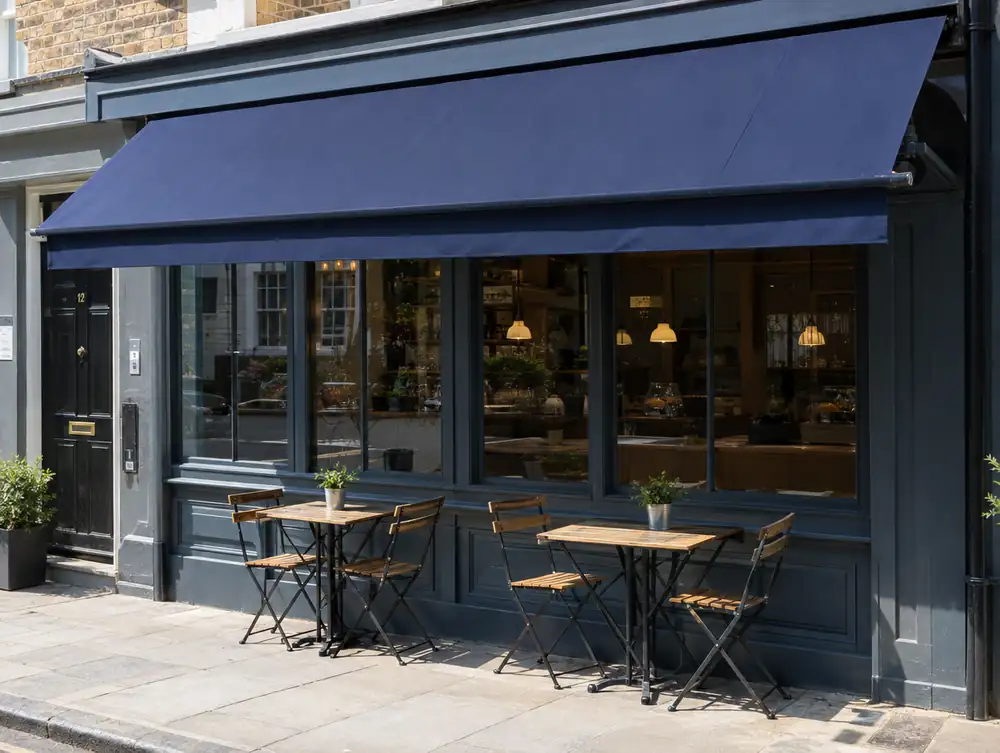
What makes canopies and awnings work well on New Barnet premises?
Where your sign sits on the fascia, the awning box goes above or below it without covering the name. If that cannot be done, we letter the valance so people can still read who you are.
If your New Barnet premises sell food from the front, we would avoid a strong fabric colour that tints the display. Neutral or striped canvas keeps produce looking natural.
If your premises were once two shops, decide early whether the front should read as one or as two. One continuous fascia with a repeated bay width usually settles the elevation better than two mismatched halves, which is worth testing on any New Barnet unit of that kind.
How much should you set aside for canopies and awnings in New Barnet?
The guide for canopies and awnings is £1,495 to £9,995 plus VAT per canopy or awning. Expect the lower end for simple work with clear access, and the upper end where detail, finish or awkward conditions add hours.
Could canopies and awnings in New Barnet need planning permission?
Security grilles and shutters are named in England's rules: installing or replacing one on a shopfront sits outside the shop permitted development rights. The frontage itself is treated the same way, so for canopies and awnings at premises in the New Barnet area, building work that materially affects the appearance needs planning permission. Confirm the position with the council before anything is ordered.
Lighting moves a sign out of Class 5 in England, because that class allows illumination only for medical-type notices. Class 4B then applies at premises in the New Barnet area: halo or character-only lighting, static, with the lowest part at least 2.5m up. Brightness is capped at 600 cd/m² on signs up to 10m² and 300 cd/m² above that, and anything outside these limits needs advertisement consent.
At survey we check how things stand for your building, although applications for planning permission or advertisement consent here normally go to London Borough of Barnet.
| Town | New Barnet |
|---|---|
| Area | Greater London |
| Postcode districts | EN4, EN5, N14, N20 |
| Planning authority | London Borough of Barnet |
| Building approval | Building Regulations (Approved Documents) |
| Distance from Great Barr | About 96 miles |
| Survey | Free for new work |
Questions about canopies and awnings in New Barnet
Will an awning hide the sign on my New Barnet premises?
It should not, if it is designed properly. We place the box and valance so the name reads with the cover out, or we add lettering to the valance.
How long will an awning last on New Barnet premises?
A good frame typically lasts 15 years or more, and acrylic canvas typically lasts 7 to 10 years. Regular cleaning and retracting in high wind make the biggest difference.
Can an awning in New Barnet be motorised?
Yes, most can. A tubular motor sits inside the roller, with a remote or wall switch, and a wind sensor can be added. You will need a power supply near the box, which we check at survey.
What rules apply to a fire exit door through a shopfront in the New Barnet area?
It must open in the direction of escape and can't be locked against immediate use, and a dedicated fire exit can't be a sliding or revolving door. In England that comes from article 14(2) of the Regulatory Reform (Fire Safety) Order 2005, and the duty sits with the responsible person, normally the employer or whoever controls the premises for a business, otherwise the owner. An outward door can clash with section 153 of the Highways Act 1980 where it opens onto the footway, so raise it early.
Do I need listed building consent for a shopfront in the New Barnet area?
Usually yes, if the building is listed. In England the local planning authority decides, and Historic England is notified of Grade I and II* works and specified Grade II works. Like-for-like repair may not need consent, so ask the council before work starts.