A double-height entrance in South Kensington deserves more than a stretched shopfront. Deeper aluminium sections carry the span, with sightlines kept as slim as the wind load allows.
Surveys for South Kensington are booked with you directly. Tell us your quieter days and we'll work around them.
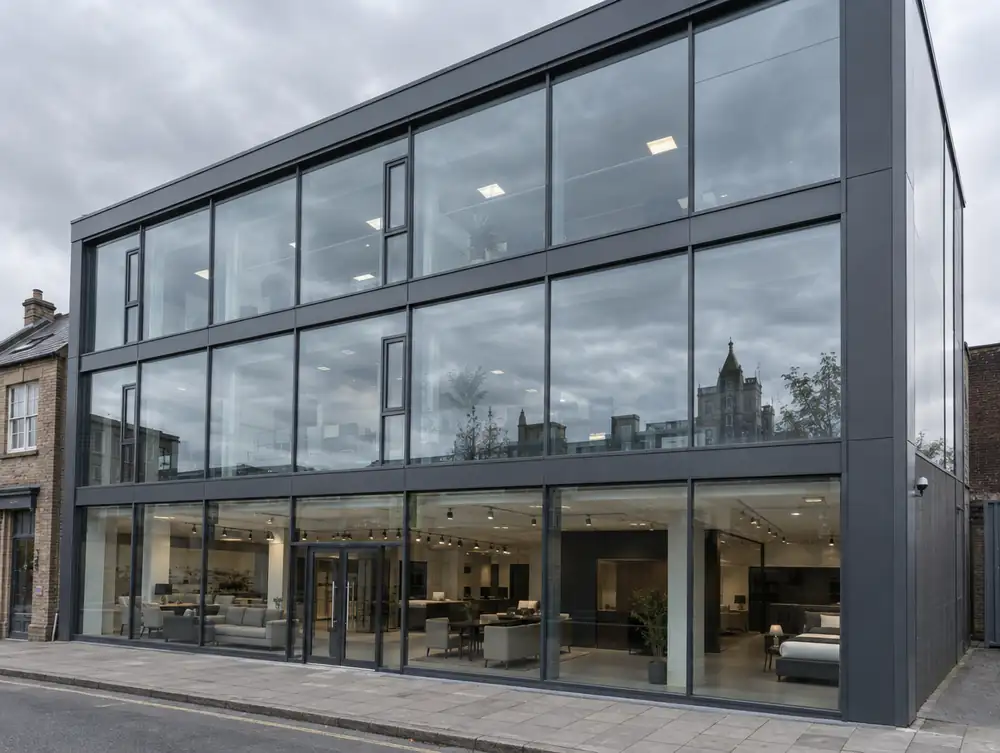
Where should you begin with curtain walling in South Kensington?
If the ground floor of your South Kensington premises is a shop, we carry the curtain wall grid down into the shopfront below. Door heads, fascia line and transoms then line up by design.
Unloading is worth thinking through early on any South Kensington site with restricted access. Mullions can run to 6m or more, so we look at lifting routes, storage and where a delivery can stop.
If your South Kensington unit is narrow, a central door can split a small window into two weak ones. Moving the door to one side gives you a single confident pane, provided the layout inside still works.
What price should you expect for curtain walling in South Kensington?
Our guide band is £550 to £1,250 plus VAT per m². Scope is the biggest lever, so a tighter brief for curtain walling brings the figure down faster than any change of detail.
What sign-off might you need for curtain walling in South Kensington?
England has no permitted development route for changing a shopfront. Part 7 Class A of the General Permitted Development Order 2015 excludes creating, altering or replacing one, and it allows no alterations at all on article 2(3) land. That leaves two outcomes for curtain walling at premises in the South Kensington area: a planning application, or work that doesn't materially affect the external appearance.
South Kensington applications for planning permission or advertisement consent are normally handled by Royal Borough of Kensington and Chelsea. Our survey includes a check of the position for your address.
| Town | South Kensington |
|---|---|
| Area | Greater London |
| Postcode districts | SW7 |
| Planning authority | Royal Borough of Kensington and Chelsea |
| Building approval | Building Regulations (Approved Documents) |
| Distance from Great Barr | About 104 miles |
| Survey | Free for new work |
Does Royal Borough of Kensington and Chelsea publish shopfront guidance?
Yes, Shopfront Design Guidelines Supplementary Planning Document (2011). It tells applicants what the council expects from new and altered shopfronts. A few of the things it asks for:
- Stallriser height should not exceed the base of the pilasters, around 450mm, or the fascia depth, whichever is less.
- Box fascias are not to be used, and painted timber is treated as the most appropriate fascia on nineteenth-century buildings.
- External shutters are not acceptable across most of the borough, with internal open-link grilles preferred.
Questions about curtain walling in South Kensington
Can you replace failing curtain walling on premises in South Kensington?
Yes. We survey the frame, brackets and seals first, because some elevations only need new glass and gaskets. If the frame itself has failed, we draw a replacement that can be phased around the building's use.
Who do I deal with during a curtain walling job in South Kensington?
You have one named contact from survey to handover. The contract is with S&K Glazing Limited, and vetted teams working under S&K Glazing carry out the work.
What should I send before a survey of my South Kensington premises?
The address, a few photographs and any existing drawings are enough to start. Tell us how the building is used and which floors stay occupied, because that shapes the access plan.
Does a shop sign in the South Kensington area need advertisement consent?
Not always. In England, an unlit sign within Class 5 of the 2007 Advertisement Regulations generally needs no application, and neither does a lit sign within Class 4B. Anything outside those classes needs consent, and Class 4B isn't available in conservation areas, so check before ordering.
Does the Equality Act apply to a shop entrance in the South Kensington area?
Yes. The Equality Act 2010 applies in England, as across Great Britain, and it requires reasonable steps to remove, alter or avoid physical features that disadvantage disabled people. The duty is anticipatory, so it looks at disabled people generally, and a new Services Code replaced the 2011 Code on 5 August 2026.