Curtain walling gives Willesden premises a glazed elevation that runs past the floor edges, where a standard shopfront frame would run out of span. We measure the structure first, then set the grid out to suit the building.
Measuring the opening is the easy part of a survey in Willesden. We also look at the beam above, the pavement fall and any meters or drains nearby.
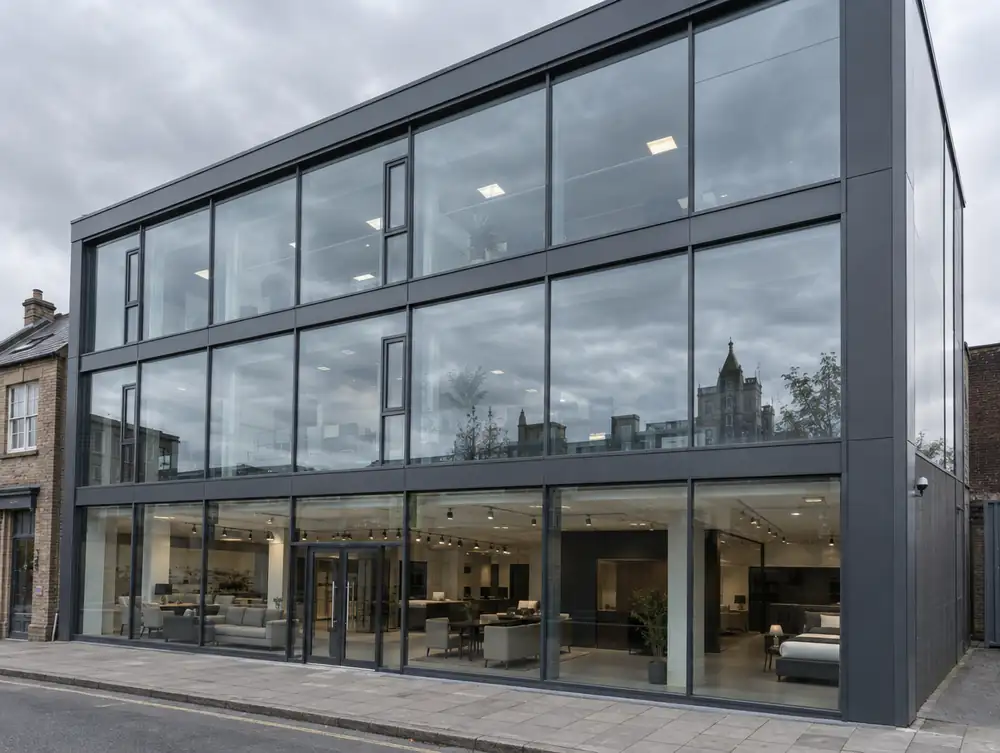
How would we approach curtain walling for your Willesden premises?
If your Willesden premises have a concrete frame, we open up a sample of slab edges at survey and plan brackets around what is really there. Steel frames and older masonry piers each need a different fixing, so nothing is priced from assumptions.
If the frontage joins a neighbouring building in Willesden, we draw that junction in full at design stage. The last mullion, the flashing and the movement joint are details people notice from the pavement.
Where the footway outside your Willesden premises is narrow, a recessed entrance earns its keep. It gives people a dry place to pause out of the walkway, and it adds a longer run of display glass either side of the door.
What consents could affect curtain walling in Willesden?
For curtain walling at premises in the Willesden area, the deciding question in England is whether the building work materially affects the external appearance. If it does, planning permission is needed, while a true like-for-like replacement usually needs none. The council confirms the position for each site.
Willesden applications for planning permission or advertisement consent are normally handled by London Borough of Brent. Our survey includes a check of the position for your address.
What should you budget for curtain walling in Willesden?
Guide price: £550 to £1,250 plus VAT per m². Materials, finish and the amount of drawing and coordination involved all move it, and your itemised quotation shows where the money goes on curtain walling.
| Town | Willesden |
|---|---|
| Area | Greater London |
| Postcode districts | NW10, NW6, W10, W12 |
| Planning authority | London Borough of Brent |
| Building approval | Building Regulations (Approved Documents) |
| Distance from Great Barr | About 100 miles |
| Survey | Free for new work |
Does Brent Council publish shopfront guidance?
Yes, Shopfronts SPD3 (2018). It tells applicants what the council expects from new and altered shopfronts. A few of the things it asks for:
- A stallriser of at least 300mm should be kept or installed at the base of the shop display.
- Fascia text should cover no more than half the fascia's width and height, with lettering no taller than 30cm.
- Solid or pin-hole roller shutters are discouraged, and security options run from laminated glass to internal open shutters, then external open shutters only where needed for insurance.
Questions about curtain walling in Willesden
What should I send before a survey of my Willesden premises?
The address, a few photographs and any existing drawings are enough to start. Tell us how the building is used and which floors stay occupied, because that shapes the access plan.
Who do I deal with during a curtain walling job in Willesden?
You have one named contact from survey to handover. The contract is with S&K Glazing Limited, and vetted teams working under S&K Glazing carry out the work.
Will you coordinate with my architect or main contractor in Willesden?
Yes. We can work to their drawings and programme, and we supply shop drawings for their review before anything is made. Your named contact stays the single route for questions on our package.
Do roller shutters need planning permission in the Willesden area?
Usually yes. Installing or replacing a security grill or shutter on a shopfront is expressly outside England's shop permitted development rights, so the only way to avoid an application is work that doesn't materially affect the appearance. Ask the council before ordering.
What rules apply to a fire exit door through a shopfront in the Willesden area?
It must open in the direction of escape and can't be locked against immediate use, and a dedicated fire exit can't be a sliding or revolving door. In England that comes from article 14(2) of the Regulatory Reform (Fire Safety) Order 2005, and the duty sits with the responsible person, normally the employer or whoever controls the premises for a business, otherwise the owner. An outward door can clash with section 153 of the Highways Act 1980 where it opens onto the footway, so raise it early.