Fascia signs for Enfield Lock premises start with the building, because the frontage has already set the depth and position of the sign band. We measure it, draw your name to scale and show you the result before anything is cut.
We measure your Enfield Lock opening in person, at a time agreed with you first, so the visit fits around your trading.
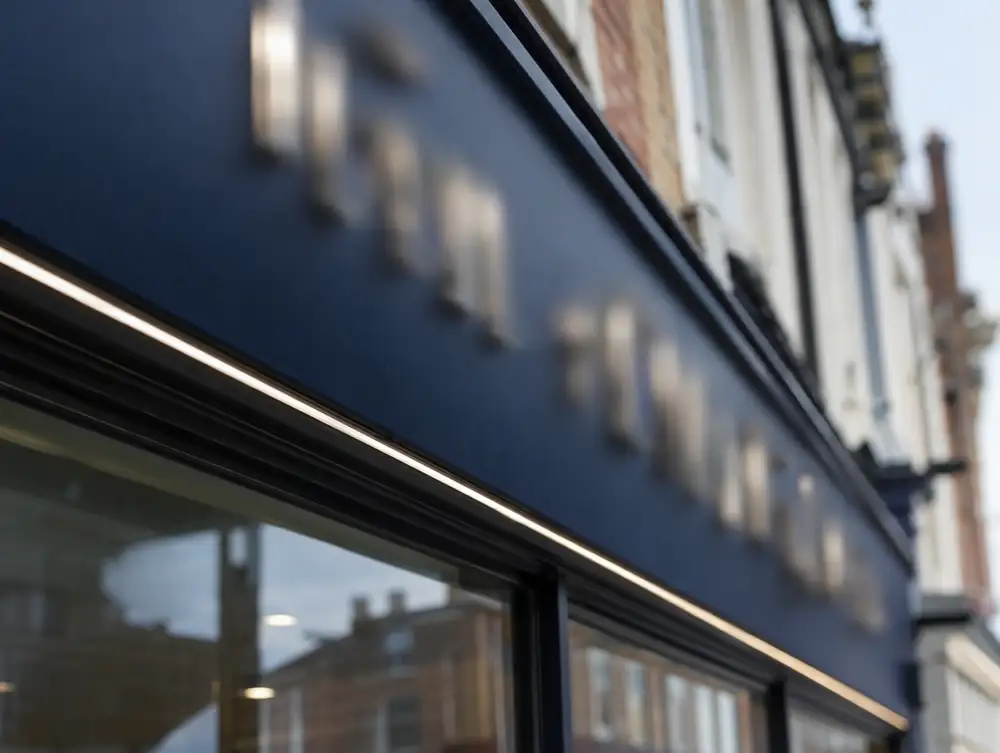
What should you think about before commissioning fascia signage in Enfield Lock?
A deep fascia above a low shopfront can often be reduced on the drawing board. If your Enfield Lock premises have one, we would show you a slimmer panel option, with the ceiling line behind it adjusted to suit.
Where the fascia on your Enfield Lock premises has been overclad, we lift a sample at survey to see what is underneath. Original timber, cornice mouldings or tile may be worth keeping, and they change what the new sign should be.
If your Enfield Lock unit is narrow, a central door can split a small window into two weak ones. Moving the door to one side gives you a single confident pane, provided the layout inside still works.
Who approves fascia signage in Enfield Lock?
For fascia signage at premises in the Enfield Lock area, the deciding question in England is whether the building work materially affects the external appearance. If it does, planning permission is needed, while a true like-for-like replacement usually needs none. The council confirms the position for each site.
In England, signs at premises in the Enfield Lock area come under the 2007 Advertisement Regulations. An unlit fascia sign generally needs no application under Class 5 of Schedule 3 if it sits on a wall containing a shop window, tops out at 4.6m or the first-floor sill if that is lower, and keeps letters to 0.75m high. Displaying a sign without the consent it needs is a criminal offence, so check before it goes up.
Expect planning and advert applications here to go to London Borough of Enfield in the normal way. We check what that means for your building when we survey it in Enfield Lock.
What is a realistic budget for fascia signage in Enfield Lock?
Allow £395 to £1,995 plus VAT per sign. Size and specification set most of that figure for fascia signage, and the rest depends on what the survey finds on site.
| Town | Enfield Lock |
|---|---|
| Area | Greater London |
| Postcode districts | EN1, EN3, EN8, EN9 |
| Planning authority | London Borough of Enfield |
| Building approval | Building Regulations (Approved Documents) |
| Distance from Great Barr | About 100 miles |
| Survey | Free for new work |
Questions about fascia signage in Enfield Lock
What if the fascia behind my old sign in Enfield Lock is rotten?
We show you photographs and price the repair before going further. A short section of timber can often be spliced in, while a badly decayed fascia is better replaced with a new subframe.
How quickly can I see a drawing for my Enfield Lock sign?
Drawings typically follow within one to two weeks of the survey, depending on the artwork and how many options you want to see. Your named contact will give you a date once the survey is booked.
Can a sign match my other sites in Greater London?
Yes. Send a photograph and the drawings or brand file from an existing site, and we match the letter style, finish and colour reference. Fascia depth may differ, so the size is adjusted to keep the proportions right.
Does the Equality Act apply to a shop entrance in the Enfield Lock area?
Yes. The Equality Act 2010 applies in England, as across Great Britain, and it requires reasonable steps to remove, alter or avoid physical features that disadvantage disabled people. The duty is anticipatory, so it looks at disabled people generally, and a new Services Code replaced the 2011 Code on 5 August 2026.
What rules apply to a fire exit door through a shopfront in the Enfield Lock area?
It must open in the direction of escape and can't be locked against immediate use, and a dedicated fire exit can't be a sliding or revolving door. In England that comes from article 14(2) of the Regulatory Reform (Fire Safety) Order 2005, and the duty sits with the responsible person, normally the employer or whoever controls the premises for a business, otherwise the owner. An outward door can clash with section 153 of the Highways Act 1980 where it opens onto the footway, so raise it early.