Halo-lit letters give Enfield Lock premises a soft glow on the panel behind, with the name itself in crisp silhouette. Face-lit and trough options suit other brands and buildings, and we show you the difference on a scale drawing.
Bring whatever you have to the survey in Enfield Lock: brand guidelines, lease plans, old drawings or a photo of a frontage you admire.
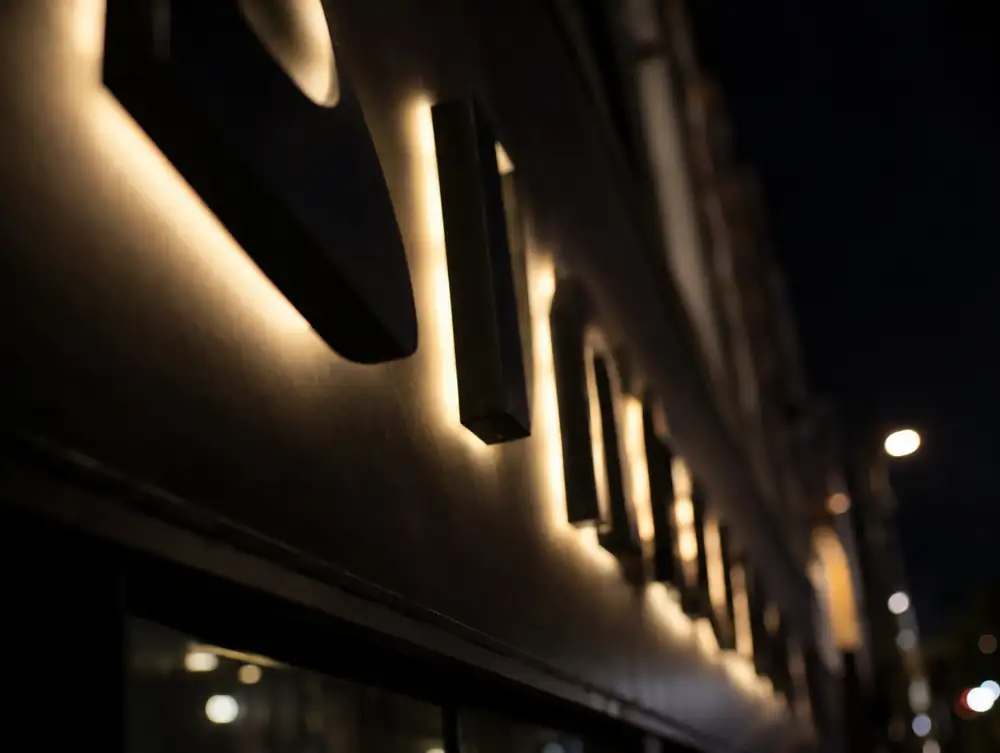
How would we approach illuminated signage for your Enfield Lock premises?
On a timber frontage, a slim trough light usually keeps more of the daytime character than lit letters. We colour-match the bar to the fascia, so it almost disappears by day.
Should your Enfield Lock premises close early, a photocell and timer can keep the sign on through the evening footfall and off for the rest of the night. It costs very little and helps the frontage look looked-after.
Where units share one long run of fascia, breaking the height makes you stand out for the wrong reason. If that describes your Enfield Lock parade, keep the line and win attention with lettering, lighting and what's in the window.
What consents could affect illuminated signage in Enfield Lock?
A true like-for-like replacement usually needs no planning permission in England, because the external appearance isn't materially affected. New materials, a different glass line or altered proportions usually do count as material, so for illuminated signage at premises in the Enfield Lock area, an application is then likely. The council confirms which side of that line a job falls on.
Class 4B, England's class for lit signs, isn't available in conservation areas, Areas of Outstanding Natural Beauty, National Parks or the Broads, so a lit sign there normally needs advertisement consent. In an area of special control it is unavailable too, and Class 5 drops to a 3.6m top height, 0.3m letters and one-tenth of the building face up to 3.6m. Ask the council which designations cover premises in the Enfield Lock area.
Enfield Lock applications for planning permission or advertisement consent are normally handled by London Borough of Enfield. Our survey includes a check of the position for your address.
What should you budget for illuminated signage in Enfield Lock?
Until the survey is done, plan on £895 to £3,995 plus VAT per sign. Unusual sizes, fine detail and phased working push the figure up, while a simple brief and clear access keep it toward the lower end.
| Town | Enfield Lock |
|---|---|
| Area | Greater London |
| Postcode districts | EN1, EN3, EN8, EN9 |
| Planning authority | London Borough of Enfield |
| Building approval | Building Regulations (Approved Documents) |
| Distance from Great Barr | About 100 miles |
| Survey | Free for new work |
Questions about illuminated signage in Enfield Lock
Will a lit sign in Enfield Lock cost much to run?
Very little. A typical LED sign uses about the same power as a few domestic lamps, and a timer trims that further. Occasional driver changes are the larger long-term cost.
Can you replace a lightbox on my Enfield Lock premises?
Yes. We take the old box down, check the wall and supply behind it, then fit the new sign. Built-up letters will often need a new panel, because the old box leaves a mark on the fascia.
How will I know what my Enfield Lock sign looks like at night?
We draw it on your elevation and describe the lighting effect in the specification, and a sample letter can be tested on your fascia where that helps. Colour temperature and output are agreed before manufacture.
Does the Equality Act apply to a shop entrance in the Enfield Lock area?
Yes. The Equality Act 2010 applies in England, as across Great Britain, and it requires reasonable steps to remove, alter or avoid physical features that disadvantage disabled people. The duty is anticipatory, so it looks at disabled people generally, and a new Services Code replaced the 2011 Code on 5 August 2026.
Do I need planning permission to change a shopfront in the Enfield Lock area?
Usually yes, if the work materially affects the building's external appearance. England's shop permitted development rights exclude creating, altering or replacing a shopfront, so there is no shortcut. A true like-for-like replacement usually needs no application, and the council confirms the position.