A restaurant, bar or salon in Cheshunt needs a sign that works as hard at nine in the evening as it does at noon. We set the colour temperature and output to suit your fascia, your interior and the street.
Bring whatever you have to the survey in Cheshunt: brand guidelines, lease plans, old drawings or a photo of a frontage you admire.
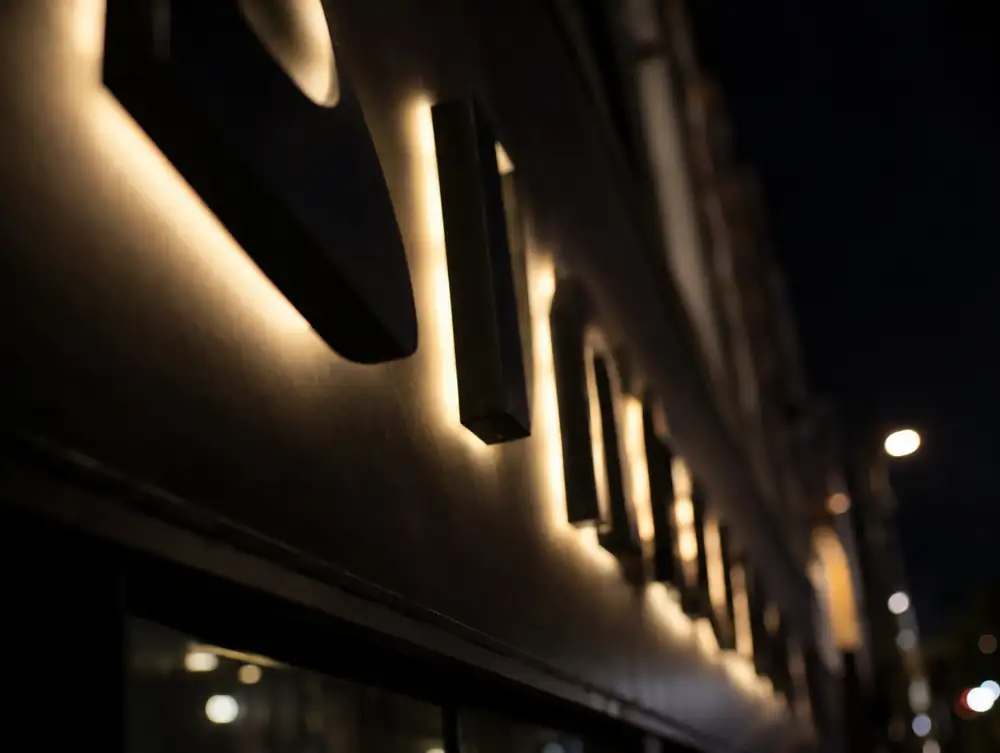
How would we approach illuminated signage for your Cheshunt premises?
On a timber frontage, a slim trough light usually keeps more of the daytime character than lit letters. We colour-match the bar to the fascia, so it almost disappears by day.
If letters will sit close to a window head or canopy, we check how the light falls across it. A small change in stand-off or letter position can prevent a hard shadow line.
If there are storeys above the shop, the frontage should feel like the base of the building and not a sign stuck on it. Lining up mullions with the windows overhead is a small move that settles the whole elevation at Cheshunt premises.
What should you budget for illuminated signage in Cheshunt?
Guide price: £895 to £3,995 plus VAT per sign. Materials, finish and the amount of drawing and coordination involved all move it, and your itemised quotation shows where the money goes on illuminated signage.
What consents could affect illuminated signage in Cheshunt?
For illuminated signage at premises in the Cheshunt area, the deciding question in England is whether the building work materially affects the external appearance. If it does, planning permission is needed, while a true like-for-like replacement usually needs none. The council confirms the position for each site.
Lighting moves a sign out of Class 5 in England, because that class allows illumination only for medical-type notices. Class 4B then applies at premises in the Cheshunt area: halo or character-only lighting, static, with the lowest part at least 2.5m up. Brightness is capped at 600 cd/m² on signs up to 10m² and 300 cd/m² above that, and anything outside these limits needs advertisement consent.
Cheshunt applications for planning permission or advertisement consent are normally handled by Broxbourne Borough Council. Our survey includes a check of the position for your address.
| Town | Cheshunt |
|---|---|
| Area | Hertfordshire |
| Postcode districts | EN10, EN7, EN8, EN9 |
| Planning authority | Broxbourne Borough Council |
| Building approval | Building Regulations (Approved Documents) |
| Distance from Great Barr | About 99 miles |
| Survey | Free for new work |
Questions about illuminated signage in Cheshunt
How will I know what my Cheshunt sign looks like at night?
We draw it on your elevation and describe the lighting effect in the specification, and a sample letter can be tested on your fascia where that helps. Colour temperature and output are agreed before manufacture.
Do you supply lit signs for premises across Hertfordshire?
Yes. We travel from Great Barr, with vetted teams working under S&K Glazing and one named contact for the job. The same scale drawing and sign-off process applies wherever your premises are.
Which illuminated sign suits a restaurant in Cheshunt?
Halo-lit letters in a warm white usually suit restaurants, as they feel calm and considered. A trough light over a painted sign is a good alternative for a more traditional room.
What rules apply to a fire exit door through a shopfront in the Cheshunt area?
It must open in the direction of escape and can't be locked against immediate use, and a dedicated fire exit can't be a sliding or revolving door. In England that comes from article 14(2) of the Regulatory Reform (Fire Safety) Order 2005, and the duty sits with the responsible person, normally the employer or whoever controls the premises for a business, otherwise the owner. An outward door can clash with section 153 of the Highways Act 1980 where it opens onto the footway, so raise it early.
Does a new shopfront in the Cheshunt area need Building Regulations approval?
Assume yes until building control says otherwise. England has no like-for-like exemption, though registered installers can self-certify replacement windows and doors in non-dwellings. That route doesn't cover structural glass, curtain walling or revolving doors.