Fascia signs for Featherstone premises start with the building, because the frontage has already set the depth and position of the sign band. We measure it, draw your name to scale and show you the result before anything is cut.
Measuring the opening is the easy part of a survey in Featherstone. We also look at the beam above, the pavement fall and any meters or drains nearby.
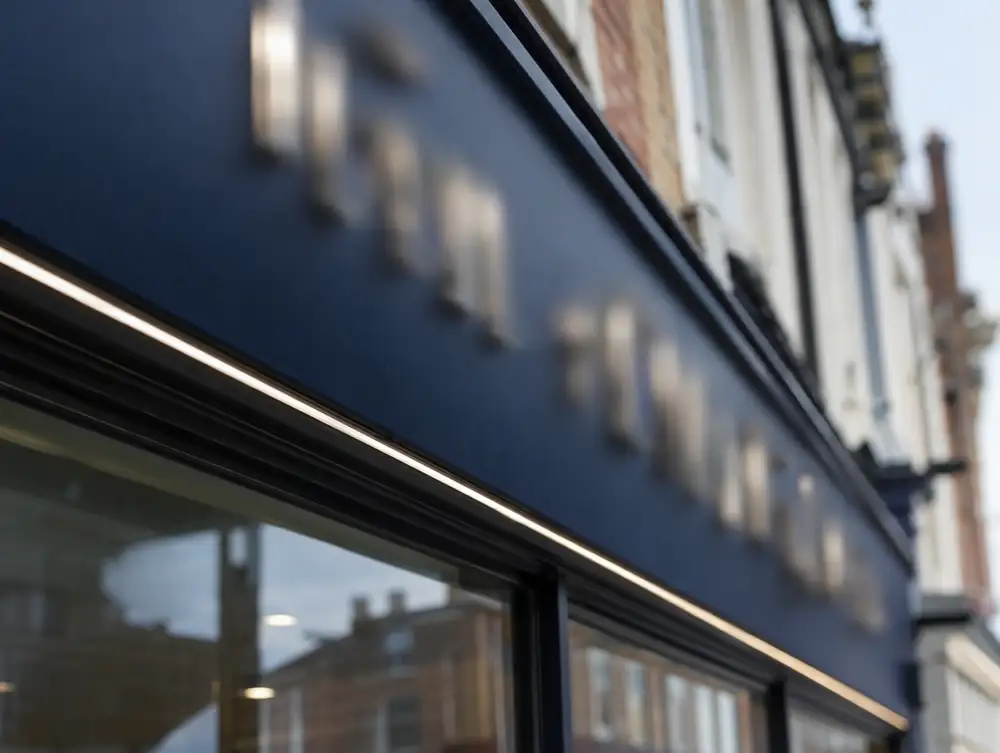
What should you think about before commissioning fascia signage in Featherstone?
If your Featherstone unit sits in a parade of similar shops, we would look at the fascia line on either side before setting your sign height. Holding that line usually looks more confident than trying to outgrow it.
A deep fascia above a low shopfront can often be reduced on the drawing board. If your Featherstone premises have one, we would show you a slimmer panel option, with the ceiling line behind it adjusted to suit.
If your Featherstone unit is narrow, a central door can split a small window into two weak ones. Moving the door to one side gives you a single confident pane, provided the layout inside still works.
What is a realistic budget for fascia signage in Featherstone?
Guide price: £395 to £1,995 plus VAT per sign. Materials, finish and the amount of drawing and coordination involved all move it, and your itemised quotation shows where the money goes on fascia signage.
Who approves fascia signage in Featherstone?
For fascia signage at premises in the Featherstone area, the deciding question in England is whether the building work materially affects the external appearance. If it does, planning permission is needed, while a true like-for-like replacement usually needs none. The council confirms the position for each site.
Lighting moves a sign out of Class 5 in England, because that class allows illumination only for medical-type notices. Class 4B then applies at premises in the Featherstone area: halo or character-only lighting, static, with the lowest part at least 2.5m up. Brightness is capped at 600 cd/m² on signs up to 10m² and 300 cd/m² above that, and anything outside these limits needs advertisement consent.
Featherstone applications for planning permission or advertisement consent are normally handled by South Staffordshire Council. Our survey includes a check of the position for your address.
| Town | Featherstone |
|---|---|
| Area | Staffordshire |
| Postcode districts | WS6, WV10, WV11, WV9 |
| Planning authority | South Staffordshire Council |
| Building approval | Building Regulations (Approved Documents) |
| Distance from Great Barr | About 10 miles |
| Survey | Free for new work |
Questions about fascia signage in Featherstone
Will you remove the old sign from my Featherstone premises?
Yes. Taking down the old sign, clearing old fixings and making good are included in the itemised quotation. We tell you what we find behind it before going further.
Can a fascia sign in Featherstone be lit later on?
Yes, if the sign is planned for it. Built-up letters can take halo lighting when the panel and cable route are prepared at the start, which costs far less than adapting them afterwards.
Will a new sign suit the rest of my Featherstone frontage?
That is what the scale drawing is for. We draw the sign on your actual elevation with door, windows and stallriser in place, so you can judge colour and proportion together.
Do I need listed building consent for a shopfront in the Featherstone area?
Usually yes, if the building is listed. In England the local planning authority decides, and Historic England is notified of Grade I and II* works and specified Grade II works. Like-for-like repair may not need consent, so ask the council before work starts.
What rules apply to a fire exit door through a shopfront in the Featherstone area?
It must open in the direction of escape and can't be locked against immediate use, and a dedicated fire exit can't be a sliding or revolving door. In England that comes from article 14(2) of the Regulatory Reform (Fire Safety) Order 2005, and the duty sits with the responsible person, normally the employer or whoever controls the premises for a business, otherwise the owner. An outward door can clash with section 153 of the Highways Act 1980 where it opens onto the footway, so raise it early.