New sign, new name or a fascia that has simply faded: any job in New Romney begins with a measured survey and a look at what sits behind the old panel. Fixings are only as good as the structure they land in.
Your survey is where the price gets real, because widths, heights, levels and access are all taken on site in New Romney.
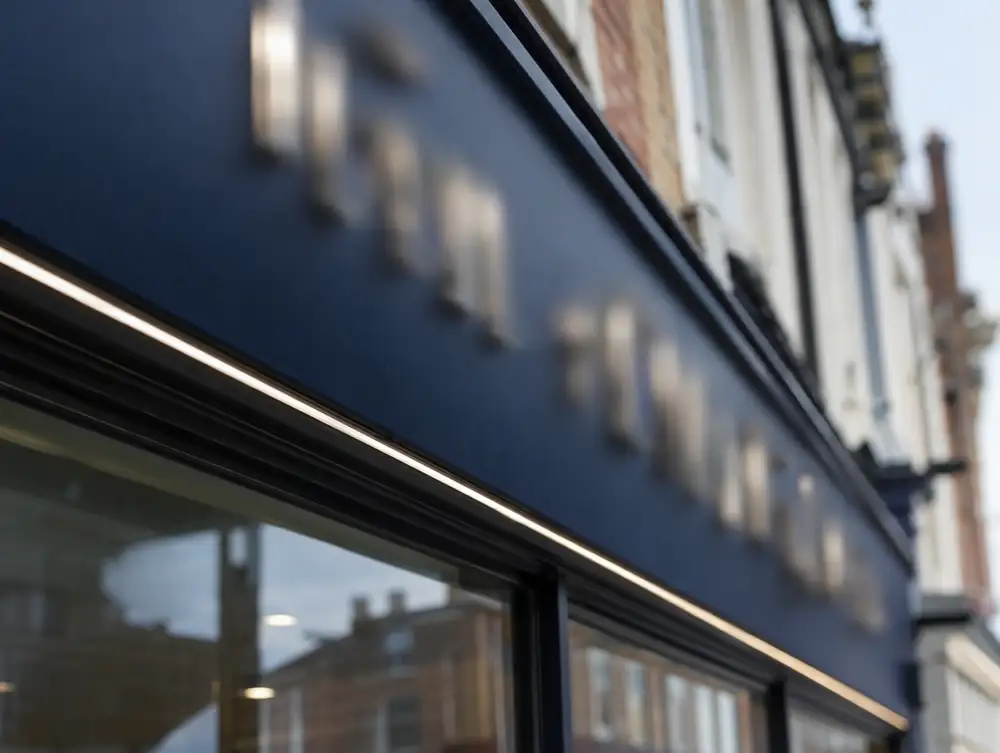
How would we approach fascia signage for your New Romney premises?
If your New Romney unit sits in a parade of similar shops, we would look at the fascia line on either side before setting your sign height. Holding that line usually looks more confident than trying to outgrow it.
Where the fascia on your New Romney premises has been overclad, we lift a sample at survey to see what is underneath. Original timber, cornice mouldings or tile may be worth keeping, and they change what the new sign should be.
If your premises were once two shops, decide early whether the front should read as one or as two. One continuous fascia with a repeated bay width usually settles the elevation better than two mismatched halves, which is worth testing on any New Romney unit of that kind.
What consents could affect fascia signage in New Romney?
For fascia signage at premises in the New Romney area, the deciding question in England is whether the building work materially affects the external appearance. If it does, planning permission is needed, while a true like-for-like replacement usually needs none. The council confirms the position for each site.
Lighting moves a sign out of Class 5 in England, because that class allows illumination only for medical-type notices. Class 4B then applies at premises in the New Romney area: halo or character-only lighting, static, with the lowest part at least 2.5m up. Brightness is capped at 600 cd/m² on signs up to 10m² and 300 cd/m² above that, and anything outside these limits needs advertisement consent.
We confirm the position at survey, because a boundary or a special designation can change who handles the file, but applications from New Romney premises normally go to Folkestone and Hythe District Council.
What should you budget for fascia signage in New Romney?
Guide price: £395 to £1,995 plus VAT per sign. Materials, finish and the amount of drawing and coordination involved all move it, and your itemised quotation shows where the money goes on fascia signage.
| Town | New Romney |
|---|---|
| Area | Kent |
| Postcode districts | TN28 |
| Planning authority | Folkestone and Hythe District Council |
| Building approval | Building Regulations (Approved Documents) |
| Distance from Great Barr | About 163 miles |
| Survey | Free for new work |
Questions about fascia signage in New Romney
Can a new fascia sign in New Romney be fitted on a closed day?
Yes, we can arrange that, or fit out of hours if that suits you better. Most fascia signs take about a day, so the work can often go into your quietest trading hours.
How quickly can I see a drawing for my New Romney sign?
Drawings typically follow within one to two weeks of the survey, depending on the artwork and how many options you want to see. Your named contact will give you a date once the survey is booked.
Can a sign match my other sites in Kent?
Yes. Send a photograph and the drawings or brand file from an existing site, and we match the letter style, finish and colour reference. Fascia depth may differ, so the size is adjusted to keep the proportions right.
What rules apply to a fire exit door through a shopfront in the New Romney area?
It must open in the direction of escape and can't be locked against immediate use, and a dedicated fire exit can't be a sliding or revolving door. In England that comes from article 14(2) of the Regulatory Reform (Fire Safety) Order 2005, and the duty sits with the responsible person, normally the employer or whoever controls the premises for a business, otherwise the owner. An outward door can clash with section 153 of the Highways Act 1980 where it opens onto the footway, so raise it early.
Does the Equality Act apply to a shop entrance in the New Romney area?
Yes. The Equality Act 2010 applies in England, as across Great Britain, and it requires reasonable steps to remove, alter or avoid physical features that disadvantage disabled people. The duty is anticipatory, so it looks at disabled people generally, and a new Services Code replaced the 2011 Code on 5 August 2026.