Good fascia signs are mostly a matter of spacing. For Richmond premises we set letter height, margins and alignment from the door and window lines below.
We measure your Richmond opening in person, at a time agreed with you first, so the visit fits around your trading.
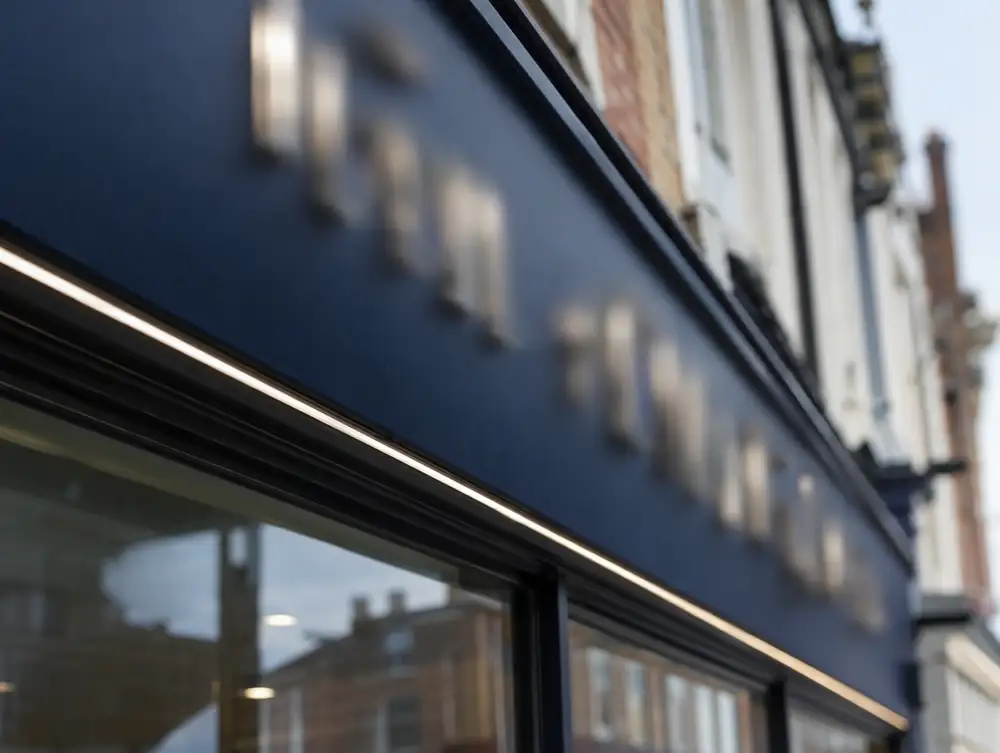
Where should you begin with fascia signage in Richmond?
On a corner plot, the sign has to turn the corner cleanly. We set letter size and panel joints so the name reads from both streets, with the return falling at a natural break.
For brands with strict guidelines, we turn logo artwork into cut files and check the smallest details at full size. If a thin stroke will not survive in metal, we suggest a small change before anything is made.
On a north-facing frontage the glass stays free of glare, but the interior can look dim from the street, so lighting needs to sit closer to the window. If your Richmond premises face south, the problem flips to reflections by day and fading stock.
What price should you expect for fascia signage in Richmond?
We would budget £395 to £1,995 plus VAT per sign. Scope sets most of the figure, so a clear brief at the start does more for the budget than any later change of detail.
What sign-off might you need for fascia signage in Richmond?
England has no permitted development route for changing a shopfront. Part 7 Class A of the General Permitted Development Order 2015 excludes creating, altering or replacing one, and it allows no alterations at all on article 2(3) land. That leaves two outcomes for fascia signage at premises in the Richmond area: a planning application, or work that doesn't materially affect the external appearance.
In England, signs at premises in the Richmond area come under the 2007 Advertisement Regulations. An unlit fascia sign generally needs no application under Class 5 of Schedule 3 if it sits on a wall containing a shop window, tops out at 4.6m or the first-floor sill if that is lower, and keeps letters to 0.75m high. Displaying a sign without the consent it needs is a criminal offence, so check before it goes up.
Expect planning and advert applications here to go to London Borough of Richmond upon Thames in the normal way. We check what that means for your building when we survey it in Richmond.
| Town | Richmond |
|---|---|
| Area | Greater London |
| Postcode districts | SW14, TW1, TW10, TW9 |
| Planning authority | London Borough of Richmond upon Thames |
| Building approval | Building Regulations (Approved Documents) |
| Distance from Great Barr | About 102 miles |
| Survey | Free for new work |
Does London Borough of Richmond upon Thames publish shopfront guidance?
Yes, Shopfronts: Supplementary Planning Document (2010). It tells applicants what the council expects from new and altered shopfronts. A few of the things it asks for:
- The fascia should be no deeper than the cornice and architrave combined, and no more than one-fifth of total shopfront height.
- External roller shutters are unlikely to be permitted, and internal grilles are the only acceptable security form in conservation areas and on listed buildings.
- Internally lit box fascia signs will usually be resisted, with externally lit fascias generally preferred.
Questions about fascia signage in Richmond
What artwork do you need for a sign in Richmond?
Vector files such as AI, EPS or PDF are ideal, along with any brand guidelines. If you only have a low-resolution logo, it can be redrawn, and that time is shown on the quotation.
Can a new fascia sign in Richmond be fitted on a closed day?
Yes, we can arrange that, or fit out of hours if that suits you better. Most fascia signs take about a day, so the work can often go into your quietest trading hours.
How quickly can I see a drawing for my Richmond sign?
Drawings typically follow within one to two weeks of the survey, depending on the artwork and how many options you want to see. Your named contact will give you a date once the survey is booked.
Do roller shutters need planning permission in the Richmond area?
Usually yes. Installing or replacing a security grill or shutter on a shopfront is expressly outside England's shop permitted development rights, so the only way to avoid an application is work that doesn't materially affect the appearance. Ask the council before ordering.
Does the Equality Act apply to a shop entrance in the Richmond area?
Yes. The Equality Act 2010 applies in England, as across Great Britain, and it requires reasonable steps to remove, alter or avoid physical features that disadvantage disabled people. The duty is anticipatory, so it looks at disabled people generally, and a new Services Code replaced the 2011 Code on 5 August 2026.