Most shopfronts that look effortless took careful drawing. For Richmond premises we test proportion, material and lighting on paper, where changes cost very little.
Surveys for Richmond are booked with you directly. Tell us your quieter days and we'll work around them.
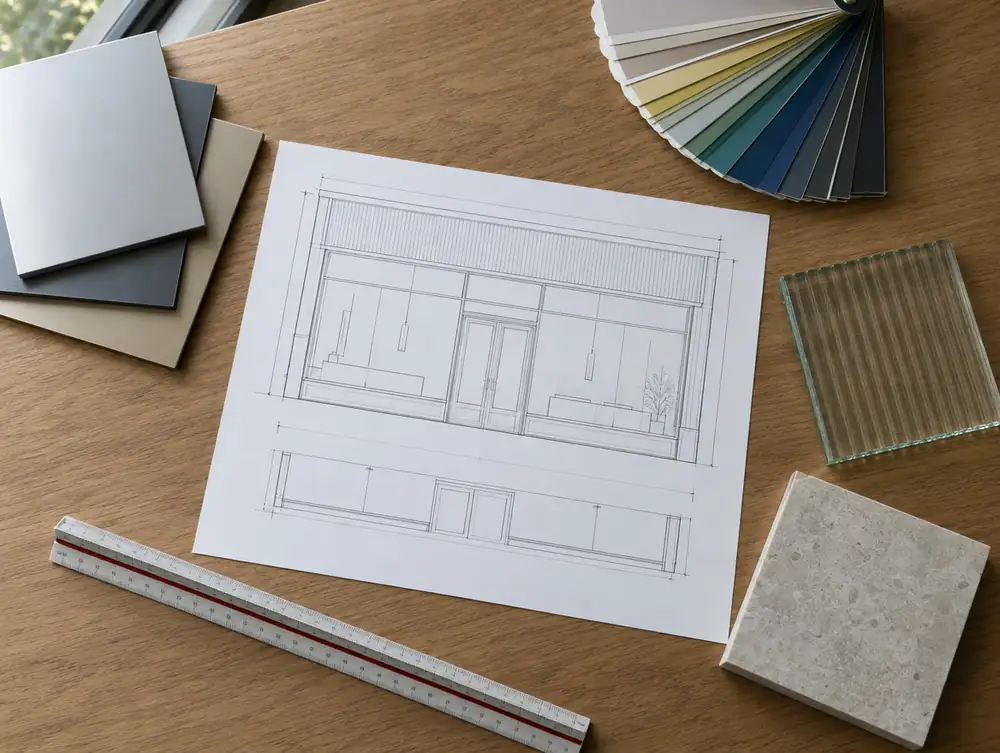
Where should you begin with shopfront design in Richmond?
For a corner unit in Richmond, we design both elevations as one. The return, the door position and the sign all depend on which street brings your customers.
Where the building above has strong vertical lines, we carry them down through pilasters and mullions. If it is plain, the shopfront can take a calmer, wider treatment.
If there are storeys above the shop, the frontage should feel like the base of the building and not a sign stuck on it. Lining up mullions with the windows overhead is a small move that settles the whole elevation at Richmond premises.
What sign-off might you need for shopfront design in Richmond?
England has no permitted development route for changing a shopfront. Part 7 Class A of the General Permitted Development Order 2015 excludes creating, altering or replacing one, and it allows no alterations at all on article 2(3) land. That leaves two outcomes for shopfront work at premises in the Richmond area: a planning application, or work that doesn't materially affect the external appearance.
At survey we check how things stand for your building, although applications for planning permission or advertisement consent here normally go to London Borough of Richmond upon Thames.
What price should you expect for shopfront design in Richmond?
The guide for shopfront design is £495 to £2,495 plus VAT per frontage. Expect the lower end for simple work with clear access, and the upper end where detail, finish or awkward conditions add hours.
| Town | Richmond |
|---|---|
| Area | Greater London |
| Postcode districts | SW14, TW1, TW10, TW9 |
| Planning authority | London Borough of Richmond upon Thames |
| Building approval | Building Regulations (Approved Documents) |
| Distance from Great Barr | About 102 miles |
| Survey | Free for new work |
Does London Borough of Richmond upon Thames publish shopfront guidance?
Yes, Shopfronts: Supplementary Planning Document (2010). It tells applicants what the council expects from new and altered shopfronts. A few of the things it asks for:
- The fascia should be no deeper than the cornice and architrave combined, and no more than one-fifth of total shopfront height.
- External roller shutters are unlikely to be permitted, and internal grilles are the only acceptable security form in conservation areas and on listed buildings.
- Internally lit box fascia signs will usually be resisted, with externally lit fascias generally preferred.
Questions about shopfront design in Richmond
Can you design a frontage for Richmond premises I have not taken on yet?
Yes. A survey and concept drawing can show what the unit could become and what it might cost. That can be useful before you sign anything.
Can a design for Richmond premises follow my brand guidelines?
Yes. Send them over with your logo files, and we apply them to your elevation. Where a rule does not fit the building, we explain why and suggest an adjustment.
Do I need a design service for a simple Richmond shopfront?
Not always. Every job gets a measured survey and scale drawings anyway. The design service adds options, visuals and a full specification, which pay off when the look matters most.
Do I need listed building consent for a shopfront in the Richmond area?
Usually yes, if the building is listed. In England the local planning authority decides, and Historic England is notified of Grade I and II* works and specified Grade II works. Like-for-like repair may not need consent, so ask the council before work starts.
Does a new shopfront in the Richmond area need Building Regulations approval?
Assume yes until building control says otherwise. England has no like-for-like exemption, though registered installers can self-certify replacement windows and doors in non-dwellings. That route doesn't cover structural glass, curtain walling or revolving doors.