For a boutique, salon, office or restaurant in Tonypandy, the ideal door almost disappears. Toughened glass gets close, provided the floor and head are detailed properly.
Bring whatever you have to the survey in Tonypandy: brand guidelines, lease plans, old drawings or a photo of a frontage you admire.
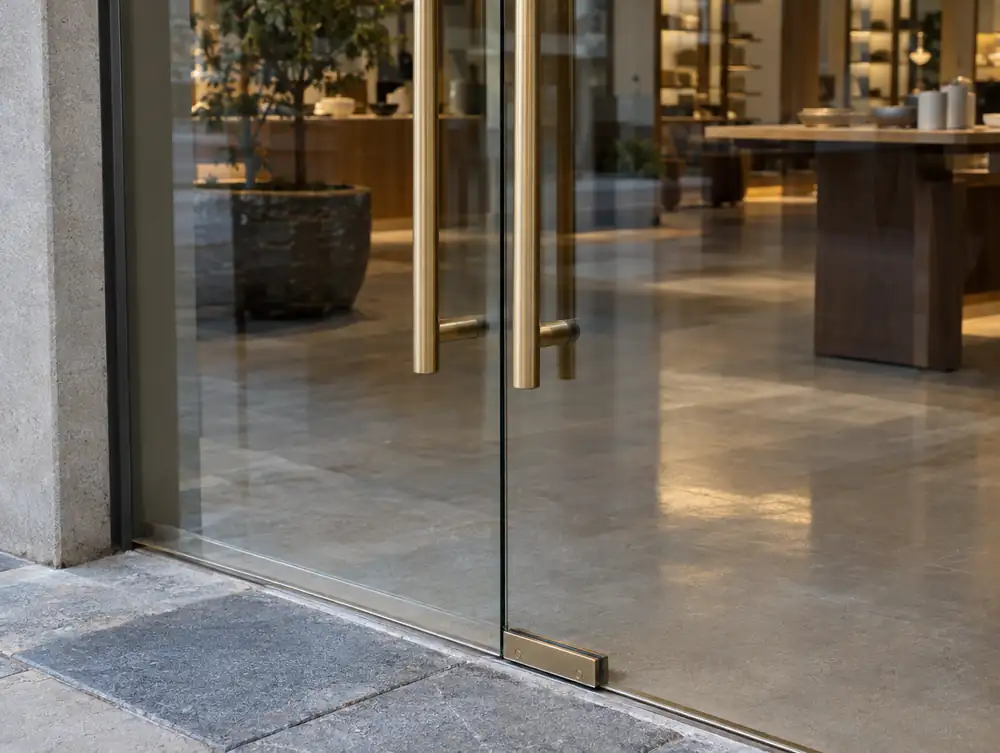
How would we approach frameless glass doors for your Tonypandy premises?
A narrow Tonypandy unit benefits from a door that takes up no visual width. We'd use a single glass leaf hung beside one clear pane, so the entrance and the display read as one view into the shop.
If a landlord in Tonypandy controls the frontage, a glass door is often an easy approval because so little changes visually. We'd supply a drawing showing the door, the fittings and any markings on the glass.
Where the building has good brick or stone around the opening, set the frame back in the reveal so the masonry can be seen. On Tonypandy premises with a flat elevation, that deep reveal throws a shadow line that adds real depth in low sun.
What should you budget for frameless glass doors in Tonypandy?
The guide for frameless glass doors is £1,495 to £4,495 plus VAT per door set. Expect the lower end for simple work with clear access, and the upper end where detail, finish or awkward conditions add hours.
What consents could affect frameless glass doors in Tonypandy?
The existing rules still apply in Wales, because most of the Planning (Wales) Act 2026 is waiting for a commencement order. For frameless glass doors at premises in the Tonypandy area, building work that materially affects the external appearance needs planning permission, while a true like-for-like replacement usually doesn't. The council confirms the current position.
We confirm the position at survey, because a boundary or a special designation can change who handles the file, but applications from Tonypandy premises normally go to Rhondda Cynon Taf County Borough Council.
| Town | Tonypandy |
|---|---|
| Area | Mid Glamorgan |
| Postcode districts | CF40 |
| Planning authority | Rhondda Cynon Taf County Borough Council |
| Building approval | Building Regulations (Approved Documents for Wales) |
| Distance from Great Barr | About 92 miles |
| Survey | Free for new work |
Does Rhondda Cynon Taf County Borough Council publish shopfront guidance?
Yes, Shopfront Design. It tells applicants what the council expects from new and altered shopfronts. A few of the things it asks for:
- External roller shutters are a last resort after other security options are shown to be unsuitable.
- Solid metal shutters are unlikely to be acceptable, while lattice or brick-bond grille shutters may be considered.
- Individual shutters covering only the glazing are one option, and powder coating is generally preferred to paint.
Questions about frameless glass doors in Tonypandy
Who fits glass doors in Tonypandy?
Vetted glazing teams working under S&K Glazing fit them, and you have a single named contact. They travel to Tonypandy from Great Barr.
Can my Tonypandy premises take a frameless glass door?
Most can, once the floor and opening have been checked. The survey shows whether a floor spring will fit, and if not, a concealed closer in a transom does the same job.
What handle should I choose for a door in Mid Glamorgan?
Full-height pulls suit tall leaves, while shorter offset handles suit small doors. We'd bring examples to your Tonypandy premises so you can feel the difference.
Does a replacement shopfront in the Tonypandy area need Building Regulations approval?
Assume yes until building control says otherwise, because Wales has no like-for-like exemption. Glazing is judged against Approved Document N, as Wales keeps Part N. A registered installer can self-certify replacement windows and doors in non-dwellings, but not structural glass, curtain walling or revolving doors.
When does a shop sign in the Tonypandy area need advertisement consent?
A sign needs advertisement consent when it falls outside Class 5 or Class 4B of the 1992 Advertisement Regulations, which still apply in Wales. Within Class 5, an unlit sign sits on a wall containing a shop window and tops out at 4.6m or the first-floor sill if lower. A lit sign in a conservation area needs consent, because Class 4B isn't available there.