After dark, your sign is the frontage. In Blackwood we would usually start with halo-lit letters, then look at face-lit or trough lighting if distance or the building calls for them.
Please have keys to any meter cupboards and shutter housings to hand when we survey in Blackwood, because what sits behind them can change the drawing.
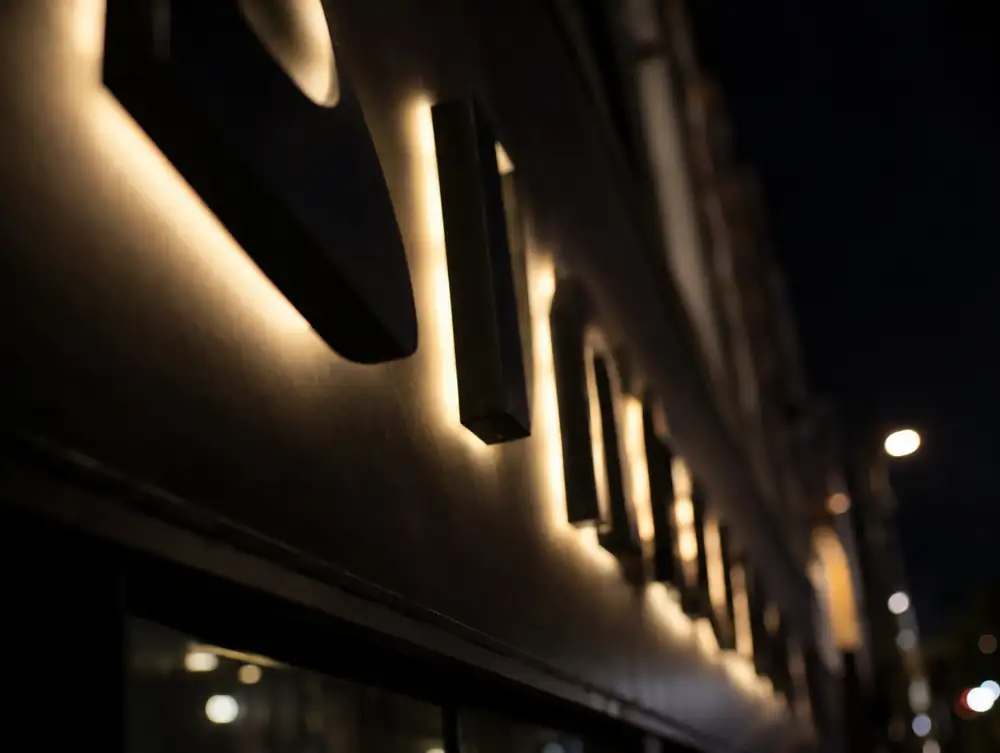
How do you design around the building when planning illuminated signage in Blackwood?
If an old lightbox is coming down, we check the cable position and the wall behind it before designing the new sign. An existing supply can often be reused, which saves work on the inside.
Where the interior is lit in warm tones, a cold white sign will look wrong from the street. We match the sign to the shop lighting behind the glass, so the two read as one scheme.
If you trade after dark in Blackwood, the view in matters more than the sign. A warm, evenly lit interior with light on the back wall will usually do more than a brighter fascia, because it gives the eye somewhere to go.
What permissions should you check for illuminated signage in Blackwood?
Section 55 of the Town and Country Planning Act 1990 sets the test in Wales: work that doesn't materially affect the external appearance isn't development. Anything that does needs planning permission, and that goes for illuminated signage at premises in the Blackwood area as much as for a full new frontage. The council confirms how the test applies to your site.
Signs in Wales still come under the 1992 Advertisement Regulations, with the classes set out in Schedule 3. At premises in the Blackwood area, an unlit fascia sign generally needs no application under Class 5 if it sits on a wall containing a shop window and tops out at 4.6m or the first-floor sill if that is lower. Ask the council about letter sizes, and bear in mind that displaying a sign without consent is a criminal offence.
Expect planning and advert applications here to go to Caerphilly County Borough Council in the normal way. We check what that means for your building when we survey it in Blackwood.
What might illuminated signage cost in Blackwood?
We would budget £895 to £3,995 plus VAT per sign. Scope sets most of the figure, so a clear brief at the start does more for the budget than any later change of detail.
| Town | Blackwood |
|---|---|
| Area | Gwent |
| Postcode districts | NP12 |
| Planning authority | Caerphilly County Borough Council |
| Building approval | Building Regulations (Approved Documents for Wales) |
| Distance from Great Barr | About 82 miles |
| Survey | Free for new work |
Questions about illuminated signage in Blackwood
Can you replace a lightbox on my Blackwood premises?
Yes. We take the old box down, check the wall and supply behind it, then fit the new sign. Built-up letters will often need a new panel, because the old box leaves a mark on the fascia.
Which illuminated sign suits a restaurant in Blackwood?
Halo-lit letters in a warm white usually suit restaurants, as they feel calm and considered. A trough light over a painted sign is a good alternative for a more traditional room.
Do you supply lit signs for premises across Gwent?
Yes. We travel from Great Barr, with vetted teams working under S&K Glazing and one named contact for the job. The same scale drawing and sign-off process applies wherever your premises are.
Is planning permission needed for a new shopfront in the Blackwood area?
Usually yes, if the work materially affects the external appearance, because Wales has no permitted development route for changing a shopfront. Most of the Planning (Wales) Act 2026 hasn't been commenced yet, so the existing rules apply. A true like-for-like replacement usually avoids an application, and the council confirms the position.
Can a shop fire exit in the Blackwood area use a sliding door?
No, a dedicated fire exit can't be a sliding or revolving door. In Wales, article 14(2) of the Regulatory Reform (Fire Safety) Order 2005 also says fire exit doors must open in the direction of escape and can't be locked against immediate use. The responsible person holds that duty, normally the employer or whoever controls the premises for a business, otherwise the owner.