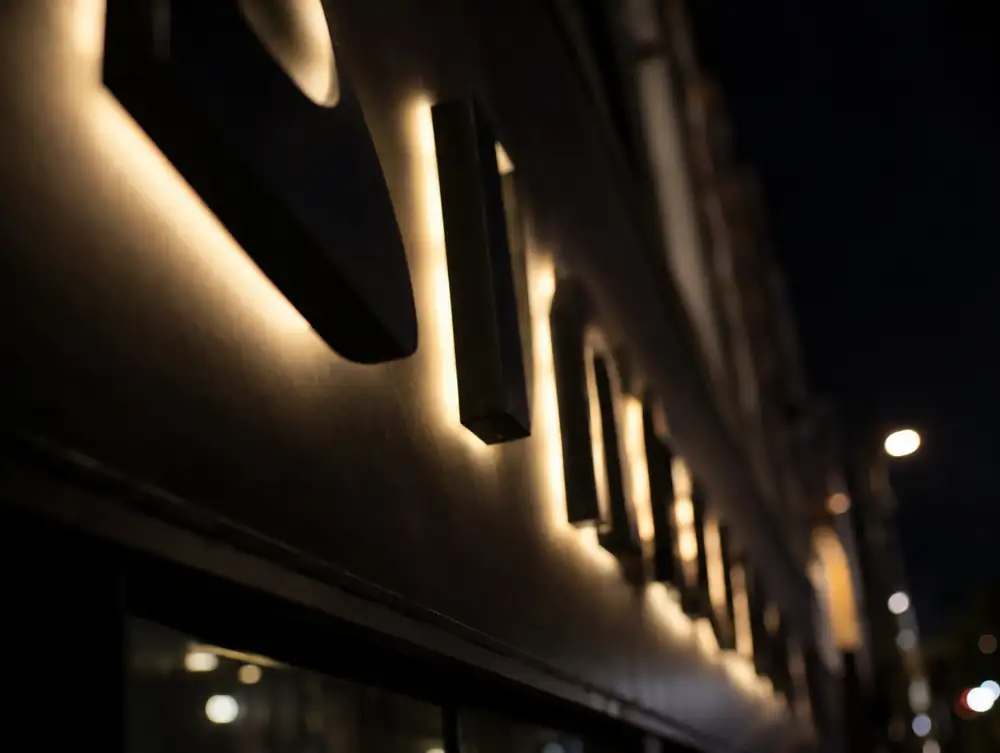
Halo-lit letters give Canning Town premises a soft glow on the panel behind, with the name itself in crisp silhouette. Face-lit and trough options suit other brands and buildings, and we show you the difference on a scale drawing.
Nothing gets ordered off the back of a survey in Canning Town, because its job is to give us the numbers to draw and price from.
What should you think about before commissioning illuminated signage in Canning Town?
Where the frontage faces a wide road, face-lit letters can carry further than halo lighting. On a narrower street the softer option usually reads well enough and looks more refined.
Where the interior is lit in warm tones, a cold white sign will look wrong from the street. We match the sign to the shop lighting behind the glass, so the two read as one scheme.
Where units share one long run of fascia, breaking the height makes you stand out for the wrong reason. If that describes your Canning Town parade, keep the line and win attention with lettering, lighting and what's in the window.
Who approves illuminated signage in Canning Town?
A true like-for-like replacement usually needs no planning permission in England, because the external appearance isn't materially affected. New materials, a different glass line or altered proportions usually do count as material, so for illuminated signage at premises in the Canning Town area, an application is then likely. The council confirms which side of that line a job falls on.
Lighting moves a sign out of Class 5 in England, because that class allows illumination only for medical-type notices. Class 4B then applies at premises in the Canning Town area: halo or character-only lighting, static, with the lowest part at least 2.5m up. Brightness is capped at 600 cd/m² on signs up to 10m² and 300 cd/m² above that, and anything outside these limits needs advertisement consent.
Canning Town applications for planning permission or advertisement consent are normally handled by London Borough of Newham. Our survey includes a check of the position for your address.
What is a realistic budget for illuminated signage in Canning Town?
The guide for illuminated signage is £895 to £3,995 plus VAT per sign. Expect the lower end for simple work with clear access, and the upper end where detail, finish or awkward conditions add hours.
| Town | Canning Town |
|---|---|
| Area | Greater London |
| Postcode districts | E13, E14, E16, E6 |
| Planning authority | London Borough of Newham |
| Building approval | Building Regulations (Approved Documents) |
| Distance from Great Barr | About 109 miles |
| Survey | Free for new work |
Questions about illuminated signage in Canning Town
Can an illuminated sign be fitted around trading in Canning Town?
Yes. External fitting is usually done from a tower or platform with little effect on the shop, and internal cable work can be arranged out of hours.
Will a lit sign in Canning Town cost much to run?
Very little. A typical LED sign uses about the same power as a few domestic lamps, and a timer trims that further. Occasional driver changes are the larger long-term cost.
Which illuminated sign suits a restaurant in Canning Town?
Halo-lit letters in a warm white usually suit restaurants, as they feel calm and considered. A trough light over a painted sign is a good alternative for a more traditional room.
What rules apply to a fire exit door through a shopfront in the Canning Town area?
It must open in the direction of escape and can't be locked against immediate use, and a dedicated fire exit can't be a sliding or revolving door. In England that comes from article 14(2) of the Regulatory Reform (Fire Safety) Order 2005, and the duty sits with the responsible person, normally the employer or whoever controls the premises for a business, otherwise the owner. An outward door can clash with section 153 of the Highways Act 1980 where it opens onto the footway, so raise it early.
Do I need listed building consent for a shopfront in the Canning Town area?
Usually yes, if the building is listed. In England the local planning authority decides, and Historic England is notified of Grade I and II* works and specified Grade II works. Like-for-like repair may not need consent, so ask the council before work starts.