After dark, your sign is the frontage. In Catford we would usually start with halo-lit letters, then look at face-lit or trough lighting if distance or the building calls for them.
Measuring the opening is the easy part of a survey in Catford. We also look at the beam above, the pavement fall and any meters or drains nearby.
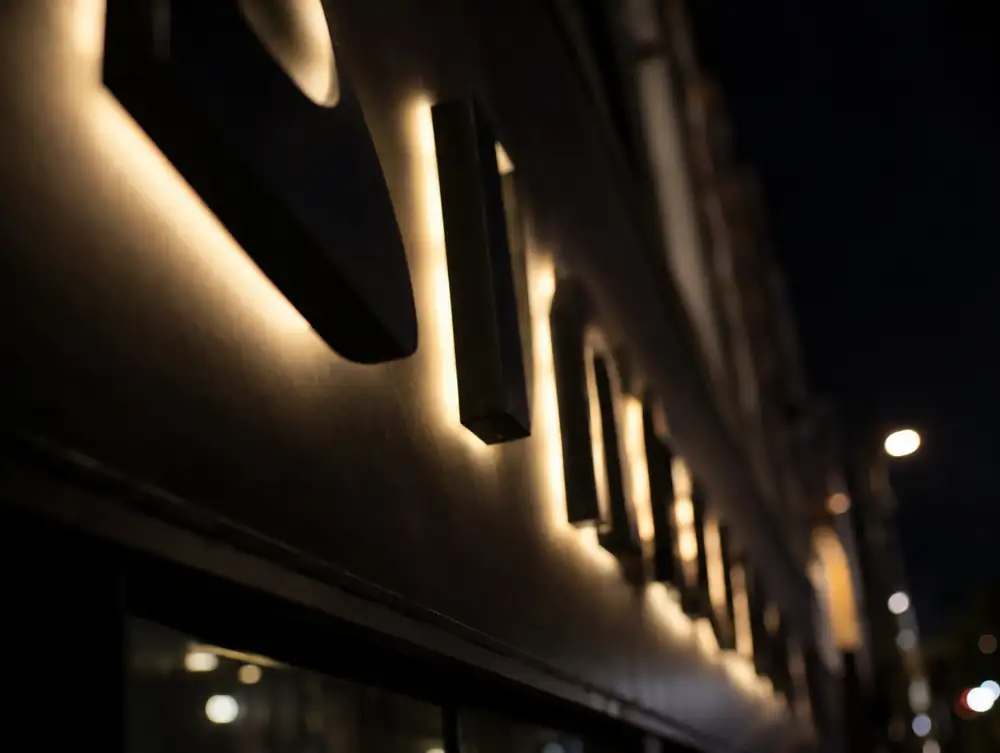
What makes illuminated signage work well on Catford premises?
On a timber frontage, a slim trough light usually keeps more of the daytime character than lit letters. We colour-match the bar to the fascia, so it almost disappears by day.
If there are flats above your Catford premises, we would keep the output modest and put the sign on a timer. A warm white at lower brightness is kinder to neighbours and still does its job.
A corner unit has two fronts to think about, and the return elevation often does as much selling as the main one. If that is your layout in Catford, carry the fascia and glass line round the corner and treat both faces as one composition.
Could illuminated signage in Catford need planning permission?
England has no permitted development route for changing a shopfront. Part 7 Class A of the General Permitted Development Order 2015 excludes creating, altering or replacing one, and it allows no alterations at all on article 2(3) land. That leaves two outcomes for illuminated signage at premises in the Catford area: a planning application, or work that doesn't materially affect the external appearance.
Lighting moves a sign out of Class 5 in England, because that class allows illumination only for medical-type notices. Class 4B then applies at premises in the Catford area: halo or character-only lighting, static, with the lowest part at least 2.5m up. Brightness is capped at 600 cd/m² on signs up to 10m² and 300 cd/m² above that, and anything outside these limits needs advertisement consent.
We confirm the position at survey, because a boundary or a special designation can change who handles the file, but applications from Catford premises normally go to London Borough of Lewisham.
How much should you set aside for illuminated signage in Catford?
Guide price: £895 to £3,995 plus VAT per sign. Materials, finish and the amount of drawing and coordination involved all move it, and your itemised quotation shows where the money goes on illuminated signage.
| Town | Catford |
|---|---|
| Area | Greater London |
| Postcode districts | SE13, SE23, SE4, SE6 |
| Planning authority | London Borough of Lewisham |
| Building approval | Building Regulations (Approved Documents) |
| Distance from Great Barr | About 111 miles |
| Survey | Free for new work |
Does Lewisham Council publish shopfront guidance?
Yes, Shopfront design guide, a supplementary planning document (2006). It tells applicants what the council expects from new and altered shopfronts. A few of the things it asks for:
- Fascias should generally be about 600mm high, never more than 900mm, and should not run unbroken across separate buildings.
- Solid external roller shutters are not acceptable, and open mesh or grille shutters should be powder coated with the box hidden behind the fascia.
- Internally lit fascia boxes are not allowed in conservation areas, with external lighting preferred.
Questions about illuminated signage in Catford
Can the sign in Catford be switched off at night?
Yes. A timer, photocell or simple switch can be built in, and many premises set the sign to go off shortly after closing or late in the evening.
Will a lit sign in Catford cost much to run?
Very little. A typical LED sign uses about the same power as a few domestic lamps, and a timer trims that further. Occasional driver changes are the larger long-term cost.
What happens if a lit letter fails on my Catford sign?
Usually a single LED driver or a damaged connection is to blame, and it can be traced from the access point. That is why drivers are placed where they can be reached without taking the sign down.
Does the Equality Act apply to a shop entrance in the Catford area?
Yes. The Equality Act 2010 applies in England, as across Great Britain, and it requires reasonable steps to remove, alter or avoid physical features that disadvantage disabled people. The duty is anticipatory, so it looks at disabled people generally, and a new Services Code replaced the 2011 Code on 5 August 2026.
Does a new shopfront in the Catford area need Building Regulations approval?
Assume yes until building control says otherwise. England has no like-for-like exemption, though registered installers can self-certify replacement windows and doors in non-dwellings. That route doesn't cover structural glass, curtain walling or revolving doors.