Design, manufacture, wiring and fitting all sit under one contract for lit signs across Christchurch and Dorset. Your named contact handles the job from measured survey to first switch-on.
Bring whatever you have to the survey in Christchurch: brand guidelines, lease plans, old drawings or a photo of a frontage you admire.
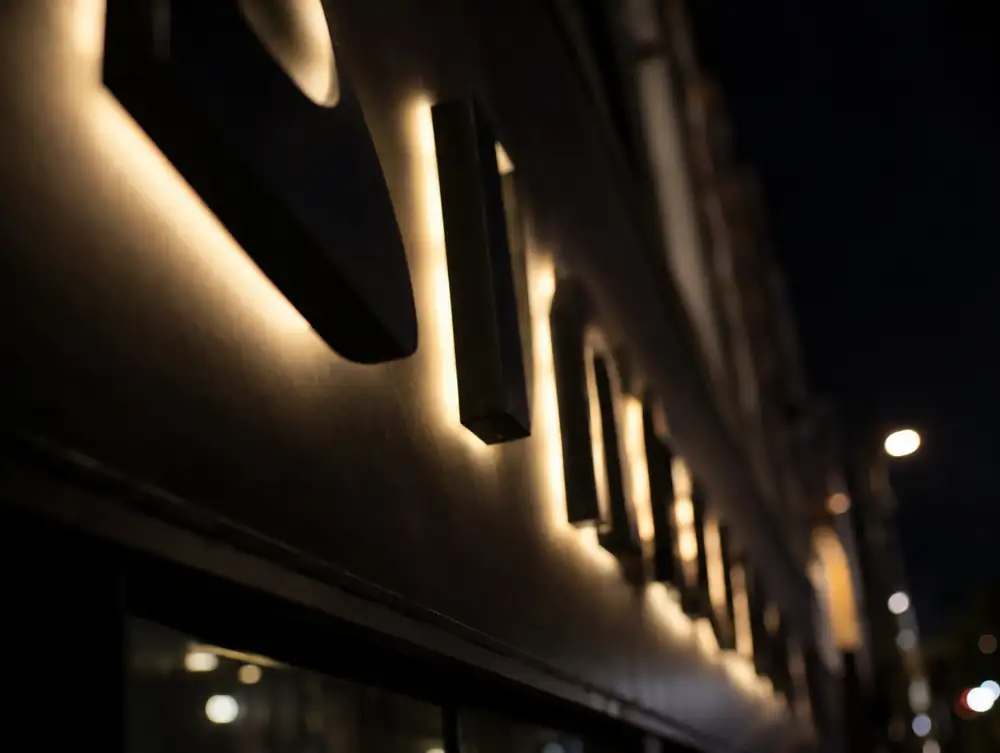
Where should you begin with illuminated signage in Christchurch?
Should your Christchurch premises close early, a photocell and timer can keep the sign on through the evening footfall and off for the rest of the night. It costs very little and helps the frontage look looked-after.
On a timber frontage, a slim trough light usually keeps more of the daytime character than lit letters. We colour-match the bar to the fascia, so it almost disappears by day.
If your Christchurch unit sits in a Victorian parade, the old pilasters usually set the rhythm, so a new front should land on them and not run past them. Keep that line and even a modern frame looks as though it belongs.
What price should you expect for illuminated signage in Christchurch?
Until the survey is done, plan on £895 to £3,995 plus VAT per sign. Unusual sizes, fine detail and phased working push the figure up, while a simple brief and clear access keep it toward the lower end.
What sign-off might you need for illuminated signage in Christchurch?
Security grilles and shutters are named in England's rules: installing or replacing one on a shopfront sits outside the shop permitted development rights. The frontage itself is treated the same way, so for illuminated signage at premises in the Christchurch area, building work that materially affects the appearance needs planning permission. Confirm the position with the council before anything is ordered.
Class 4B, England's class for lit signs, isn't available in conservation areas, Areas of Outstanding Natural Beauty, National Parks or the Broads, so a lit sign there normally needs advertisement consent. In an area of special control it is unavailable too, and Class 5 drops to a 3.6m top height, 0.3m letters and one-tenth of the building face up to 3.6m. Ask the council which designations cover premises in the Christchurch area.
Christchurch applications for planning permission or advertisement consent are normally handled by Bournemouth, Christchurch and Poole Council. Our survey includes a check of the position for your address.
| Town | Christchurch |
|---|---|
| Area | Dorset |
| Postcode districts | BH23, BH5, BH6, BH7 |
| Planning authority | Bournemouth, Christchurch and Poole Council |
| Building approval | Building Regulations (Approved Documents) |
| Distance from Great Barr | About 125 miles |
| Survey | Free for new work |
Questions about illuminated signage in Christchurch
Can the sign in Christchurch be switched off at night?
Yes. A timer, photocell or simple switch can be built in, and many premises set the sign to go off shortly after closing or late in the evening.
How will I know what my Christchurch sign looks like at night?
We draw it on your elevation and describe the lighting effect in the specification, and a sample letter can be tested on your fascia where that helps. Colour temperature and output are agreed before manufacture.
What happens if a lit letter fails on my Christchurch sign?
Usually a single LED driver or a damaged connection is to blame, and it can be traced from the access point. That is why drivers are placed where they can be reached without taking the sign down.
Do I need listed building consent for a shopfront in the Christchurch area?
Usually yes, if the building is listed. In England the local planning authority decides, and Historic England is notified of Grade I and II* works and specified Grade II works. Like-for-like repair may not need consent, so ask the council before work starts.
Does the Equality Act apply to a shop entrance in the Christchurch area?
Yes. The Equality Act 2010 applies in England, as across Great Britain, and it requires reasonable steps to remove, alter or avoid physical features that disadvantage disabled people. The duty is anticipatory, so it looks at disabled people generally, and a new Services Code replaced the 2011 Code on 5 August 2026.