Illuminated signs for Dunfermline premises are designed from the evening view, because that is when the choice of light shows. We draw the letters, the glow and the power route together, so the sign looks planned from the first night.
Expect us to measure the opening, photograph the existing front and check how materials will reach it on the day, at a time you have agreed.
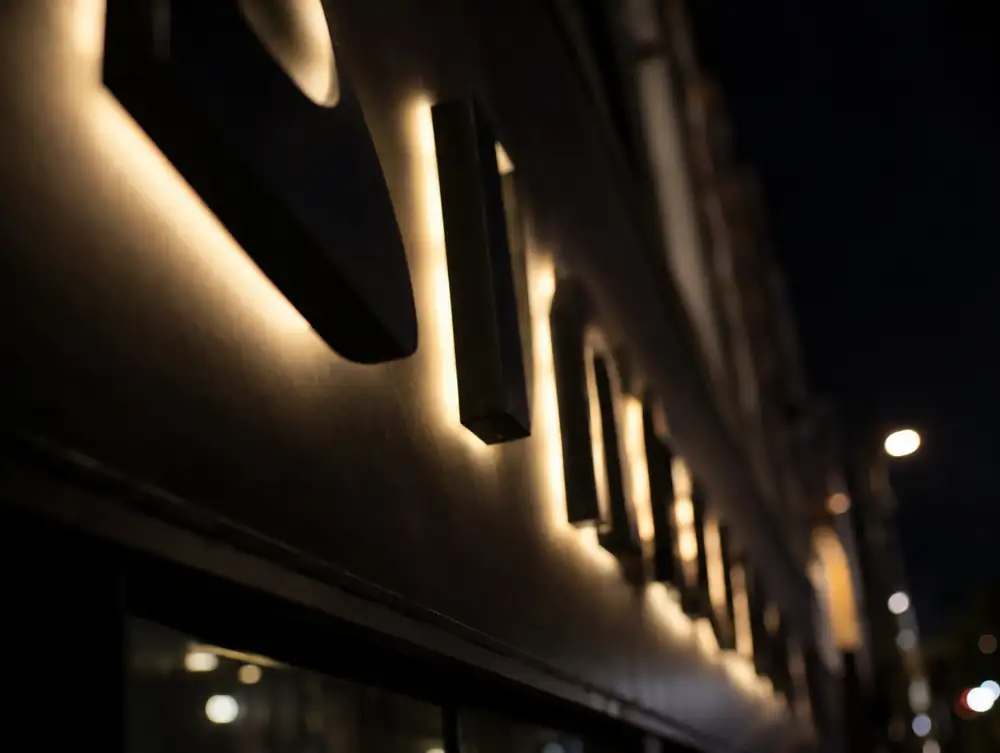
What goes into getting illuminated signage right in Dunfermline?
On a timber frontage, a slim trough light usually keeps more of the daytime character than lit letters. We colour-match the bar to the fascia, so it almost disappears by day.
If letters will sit close to a window head or canopy, we check how the light falls across it. A small change in stand-off or letter position can prevent a hard shadow line.
A corner unit has two fronts to think about, and the return elevation often does as much selling as the main one. If that is your layout in Dunfermline, carry the fascia and glass line round the corner and treat both faces as one composition.
Which applications might illuminated signage in Dunfermline involve?
Section 26 of the Town and Country Planning (Scotland) Act 1997 sets the test: work that doesn't materially affect the external appearance isn't development. For illuminated signage at premises in the Dunfermline area, anything that does needs planning permission, and a true like-for-like replacement usually doesn't. The council confirms how that applies to each site.
The 0.25m projection limit in Class VI means most lit projecting signs in Scotland fall outside it. One at premises in the Dunfermline area will usually need advertisement consent, so allow for an application in the programme.
Planning and advert applications for Dunfermline premises normally go to Fife Council. We check the position for your address at survey.
How much could illuminated signage in Dunfermline cost you?
As a working budget, use £895 to £3,995 plus VAT per sign. Your place inside that range for illuminated signage depends mostly on how much of the existing frontage can stay and how much has to be put right first.
| Town | Dunfermline |
|---|---|
| Area | Fife |
| Postcode districts | KY12 |
| Planning authority | Fife Council |
| Building approval | Building warrant (Technical Handbook) |
| Distance from Great Barr | About 251 miles |
| Survey | Free for new work |
Does Fife Council publish shopfront guidance?
Yes, Shop Front Design Guidelines (2016). It tells applicants what the council expects from new and altered shopfronts. A few of the things it asks for:
- Solid security shutters are discouraged, and shutter boxes may not project in front of the shop front.
- Internal lattice shutters and reinforced laminated glass are encouraged in town centres, with demountable mesh grilles preferred on traditional shop fronts.
- Each shop normally gets one fascia sign and one projecting sign, and only one of them may be lit.
Questions about illuminated signage in Dunfermline
Can an illuminated sign be fitted around trading in Dunfermline?
Yes. External fitting is usually done from a tower or platform with little effect on the shop, and internal cable work can be arranged out of hours.
How will I know what my Dunfermline sign looks like at night?
We draw it on your elevation and describe the lighting effect in the specification, and a sample letter can be tested on your fascia where that helps. Colour temperature and output are agreed before manufacture.
What happens if a lit letter fails on my Dunfermline sign?
Usually a single LED driver or a damaged connection is to blame, and it can be traced from the access point. That is why drivers are placed where they can be reached without taking the sign down.
Do I need a building warrant for a shopfront in the Dunfermline area?
Usually yes in Scotland, if the work alters a wall or structure. Schedule 3 of the Building (Scotland) Regulations 2004 lists some work that needs no warrant, such as replacing a door or window with its frame, but the standards still apply. Shopfronts aren't named there, so ask the council before relying on it.
Which way must a fire exit door open on a shop in the Dunfermline area?
In the direction of escape. Regulation 13(2) of the Fire Safety (Scotland) Regulations 2006 also rules out sliding and revolving doors on a dedicated fire exit and says fire exit doors can't be locked against immediate use. Duties sit with dutyholders under Part 3 of the Fire (Scotland) Act 2005, meaning the employer and any person with control of the premises.