Aluminium shopfronts for Dunfermline premises start with a measured survey of your opening, because the neat lines of the metal will expose any lean in the building. We draw the frame to scale and you sign off every dimension before anything is made.
It helps if you can be there when we visit Dunfermline, since five minutes walking the frontage together answers more than a long email.
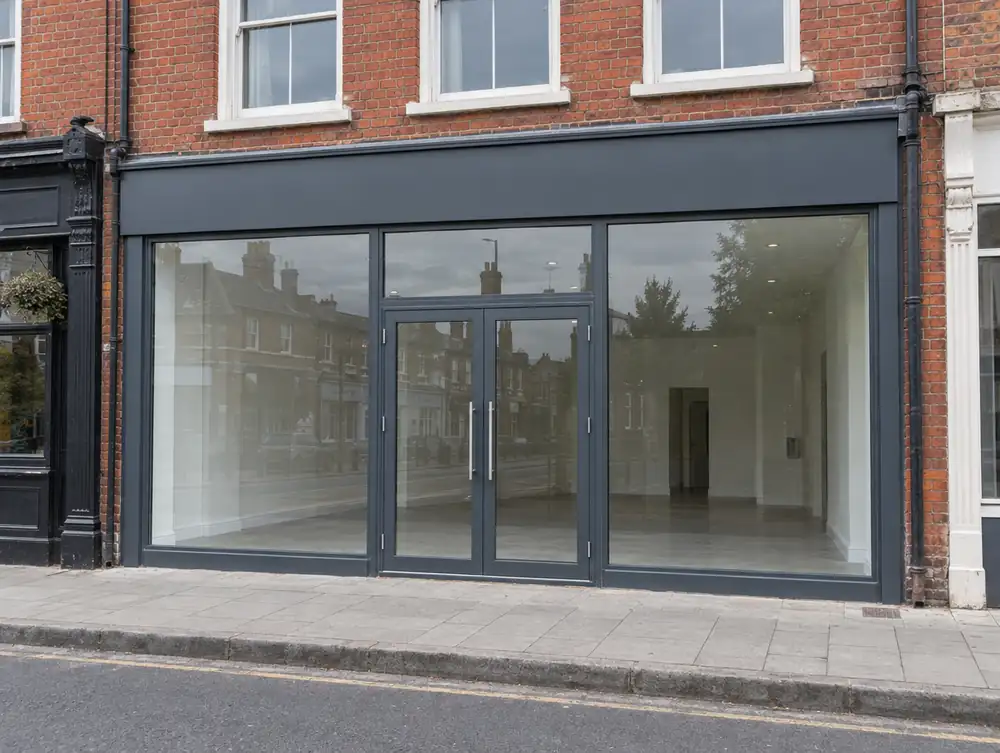
What should you think about before commissioning aluminium shopfronts in Dunfermline?
Where Dunfermline premises have a deep recessed entrance, it's usually worth keeping. The angled returns add display length and shelter, and a slim frame with soffit lighting turns a dark corner into the brightest part of the front in the evening.
A narrow Dunfermline unit gains from fewer parts. Under about 4m wide, we'd offset the door and use one large pane rather than a central door with two slivers of glass either side, which makes the front feel wider than it measures.
On a north-facing frontage the glass stays free of glare, but the interior can look dim from the street, so lighting needs to sit closer to the window. If your Dunfermline premises face south, the problem flips to reflections by day and fading stock.
What is a realistic budget for aluminium shopfronts in Dunfermline?
As a working budget, use £2,495 to £11,995 plus VAT for a typical 3 to 7 m frontage. Your place inside that range for aluminium shopfronts depends mostly on how much of the existing frontage can stay and how much has to be put right first.
Who approves aluminium shopfronts in Dunfermline?
Section 26 of the Town and Country Planning (Scotland) Act 1997 sets the test: work that doesn't materially affect the external appearance isn't development. For aluminium shopfronts at premises in the Dunfermline area, anything that does needs planning permission, and a true like-for-like replacement usually doesn't. The council confirms how that applies to each site.
For Dunfermline, the usual route for planning and advert applications is through Fife Council, and we confirm that when we visit.
| Town | Dunfermline |
|---|---|
| Area | Fife |
| Postcode districts | KY12 |
| Planning authority | Fife Council |
| Building approval | Building warrant (Technical Handbook) |
| Distance from Great Barr | About 251 miles |
| Survey | Free for new work |
Does Fife Council publish shopfront guidance?
Yes, Shop Front Design Guidelines (2016). It tells applicants what the council expects from new and altered shopfronts. A few of the things it asks for:
- Solid security shutters are discouraged, and shutter boxes may not project in front of the shop front.
- Internal lattice shutters and reinforced laminated glass are encouraged in town centres, with demountable mesh grilles preferred on traditional shop fronts.
- Each shop normally gets one fascia sign and one projecting sign, and only one of them may be lit.
Questions about aluminium shopfronts in Dunfermline
What happens to my old shopfront in Dunfermline?
We strip it out and take it away, and that work appears as its own line on the quotation. If part of the old front is worth keeping, such as a stallriser or decorative ironwork, say so at survey and we'll draw around it.
Will an aluminium front make my Dunfermline shop warmer?
It can, though the glass matters more than the frame. A thermally broken section with double-glazed units loses less heat than single glazing, and a well-sealed door is often the change you notice most on a cold day.
Who carries out the work in Dunfermline?
Vetted teams working under S&K Glazing carry it out, with one named contact from survey to handover. The contract is with S&K Glazing Limited, and we travel to Dunfermline from Great Barr.
Which way must a fire exit door open on a shop in the Dunfermline area?
In the direction of escape. Regulation 13(2) of the Fire Safety (Scotland) Regulations 2006 also rules out sliding and revolving doors on a dedicated fire exit and says fire exit doors can't be locked against immediate use. Duties sit with dutyholders under Part 3 of the Fire (Scotland) Act 2005, meaning the employer and any person with control of the premises.
Does a shop sign in the Dunfermline area need advertisement consent?
Not always. Scotland's 1984 Regulations let an unlit sign within Class IV(1) go up without an application, and Class VI does the same for a lit sign with each character lit from within. Class VI isn't available in conservation areas, and one council says lit signs always need express consent, so ask first.