Evening trade in Helensburgh depends on being found. A well-lit name helps people pick out your door at a distance, and good lighting design does that without glare.
Please have keys to any meter cupboards and shutter housings to hand when we survey in Helensburgh, because what sits behind them can change the drawing.
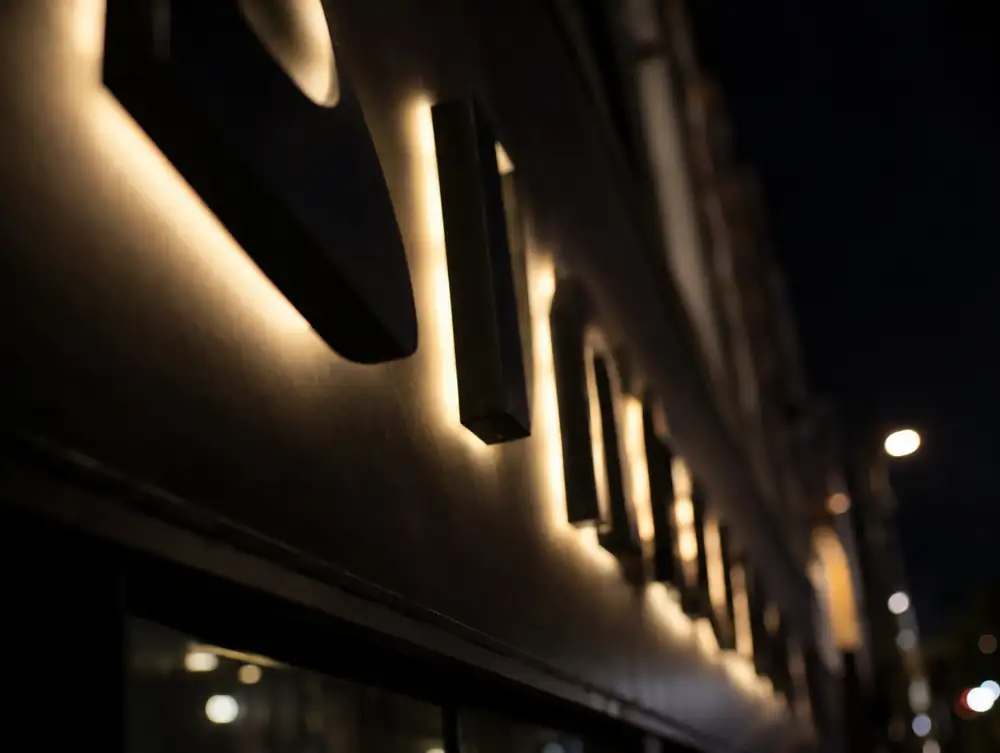
Where should you begin with illuminated signage in Helensburgh?
Should your Helensburgh premises close early, a photocell and timer can keep the sign on through the evening footfall and off for the rest of the night. It costs very little and helps the frontage look looked-after.
Where the frontage faces a wide road, face-lit letters can carry further than halo lighting. On a narrower street the softer option usually reads well enough and looks more refined.
If the pavement falls across your frontage, let the stallriser take up the slope and keep the glass line dead level. The eye reads the long horizontal, so Helensburgh premises on a slope look settled once that line is true.
What price should you expect for illuminated signage in Helensburgh?
We would budget £895 to £3,995 plus VAT per sign. Scope sets most of the figure, so a clear brief at the start does more for the budget than any later change of detail.
What sign-off might you need for illuminated signage in Helensburgh?
Shutters aren't named in Class 9A, so in Scotland they usually fall to the appearance test. The same goes for illuminated signage at premises in the Helensburgh area: building work that materially affects the external appearance needs planning permission, and a true like-for-like usually doesn't. Ask the council to confirm the position for your site.
Signs in Scotland come under the 1984 Advertisement Regulations, which have their own class numbers. At premises in the Helensburgh area, an unlit fascia sign generally needs no application under Class IV(1) of Schedule 4 if it sits on a wall containing a shop window, tops out at 4.6m or first-floor level, and keeps letters to 0.75m high. Anything beyond that needs advertisement consent, and displaying a sign without consent is a criminal offence.
For Helensburgh, the usual route for planning and advert applications is through Argyll and Bute Council, and we confirm that when we visit.
Do you cover Helensburgh?
Work in Helensburgh is welcome, and the survey is fixed by arrangement when the scope is clear. Any travel and access costs are quoted separately, which keeps the price of the frontage itself easy to read.
| Town | Helensburgh |
|---|---|
| Area | Argyll and Bute |
| Postcode districts | G84 |
| Planning authority | Argyll and Bute Council |
| Building approval | Building warrant (Technical Handbook) |
| Distance from Great Barr | About 264 miles |
| Survey | By arrangement |
Questions about illuminated signage in Helensburgh
Will a lit sign in Helensburgh cost much to run?
Very little. A typical LED sign uses about the same power as a few domestic lamps, and a timer trims that further. Occasional driver changes are the larger long-term cost.
Can an illuminated sign be fitted around trading in Helensburgh?
Yes. External fitting is usually done from a tower or platform with little effect on the shop, and internal cable work can be arranged out of hours.
What happens if a lit letter fails on my Helensburgh sign?
Usually a single LED driver or a damaged connection is to blame, and it can be traced from the access point. That is why drivers are placed where they can be reached without taking the sign down.
Do I need a building warrant for a shopfront in the Helensburgh area?
Usually yes in Scotland, if the work alters a wall or structure. Schedule 3 of the Building (Scotland) Regulations 2004 lists some work that needs no warrant, such as replacing a door or window with its frame, but the standards still apply. Shopfronts aren't named there, so ask the council before relying on it.
Do I need planning permission to alter a shopfront in the Helensburgh area?
Usually yes, if the work materially affects the external appearance. Class 9A, Scotland's shop permitted development right, doesn't cover work that alters or extends beyond the existing front. A true like-for-like replacement usually needs no permission, and the council confirms the position.