A restaurant, bar or salon in Marylebone needs a sign that works as hard at nine in the evening as it does at noon. We set the colour temperature and output to suit your fascia, your interior and the street.
Your survey is where the price gets real, because widths, heights, levels and access are all taken on site in Marylebone.
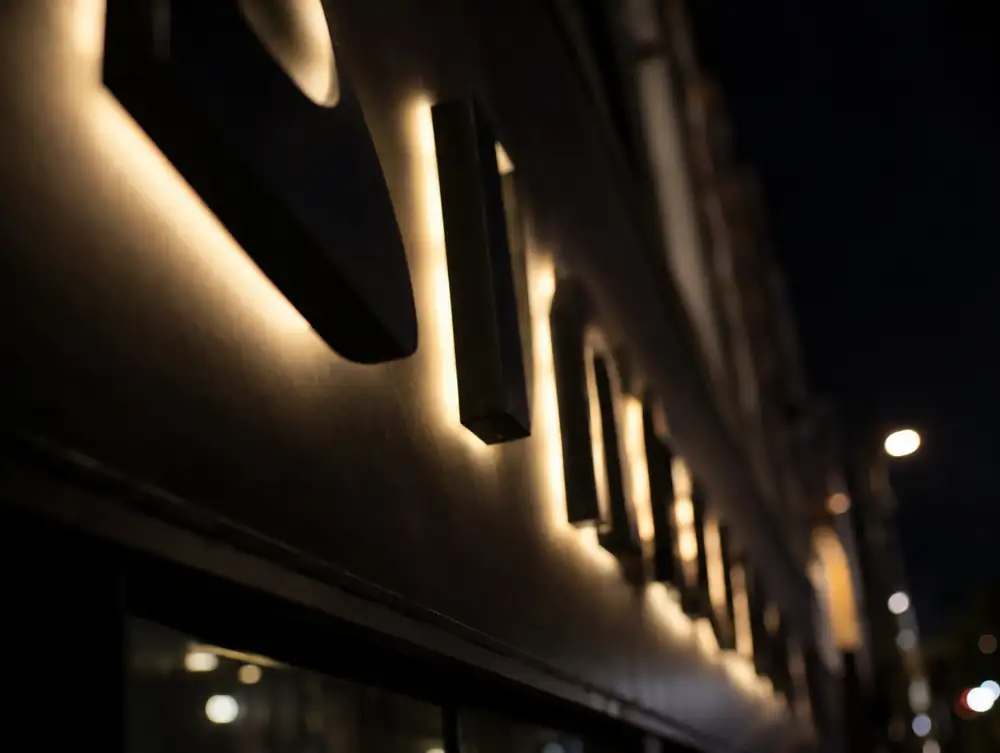
How would we approach illuminated signage for your Marylebone premises?
If your Marylebone fascia is dark and glossy, halo light may disappear into it. We would test a sample or suggest a matt panel behind the letters, so the glow has something to land on.
Where the interior is lit in warm tones, a cold white sign will look wrong from the street. We match the sign to the shop lighting behind the glass, so the two read as one scheme.
Where the building has good brick or stone around the opening, set the frame back in the reveal so the masonry can be seen. On Marylebone premises with a flat elevation, that deep reveal throws a shadow line that adds real depth in low sun.
What consents could affect illuminated signage in Marylebone?
For illuminated signage at premises in the Marylebone area, the deciding question in England is whether the building work materially affects the external appearance. If it does, planning permission is needed, while a true like-for-like replacement usually needs none. The council confirms the position for each site.
Class 4B, England's class for lit signs, isn't available in conservation areas, Areas of Outstanding Natural Beauty, National Parks or the Broads, so a lit sign there normally needs advertisement consent. In an area of special control it is unavailable too, and Class 5 drops to a 3.6m top height, 0.3m letters and one-tenth of the building face up to 3.6m. Ask the council which designations cover premises in the Marylebone area.
We confirm the position at survey, because a boundary or a special designation can change who handles the file, but applications from Marylebone premises normally go to Westminster City Council.
What should you budget for illuminated signage in Marylebone?
Our guide band is £895 to £3,995 plus VAT per sign. Scope is the biggest lever, so a tighter brief for illuminated signage brings the figure down faster than any change of detail.
| Town | Marylebone |
|---|---|
| Area | Greater London |
| Postcode districts | NW8, W1H, W1U, W2 |
| Planning authority | Westminster City Council |
| Building approval | Building Regulations (Approved Documents) |
| Distance from Great Barr | About 102 miles |
| Survey | Free for new work |
Does Westminster City Council publish shopfront guidance?
Yes, Shopfronts, Blinds and Signs - A Guide to their Design (1993). It tells applicants what the council expects from new and altered shopfronts. A few of the things it asks for:
- Roller shutters will not normally be given consent, and internally fitted brick-bond grilles are the preferred solution.
- Large internally lit box signs are generally inappropriate, while externally lit fascias and back-lit or halo-lit letters are accepted.
- Projecting signs need at least 2.6m clearance above the pavement and should sit at fascia level, centred on a pilaster.
Questions about illuminated signage in Marylebone
Can the sign in Marylebone be switched off at night?
Yes. A timer, photocell or simple switch can be built in, and many premises set the sign to go off shortly after closing or late in the evening.
How will I know what my Marylebone sign looks like at night?
We draw it on your elevation and describe the lighting effect in the specification, and a sample letter can be tested on your fascia where that helps. Colour temperature and output are agreed before manufacture.
Which illuminated sign suits a restaurant in Marylebone?
Halo-lit letters in a warm white usually suit restaurants, as they feel calm and considered. A trough light over a painted sign is a good alternative for a more traditional room.
Do I need planning permission to change a shopfront in the Marylebone area?
Usually yes, if the work materially affects the building's external appearance. England's shop permitted development rights exclude creating, altering or replacing a shopfront, so there is no shortcut. A true like-for-like replacement usually needs no application, and the council confirms the position.
Does the Equality Act apply to a shop entrance in the Marylebone area?
Yes. The Equality Act 2010 applies in England, as across Great Britain, and it requires reasonable steps to remove, alter or avoid physical features that disadvantage disabled people. The duty is anticipatory, so it looks at disabled people generally, and a new Services Code replaced the 2011 Code on 5 August 2026.