Design, manufacture, wiring and fitting all sit under one contract for lit signs across Stornoway and Scottish Islands. Your named contact handles the job from measured survey to first switch-on.
Nothing gets ordered off the back of a survey in Stornoway, because its job is to give us the numbers to draw and price from.
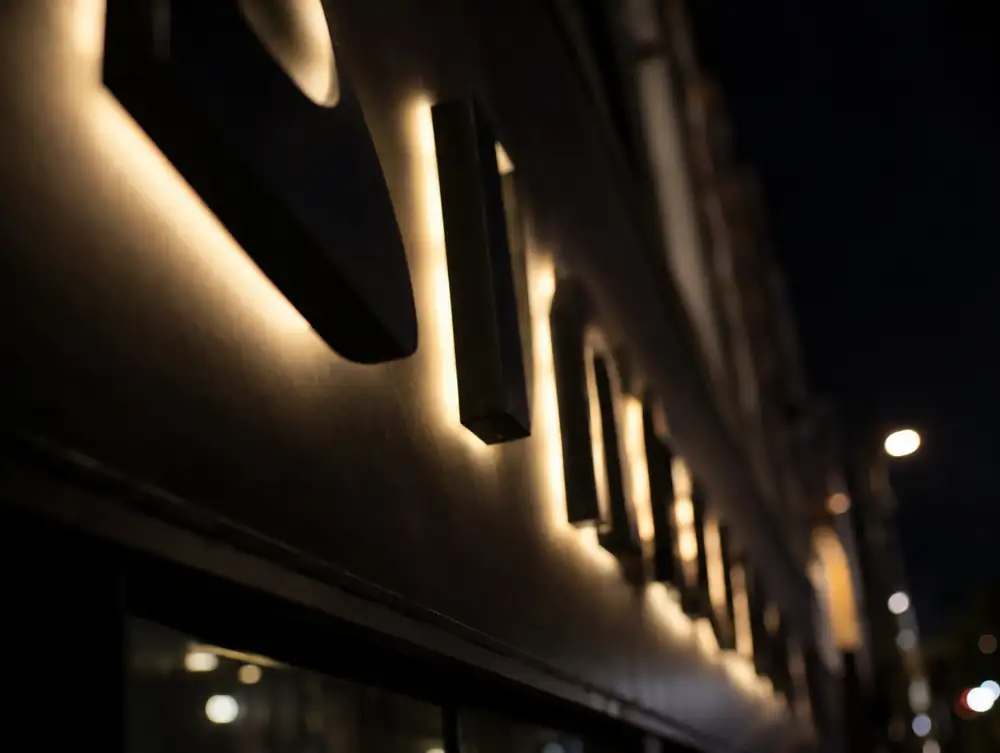
Where should you begin with illuminated signage in Stornoway?
On a timber frontage, a slim trough light usually keeps more of the daytime character than lit letters. We colour-match the bar to the fascia, so it almost disappears by day.
Should your Stornoway premises close early, a photocell and timer can keep the sign on through the evening footfall and off for the rest of the night. It costs very little and helps the frontage look looked-after.
If there are storeys above the shop, the frontage should feel like the base of the building and not a sign stuck on it. Lining up mullions with the windows overhead is a small move that settles the whole elevation at Stornoway premises.
What sign-off might you need for illuminated signage in Stornoway?
Shutters aren't named in Class 9A, so in Scotland they usually fall to the appearance test. The same goes for illuminated signage at premises in the Stornoway area: building work that materially affects the external appearance needs planning permission, and a true like-for-like usually doesn't. Ask the council to confirm the position for your site.
Class VI is the class for lit signs in Scotland, and it is tightly drawn: each character lit from within, the sign at least 2.5m up, no more than 0.25m of projection, and static lighting. One Scottish council says illuminated signs always need express consent, which doesn't match Class VI, so ask the council for the Stornoway area before ordering.
Stornoway applications for planning permission or advertisement consent are normally handled by Comhairle nan Eilean Siar. Our survey includes a check of the position for your address.
What price should you expect for illuminated signage in Stornoway?
Guide price: £895 to £3,995 plus VAT per sign. Materials, finish and the amount of drawing and coordination involved all move it, and your itemised quotation shows where the money goes on illuminated signage.
Do you cover Stornoway?
Work in Stornoway is welcome, and the survey is fixed by arrangement when the scope is clear. Any travel and access costs are quoted separately, which keeps the price of the frontage itself easy to read.
| Town | Stornoway |
|---|---|
| Area | Scottish Islands |
| Postcode districts | HS1 |
| Planning authority | Comhairle nan Eilean Siar |
| Building approval | Building warrant (Technical Handbook) |
| Survey | By arrangement |
Questions about illuminated signage in Stornoway
Which illuminated sign suits a restaurant in Stornoway?
Halo-lit letters in a warm white usually suit restaurants, as they feel calm and considered. A trough light over a painted sign is a good alternative for a more traditional room.
Can an illuminated sign be fitted around trading in Stornoway?
Yes. External fitting is usually done from a tower or platform with little effect on the shop, and internal cable work can be arranged out of hours.
Will a lit sign in Stornoway cost much to run?
Very little. A typical LED sign uses about the same power as a few domestic lamps, and a timer trims that further. Occasional driver changes are the larger long-term cost.
Does a shop sign in the Stornoway area need advertisement consent?
Not always. Scotland's 1984 Regulations let an unlit sign within Class IV(1) go up without an application, and Class VI does the same for a lit sign with each character lit from within. Class VI isn't available in conservation areas, and one council says lit signs always need express consent, so ask first.
Which way must a fire exit door open on a shop in the Stornoway area?
In the direction of escape. Regulation 13(2) of the Fire Safety (Scotland) Regulations 2006 also rules out sliding and revolving doors on a dedicated fire exit and says fire exit doors can't be locked against immediate use. Duties sit with dutyholders under Part 3 of the Fire (Scotland) Act 2005, meaning the employer and any person with control of the premises.