Replacing an old lightbox on Sunbury-on-Thames premises is a good moment to rethink how the name is lit. Slimmer letters and hidden LEDs can give a far more refined result from the same fascia.
Nothing gets ordered off the back of a survey in Sunbury-on-Thames, because its job is to give us the numbers to draw and price from.
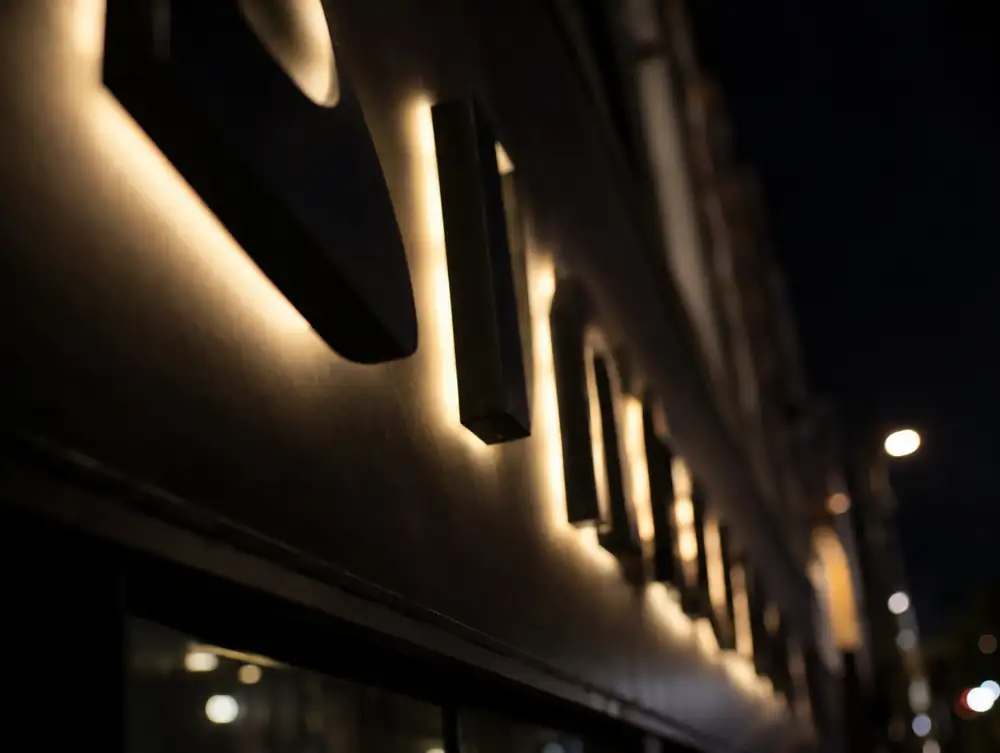
What goes into getting illuminated signage right in Sunbury-on-Thames?
Where the interior is lit in warm tones, a cold white sign will look wrong from the street. We match the sign to the shop lighting behind the glass, so the two read as one scheme.
If your Sunbury-on-Thames fascia is dark and glossy, halo light may disappear into it. We would test a sample or suggest a matt panel behind the letters, so the glow has something to land on.
If you trade after dark in Sunbury-on-Thames, the view in matters more than the sign. A warm, evenly lit interior with light on the back wall will usually do more than a brighter fascia, because it gives the eye somewhere to go.
Which applications might illuminated signage in Sunbury-on-Thames involve?
A true like-for-like replacement usually needs no planning permission in England, because the external appearance isn't materially affected. New materials, a different glass line or altered proportions usually do count as material, so for illuminated signage at premises in the Sunbury-on-Thames area, an application is then likely. The council confirms which side of that line a job falls on.
Lighting moves a sign out of Class 5 in England, because that class allows illumination only for medical-type notices. Class 4B then applies at premises in the Sunbury-on-Thames area: halo or character-only lighting, static, with the lowest part at least 2.5m up. Brightness is capped at 600 cd/m² on signs up to 10m² and 300 cd/m² above that, and anything outside these limits needs advertisement consent.
We confirm the position at survey, because a boundary or a special designation can change who handles the file, but applications from Sunbury-on-Thames premises normally go to Spelthorne Borough Council.
How much could illuminated signage in Sunbury-on-Thames cost you?
The guide for illuminated signage is £895 to £3,995 plus VAT per sign. Expect the lower end for simple work with clear access, and the upper end where detail, finish or awkward conditions add hours.
| Town | Sunbury-on-Thames |
|---|---|
| Area | Surrey |
| Postcode districts | KT12, TW15, TW16, TW17 |
| Planning authority | Spelthorne Borough Council |
| Building approval | Building Regulations (Approved Documents) |
| Distance from Great Barr | About 101 miles |
| Survey | Free for new work |
Questions about illuminated signage in Sunbury-on-Thames
Which illuminated sign suits a restaurant in Sunbury-on-Thames?
Halo-lit letters in a warm white usually suit restaurants, as they feel calm and considered. A trough light over a painted sign is a good alternative for a more traditional room.
Do you supply lit signs for premises across Surrey?
Yes. We travel from Great Barr, with vetted teams working under S&K Glazing and one named contact for the job. The same scale drawing and sign-off process applies wherever your premises are.
Can the sign in Sunbury-on-Thames be switched off at night?
Yes. A timer, photocell or simple switch can be built in, and many premises set the sign to go off shortly after closing or late in the evening.
Do I need listed building consent for a shopfront in the Sunbury-on-Thames area?
Usually yes, if the building is listed. In England the local planning authority decides, and Historic England is notified of Grade I and II* works and specified Grade II works. Like-for-like repair may not need consent, so ask the council before work starts.
Does the Equality Act apply to a shop entrance in the Sunbury-on-Thames area?
Yes. The Equality Act 2010 applies in England, as across Great Britain, and it requires reasonable steps to remove, alter or avoid physical features that disadvantage disabled people. The duty is anticipatory, so it looks at disabled people generally, and a new Services Code replaced the 2011 Code on 5 August 2026.