Every shutter starts with the box, because a box added as an afterthought spoils the frontage. On Kensal Green premises we draw its position with the fascia, the glass line and the ceiling.
Measuring the opening is the easy part of a survey in Kensal Green. We also look at the beam above, the pavement fall and any meters or drains nearby.
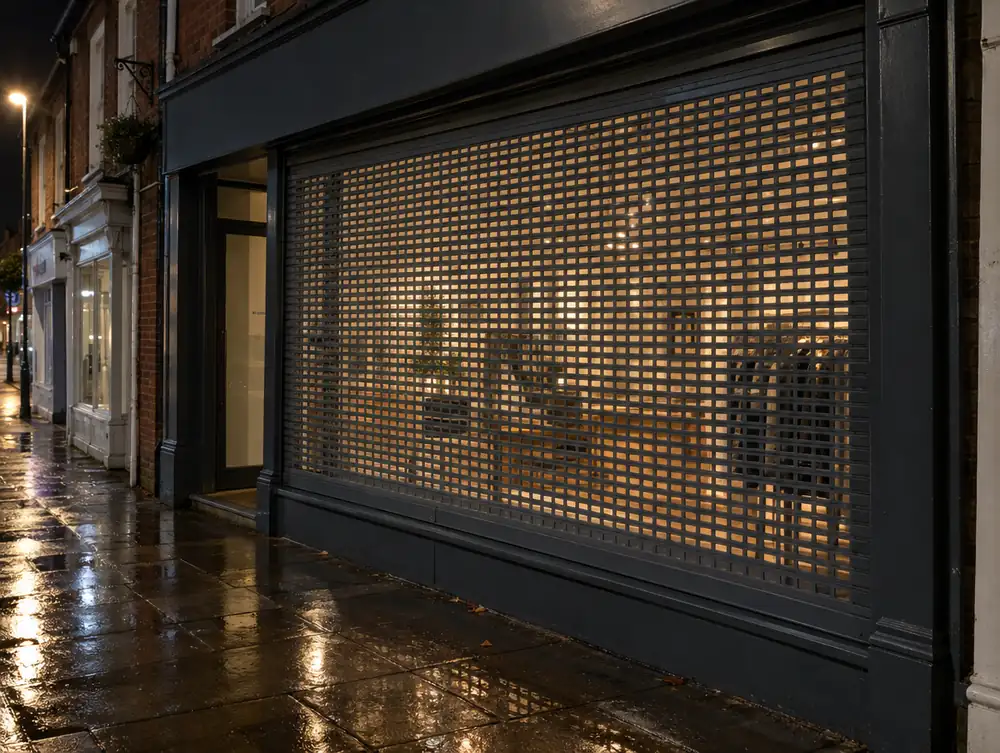
How do you design around the building when planning perforated roller shutters in Kensal Green?
On premises with a recessed entrance, the shutter line needs careful thought. We usually bring it forward to the building line, or close the recess separately, so the doorway does not become a hiding place.
For premises that open early or trade late, shutter noise can matter to neighbours. A motor with a soft start and well-set guides runs noticeably more quietly.
If your Kensal Green unit is narrow, a central door can split a small window into two weak ones. Moving the door to one side gives you a single confident pane, provided the layout inside still works.
What might perforated roller shutters cost in Kensal Green?
Until the survey is done, plan on £1,695 to £4,495 plus VAT per shutter. Unusual sizes, fine detail and phased working push the figure up, while a simple brief and clear access keep it toward the lower end.
What permissions should you check for perforated roller shutters in Kensal Green?
England has no permitted development route for changing a shopfront. Part 7 Class A of the General Permitted Development Order 2015 excludes creating, altering or replacing one, and it allows no alterations at all on article 2(3) land. That leaves two outcomes for perforated roller shutters at premises in the Kensal Green area: a planning application, or work that doesn't materially affect the external appearance.
At survey we check how things stand for your building, although applications for planning permission or advertisement consent here normally go to London Borough of Brent.
| Town | Kensal Green |
|---|---|
| Area | Greater London |
| Postcode districts | NW10, NW6, W10, W9 |
| Planning authority | London Borough of Brent |
| Building approval | Building Regulations (Approved Documents) |
| Distance from Great Barr | About 100 miles |
| Survey | Free for new work |
Does Brent Council publish shopfront guidance?
Yes, Shopfronts SPD3 (2018). It tells applicants what the council expects from new and altered shopfronts. A few of the things it asks for:
- A stallriser of at least 300mm should be kept or installed at the base of the shop display.
- Fascia text should cover no more than half the fascia's width and height, with lettering no taller than 30cm.
- Solid or pin-hole roller shutters are discouraged, and security options run from laminated glass to internal open shutters, then external open shutters only where needed for insurance.
Questions about perforated roller shutters in Kensal Green
What happens if the shutter jams at closing time in Kensal Green?
Do not force it, because that can damage the curtain and motor. Use the manual override if it is safe, then call us. Repairs are charged call-outs, and the fixed price is shown on our site.
What controls can a shutter have?
A key switch, a wall button or a remote are the usual choices, each with a manual override. Many shops use a key switch at the door, so closing up needs someone present.
Can you fit an internal shutter on my Kensal Green premises?
Usually, yes. We check for ceiling space, a clear path behind the window and a solid fixing for the guides. Where space is tight, a slim box or a smaller display can make it work.
Does a shop sign in the Kensal Green area need advertisement consent?
Not always. In England, an unlit sign within Class 5 of the 2007 Advertisement Regulations generally needs no application, and neither does a lit sign within Class 4B. Anything outside those classes needs consent, and Class 4B isn't available in conservation areas, so check before ordering.
Do I need listed building consent for a shopfront in the Kensal Green area?
Usually yes, if the building is listed. In England the local planning authority decides, and Historic England is notified of Grade I and II* works and specified Grade II works. Like-for-like repair may not need consent, so ask the council before work starts.