Security after hours is rarely a simple choice between a heavy shutter and nothing. We look at your stock, your glass and your Motherwell premises together, then specify what the risk calls for.
We measure your Motherwell opening in person, at a time agreed with you first, so the visit fits around your trading.
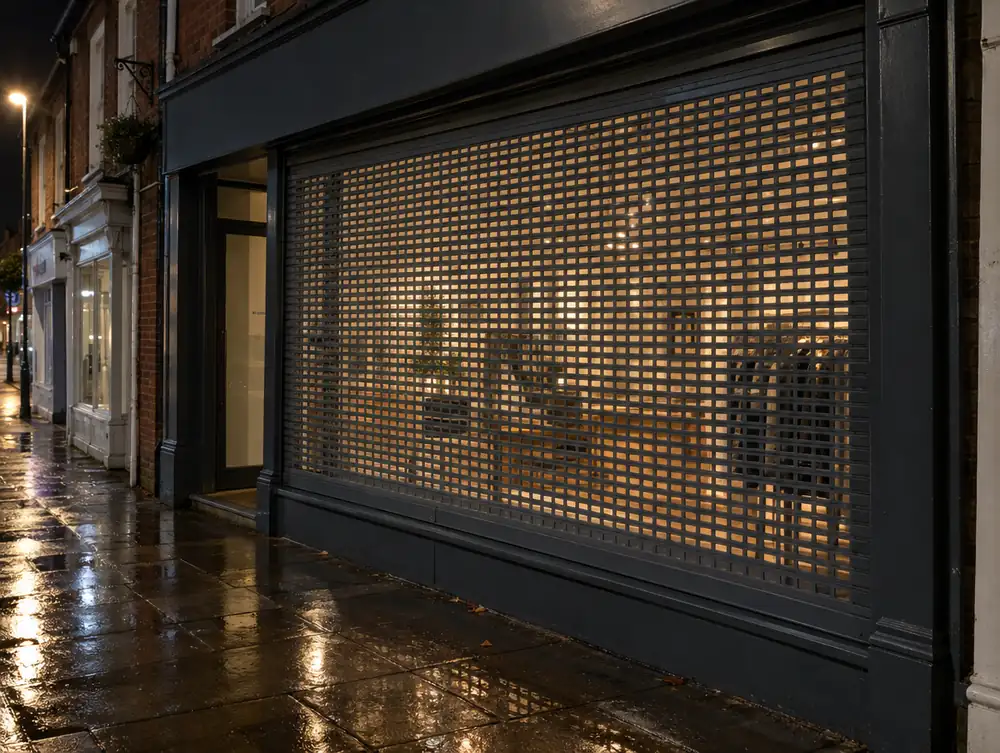
How would we approach perforated roller shutters for your Motherwell premises?
If your Motherwell unit has an old external shutter, we check whether the box can come off and leave a clean fascia. That single change can lift a frontage more than a new sign.
For premises that open early or trade late, shutter noise can matter to neighbours. A motor with a soft start and well-set guides runs noticeably more quietly.
If there are storeys above the shop, the frontage should feel like the base of the building and not a sign stuck on it. Lining up mullions with the windows overhead is a small move that settles the whole elevation at Motherwell premises.
What should you budget for perforated roller shutters in Motherwell?
Allow £1,695 to £4,495 plus VAT per shutter. Size and specification set most of that figure for perforated roller shutters, and the rest depends on what the survey finds on site.
What consents could affect perforated roller shutters in Motherwell?
Scottish guidance says like-for-like windows need no permission, and a true like-for-like frontage replacement usually follows the same logic. Class 7A covers altering or replacing an existing window, but it doesn't mention shopfronts, so ask before relying on it for a display window. For perforated roller shutters at premises in the Motherwell area, a material effect on the external appearance means planning permission, and the council confirms the position.
Planning and advert applications for Motherwell premises normally go to North Lanarkshire Council. We check the position for your address at survey.
| Town | Motherwell |
|---|---|
| Area | Lanarkshire |
| Postcode districts | ML1, ML4 |
| Planning authority | North Lanarkshire Council |
| Building approval | Building warrant (Technical Handbook) |
| Distance from Great Barr | About 239 miles |
| Survey | Free for new work |
Does North Lanarkshire Council publish shopfront guidance?
Yes, Shopfronts & Security (2011). It tells applicants what the council expects from new and altered shopfronts. A few of the things it asks for:
- Original stallrisers should be retained or reinstated, and new ones should be 450mm to 700mm high.
- Fascias should be horizontally proportioned and roughly 300mm to 450mm high.
- Demountable grilles are preferred, and externally stored roller shutters carry a high risk of refusal.
Questions about perforated roller shutters in Motherwell
What happens if the shutter jams at closing time in Motherwell?
Do not force it, because that can damage the curtain and motor. Use the manual override if it is safe, then call us. Repairs are charged call-outs, and the fixed price is shown on our site.
What controls can a shutter have?
A key switch, a wall button or a remote are the usual choices, each with a manual override. Many shops use a key switch at the door, so closing up needs someone present.
Can one person open the shutter at my Motherwell shop?
Yes. Powered shutters run at the turn of a key or a button press, and a manual override is available if the power fails. We show your staff both at handover.
Do I need listed building consent for a shopfront in the Motherwell area?
Almost certainly, if the building is listed and windows or doors are changing, according to Historic Environment Scotland. The planning authority decides, and Historic Environment Scotland is consulted on some applications. Scottish Ministers are notified if it objects.
Which way must a fire exit door open on a shop in the Motherwell area?
In the direction of escape. Regulation 13(2) of the Fire Safety (Scotland) Regulations 2006 also rules out sliding and revolving doors on a dedicated fire exit and says fire exit doors can't be locked against immediate use. Duties sit with dutyholders under Part 3 of the Fire (Scotland) Act 2005, meaning the employer and any person with control of the premises.