Good automatic entrances look calm and quiet, with very little on show. For Motherwell premises, that means hiding the operator, aligning the leaves and setting the door to your hours.
It helps if you can be there when we visit Motherwell, since five minutes walking the frontage together answers more than a long email.
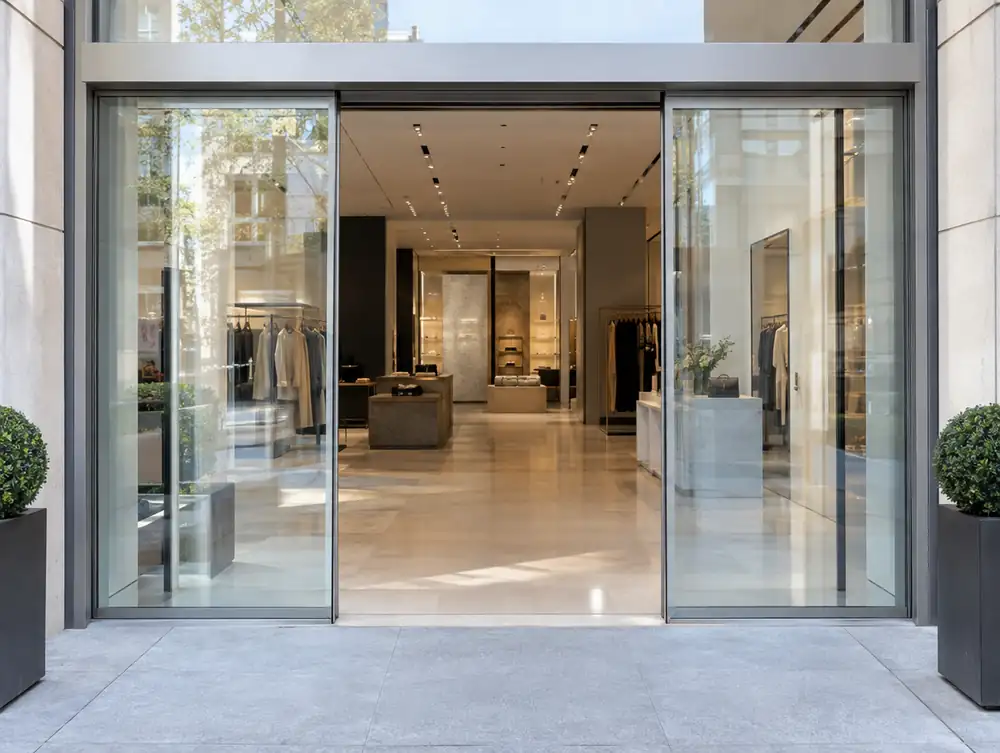
What makes automatic sliding doors work well on Motherwell premises?
Automatic doors suit a night fit in Motherwell, because most of the work is at the head and the opening stays usable in stages. We'd fit the track and leaves out of hours, then commission the door before you open.
Where a landlord in Motherwell wants the frontage kept looking the same, a slim slider can sit behind the existing line. We'd draw the operator inside the fascia and give the landlord a clear elevation to approve.
If you trade after dark in Motherwell, the view in matters more than the sign. A warm, evenly lit interior with light on the back wall will usually do more than a brighter fascia, because it gives the eye somewhere to go.
Could automatic sliding doors in Motherwell need planning permission?
Shutters aren't named in Class 9A, so in Scotland they usually fall to the appearance test. The same goes for automatic sliding doors at premises in the Motherwell area: building work that materially affects the external appearance needs planning permission, and a true like-for-like usually doesn't. Ask the council to confirm the position for your site.
For Motherwell, the usual route for planning and advert applications is through North Lanarkshire Council, and we confirm that when we visit.
How much should you set aside for automatic sliding doors in Motherwell?
A sensible starting budget is £3,895 to £11,995 plus VAT per entrance. What shifts the figure is whatever can't be seen yet, such as the condition behind the old frontage or the services running through it.
| Town | Motherwell |
|---|---|
| Area | Lanarkshire |
| Postcode districts | ML1, ML4 |
| Planning authority | North Lanarkshire Council |
| Building approval | Building warrant (Technical Handbook) |
| Distance from Great Barr | About 239 miles |
| Survey | Free for new work |
Does North Lanarkshire Council publish shopfront guidance?
Yes, Shopfronts & Security (2011). It tells applicants what the council expects from new and altered shopfronts. A few of the things it asks for:
- Original stallrisers should be retained or reinstated, and new ones should be 450mm to 700mm high.
- Fascias should be horizontally proportioned and roughly 300mm to 450mm high.
- Demountable grilles are preferred, and externally stored roller shutters carry a high risk of refusal.
Questions about automatic sliding doors in Motherwell
Will the door keep opening for passers-by in Motherwell?
Not if it is set up properly. We narrow the sensor field on site and test it against real footfall, so only people heading for the door trigger it.
What do I need to arrange for a door in Motherwell?
Usually just a power supply near the head, and we'll tell you exactly what at survey. We can bring that into the one contract if you'd rather not chase an electrician.
Can an automatic door work with my Motherwell shop's alarm and locks?
Yes. The door can lock at closing, and it can link to your alarm or access control where the systems allow, with a manual key position as a fallback.
Does a shop sign in the Motherwell area need advertisement consent?
Not always. Scotland's 1984 Regulations let an unlit sign within Class IV(1) go up without an application, and Class VI does the same for a lit sign with each character lit from within. Class VI isn't available in conservation areas, and one council says lit signs always need express consent, so ask first.
Do I need a building warrant for a shopfront in the Motherwell area?
Usually yes in Scotland, if the work alters a wall or structure. Schedule 3 of the Building (Scotland) Regulations 2004 lists some work that needs no warrant, such as replacing a door or window with its frame, but the standards still apply. Shopfronts aren't named there, so ask the council before relying on it.