Your brand and your building both have a say in a new frontage. On premises in Rhondda we start with what the structure allows, then bring in the name, colours and materials.
Your survey is where the price gets real, because widths, heights, levels and access are all taken on site in Rhondda.
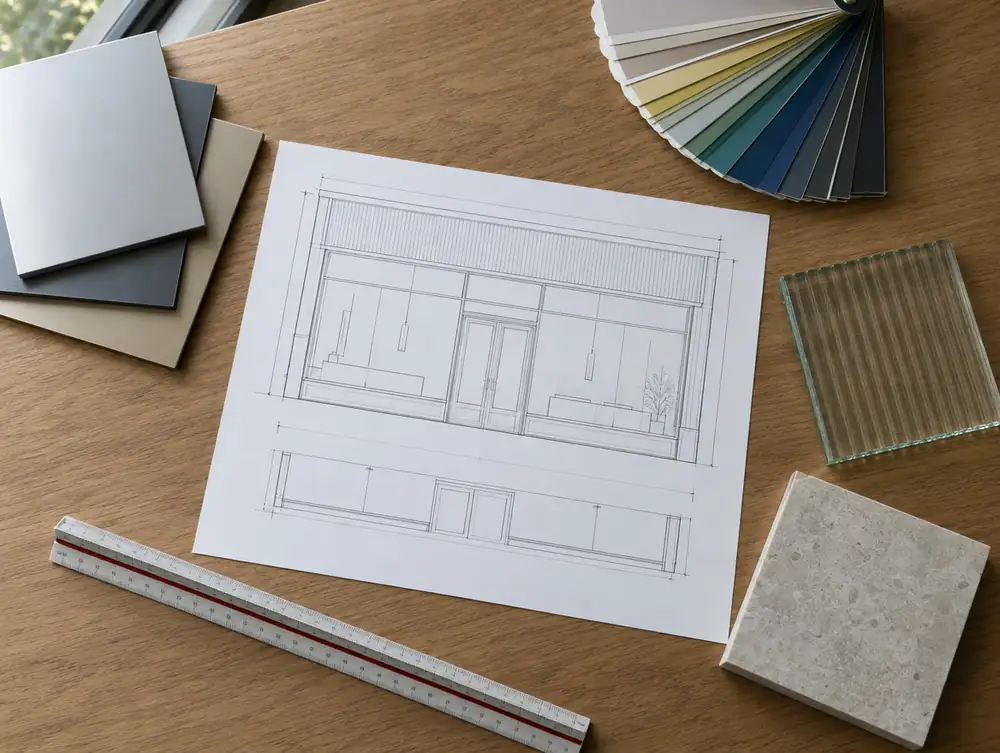
How would we approach shopfront design for your Rhondda premises?
If you trade after dark, we add an evening view to the drawings. Interior light, the sign and any shade change how the frontage reads, so we would sooner show you than describe it.
If the pavement falls along your frontage, we survey the levels before drawing a line. Door threshold, stallriser and sill are then set from the real ground, which is where designs drawn from photographs tend to fail.
If the pavement falls across your frontage, let the stallriser take up the slope and keep the glass line dead level. The eye reads the long horizontal, so Rhondda premises on a slope look settled once that line is true.
What should you budget for shopfront design in Rhondda?
Our guide band is £495 to £2,495 plus VAT per frontage. Scope is the biggest lever, so a tighter brief for shopfront design brings the figure down faster than any change of detail.
What consents could affect shopfront design in Rhondda?
Going by Part 42 of the 1995 Order as inserted in 2014, Wales has no permitted development route for changing a shopfront. The right covers A1 and A2 premises, but it excludes creating, altering or replacing a shopfront, or fitting or replacing a security grill or shutter on one, and it doesn't apply on Article 1(5) land. For shopfront work at premises in the Rhondda area, that leaves a planning application, or work that leaves the appearance materially unchanged.
We confirm the position at survey, because a boundary or a special designation can change who handles the file, but applications from Rhondda premises normally go to Rhondda Cynon Taf County Borough Council.
| Town | Rhondda |
|---|---|
| Area | Mid Glamorgan |
| Postcode districts | CF40, CF41, CF42, CF43 |
| Planning authority | Rhondda Cynon Taf County Borough Council |
| Building approval | Building Regulations (Approved Documents for Wales) |
| Distance from Great Barr | About 90 miles |
| Survey | Free for new work |
Does Rhondda Cynon Taf County Borough Council publish shopfront guidance?
Yes, Shopfront Design. It tells applicants what the council expects from new and altered shopfronts. A few of the things it asks for:
- External roller shutters are a last resort after other security options are shown to be unsuitable.
- Solid metal shutters are unlikely to be acceptable, while lattice or brick-bond grille shutters may be considered.
- Individual shutters covering only the glazing are one option, and powder coating is generally preferred to paint.
Questions about shopfront design in Rhondda
Can a design for Rhondda premises follow my brand guidelines?
Yes. Send them over with your logo files, and we apply them to your elevation. Where a rule does not fit the building, we explain why and suggest an adjustment.
How many options will I see for my Rhondda premises?
Usually two or three directions at concept stage, then one developed design. If you already know what you want, we can go straight to the developed drawings.
Can you show the design to my landlord in Mid Glamorgan?
Yes. The drawings and visuals are prepared so a landlord or agent can review them easily. We can answer their questions directly if that helps.
Does a replacement shopfront in the Rhondda area need Building Regulations approval?
Assume yes until building control says otherwise, because Wales has no like-for-like exemption. Glazing is judged against Approved Document N, as Wales keeps Part N. A registered installer can self-certify replacement windows and doors in non-dwellings, but not structural glass, curtain walling or revolving doors.
Can a shop fire exit in the Rhondda area use a sliding door?
No, a dedicated fire exit can't be a sliding or revolving door. In Wales, article 14(2) of the Regulatory Reform (Fire Safety) Order 2005 also says fire exit doors must open in the direction of escape and can't be locked against immediate use. The responsible person holds that duty, normally the employer or whoever controls the premises for a business, otherwise the owner.