Automatic sliding doors for Rhondda premises start with how people reach your entrance. We look at the pavement, the footfall and the space either side of the opening before recommending a door.
A survey in Rhondda usually starts outside, looking at the whole elevation before any tape comes out, because the frontage has to answer the building above it.
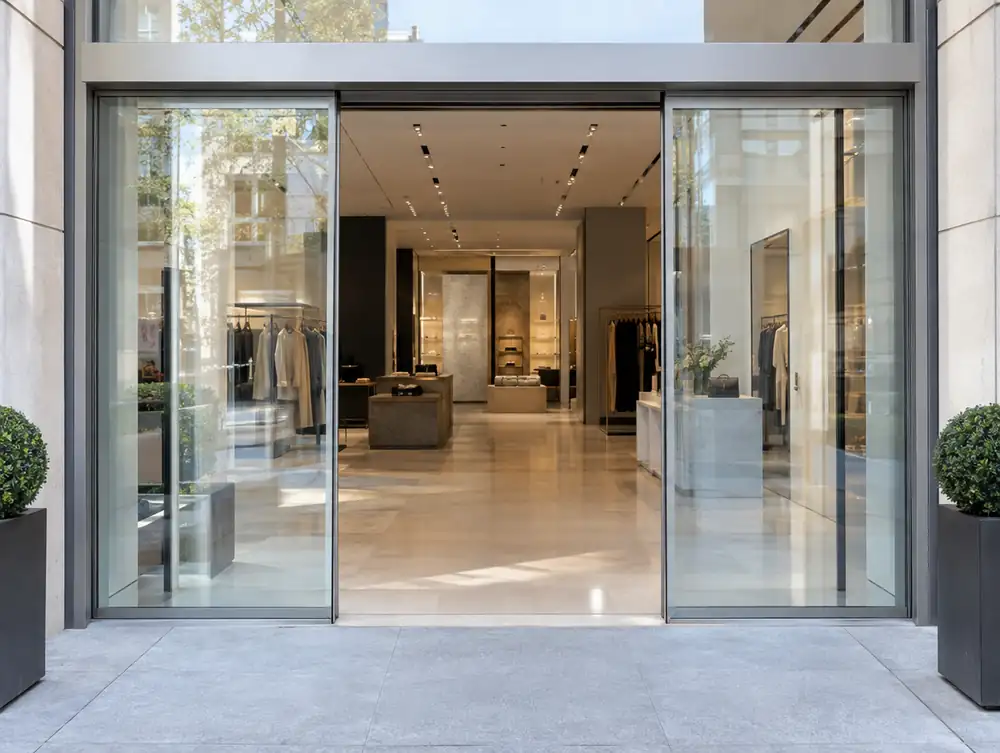
What goes into getting automatic sliding doors right in Rhondda?
If your Rhondda entrance catches low sun, infrared sensors can misread the light on the floor. We'd favour radar with a presence sensor set for those conditions, and consider solar control glass in the leaves.
For a pharmacy or retail chain with a branch in Rhondda, we'd keep the door type, finish and settings the same as the estate standard. Opening width and head detail then adapt to this particular front.
On a north-facing frontage the glass stays free of glare, but the interior can look dim from the street, so lighting needs to sit closer to the window. If your Rhondda premises face south, the problem flips to reflections by day and fading stock.
How much could automatic sliding doors in Rhondda cost you?
As a working budget, use £3,895 to £11,995 plus VAT per entrance. Your place inside that range for automatic sliding doors depends mostly on how much of the existing frontage can stay and how much has to be put right first.
Which applications might automatic sliding doors in Rhondda involve?
The existing rules still apply in Wales, because most of the Planning (Wales) Act 2026 is waiting for a commencement order. For automatic sliding doors at premises in the Rhondda area, building work that materially affects the external appearance needs planning permission, while a true like-for-like replacement usually doesn't. The council confirms the current position.
Expect planning and advert applications here to go to Rhondda Cynon Taf County Borough Council in the normal way. We check what that means for your building when we survey it in Rhondda.
| Town | Rhondda |
|---|---|
| Area | Mid Glamorgan |
| Postcode districts | CF40, CF41, CF42, CF43 |
| Planning authority | Rhondda Cynon Taf County Borough Council |
| Building approval | Building Regulations (Approved Documents for Wales) |
| Distance from Great Barr | About 90 miles |
| Survey | Free for new work |
Does Rhondda Cynon Taf County Borough Council publish shopfront guidance?
Yes, Shopfront Design. It tells applicants what the council expects from new and altered shopfronts. A few of the things it asks for:
- External roller shutters are a last resort after other security options are shown to be unsuitable.
- Solid metal shutters are unlikely to be acceptable, while lattice or brick-bond grille shutters may be considered.
- Individual shutters covering only the glazing are one option, and powder coating is generally preferred to paint.
Questions about automatic sliding doors in Rhondda
How noisy would an automatic door be at my Rhondda shop?
A healthy door is very quiet, and you'd normally hear only a soft hum. Noise usually means worn rollers or grit in the guide, which a service will put right.
Can you match the door to my existing front in Mid Glamorgan?
Yes. Frames come in any RAL colour, and we'd line up the leaves with your existing mullions so the door doesn't look like an add-on.
Can an automatic door work with my Rhondda shop's alarm and locks?
Yes. The door can lock at closing, and it can link to your alarm or access control where the systems allow, with a manual key position as a fallback.
Who decides listed building consent for a shopfront in the Rhondda area?
Planning authorities and Welsh Ministers share control of listed building consent in Wales, under the Historic Environment (Wales) Act 2023. Cadw is the national body, and the 1990 Act no longer applies. Ask the council where an application should start.
When does a shop sign in the Rhondda area need advertisement consent?
A sign needs advertisement consent when it falls outside Class 5 or Class 4B of the 1992 Advertisement Regulations, which still apply in Wales. Within Class 5, an unlit sign sits on a wall containing a shop window and tops out at 4.6m or the first-floor sill if lower. A lit sign in a conservation area needs consent, because Class 4B isn't available there.