Seen a frontage you admire? Bring the picture to our first talk about stallrisers and cladding in Glasgow and Clyde, and we will work out what makes it succeed, from fascia depth to glass line, and what that means for your building.
Most frontages share something with someone, be that a door to the flats above, a meter cupboard or a pilaster on the boundary. We pick those up early on stallrisers and cladding in Glasgow and Clyde, because they are far easier to design around than to discover on the day.
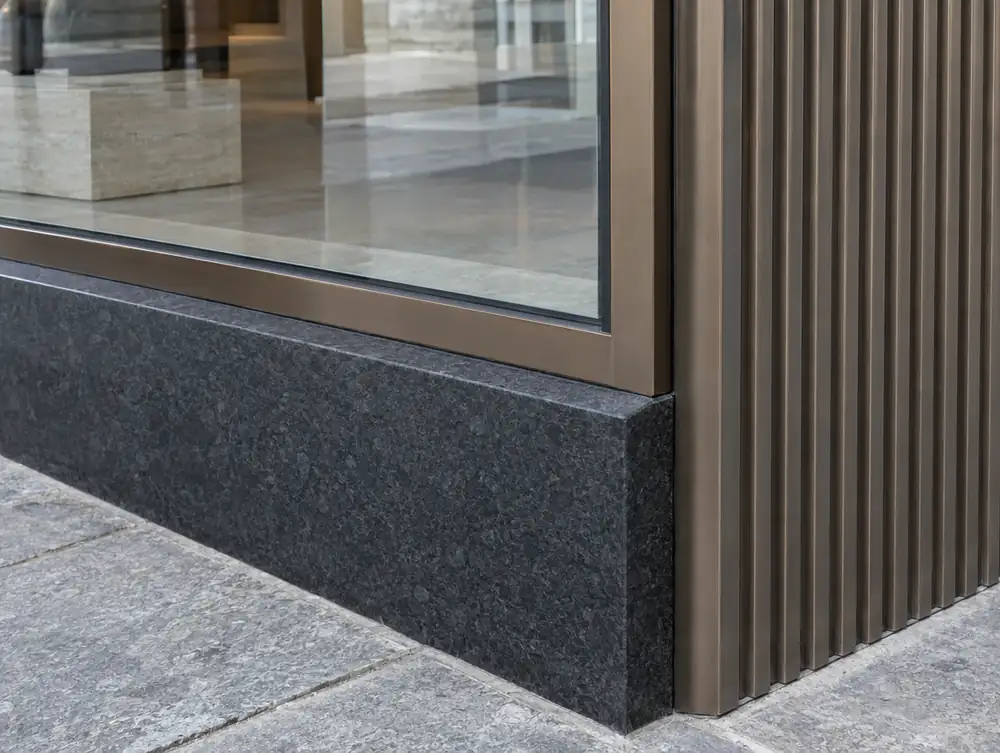
What makes stallrisers and cladding work well for premises in Glasgow and Clyde?
Stripping an old facing can reveal what the building had first. If original tile or timber turns up on your premises in Glasgow and Clyde, we stop and talk to you, since repairing it may cost less than cladding over it.
A pavement that falls along the frontage needs careful handling. Where your premises in Glasgow and Clyde sit on a slope, the sill stays level and the stallriser takes up the difference.
What consents apply to stallrisers and cladding in Glasgow and Clyde?
Shutters aren't named in Class 9A, so in Scotland they usually fall to the appearance test. The same goes for stallrisers and cladding at premises in the Glasgow and Clyde area: building work that materially affects the external appearance needs planning permission, and a true like-for-like usually doesn't. Ask the council to confirm the position for your site.
How much do stallrisers and cladding cost in Glasgow and Clyde?
Until the survey is done, plan on £195 to £495 plus VAT per m². Unusual sizes, fine detail and phased working push the figure up, while a simple brief and clear access keep it toward the lower end.
| Area | Glasgow and Clyde |
|---|---|
| Nation | Scotland |
| Towns covered | 20 |
| Main town | Glasgow |
| Planning regime | Scotland: 1997 Planning Act and the 1984 Advertisement Regulations |
| Building approval | Building warrant (Technical Handbook) |
| Survey | Free for new work, from our Great Barr base |
Questions about stallrisers and cladding in Glasgow and Clyde
Can you match an existing tiled stallriser on premises in Glasgow and Clyde?
Often, yes, though an exact glaze match can be difficult. We take a sample tile, compare it with what is available, and suggest a specialist tile or a change at a natural break if the colour cannot be found.
How do I pick a stallriser finish for a unit in Glasgow and Clyde?
Start with the brick, stone or render above the shop, then bring in the brand colour. Samples held against the building in daylight will tell you more than a screen, so try them in the morning and the evening.
Can stallriser work on premises around Glasgow be done in a day?
A straightforward composite or painted panel often can, and fitting can be arranged on a closed day. Stone and tile take longer because of fixing and setting time, so we would agree a short phased plan.
Do roller shutters need planning permission in the Glasgow and Clyde area?
Usually yes, if they materially affect the external appearance. Class 9A doesn't name shutters, so in Scotland treat them as falling to the appearance test rather than assuming a permitted development route. Ask the council before ordering, as this is a reading of the rules and not an official statement.
Which way must a fire exit door open on a shop in the Glasgow and Clyde area?
In the direction of escape. Regulation 13(2) of the Fire Safety (Scotland) Regulations 2006 also rules out sliding and revolving doors on a dedicated fire exit and says fire exit doors can't be locked against immediate use. Duties sit with dutyholders under Part 3 of the Fire (Scotland) Act 2005, meaning the employer and any person with control of the premises.