Our quotation for stallrisers and cladding in the Scottish Islands is written, itemised and valid for 90 days. Nothing is ordered until you accept it, which gives you time to take it to a landlord, a partner or a board.
If you're a tenant, your landlord will probably want to see what is proposed. The scale drawings we produce for stallrisers and cladding are clear enough to send straight on, which saves a round of explaining.
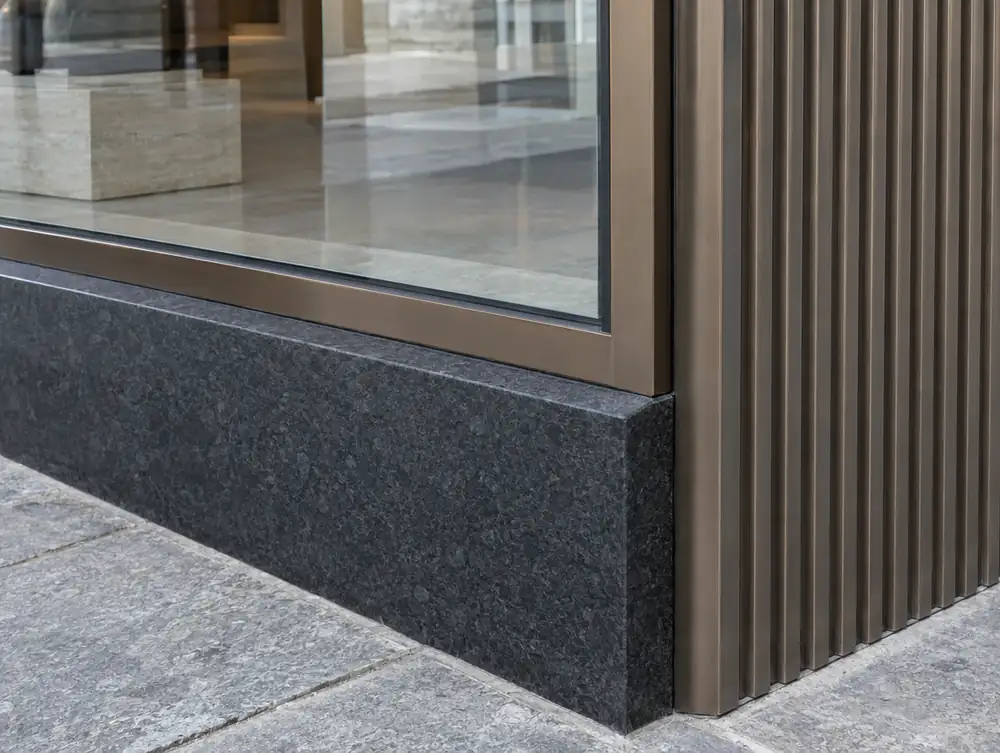
What makes stallrisers and cladding work well for premises in the Scottish Islands?
Road grit does the most damage at this level. On premises across the Scottish Islands that take winter salt or regular pavement washing, we fit a replaceable plinth so the lowest edge can be changed without disturbing the facing.
Neighbouring frontages are the first reference for height. At survey near Kirkwall we note the sill lines on either side of your unit, then decide whether to match them or make a deliberate break.
What consents apply to stallrisers and cladding in the Scottish Islands?
Class 9A, Scotland's shop permitted development right, gives no route for a shopfront change. It covers Class 1A premises, but not work that alters or extends beyond the existing front, and it doesn't apply in conservation areas, National Parks or World Heritage Sites. For stallrisers and cladding at premises in the Scottish Islands area, that generally means a planning application unless the external appearance isn't materially affected.
How much do stallrisers and cladding cost in the Scottish Islands?
Guide price: £195 to £495 plus VAT per m². Materials, finish and the amount of drawing and coordination involved all move it, and your itemised quotation shows where the money goes on stallrisers and cladding.
| Area | Scottish Islands |
|---|---|
| Nation | Scotland |
| Towns covered | 3 |
| Main town | Kirkwall |
| Planning regime | Scotland: 1997 Planning Act and the 1984 Advertisement Regulations |
| Building approval | Building warrant (Technical Handbook) |
| Survey | By arrangement |
Questions about stallrisers and cladding in the Scottish Islands
Will road salt damage a metal stallriser in the Scottish Islands?
It will, if cut edges are left exposed. We use folded sheet with hidden edges, keep the base clear of the pavement and fit a replaceable plinth where salt is heavy.
Can you match an existing tiled stallriser on premises in the Scottish Islands?
Often, yes, though an exact glaze match can be difficult. We take a sample tile, compare it with what is available, and suggest a specialist tile or a change at a natural break if the colour cannot be found.
How do I pick a stallriser finish for a unit in the Scottish Islands?
Start with the brick, stone or render above the shop, then bring in the brand colour. Samples held against the building in daylight will tell you more than a screen, so try them in the morning and the evening.
Do I need planning permission to alter a shopfront in the Scottish Islands area?
Usually yes, if the work materially affects the external appearance. Class 9A, Scotland's shop permitted development right, doesn't cover work that alters or extends beyond the existing front. A true like-for-like replacement usually needs no permission, and the council confirms the position.
Does a shop sign in the Scottish Islands area need advertisement consent?
Not always. Scotland's 1984 Regulations let an unlit sign within Class IV(1) go up without an application, and Class VI does the same for a lit sign with each character lit from within. Class VI isn't available in conservation areas, and one council says lit signs always need express consent, so ask first.