Few businesses can shut for a week, so any time on site for stallrisers and cladding in West Yorkshire is planned around the hours you trade. Closed-day or out-of-hours installation can be arranged.
What sits behind the existing fascia often decides the job. Old beams, abandoned cable runs and earlier frames are common finds, which is why our visit to West Yorkshire premises looks past the surface before anything is drawn or priced for stallrisers and cladding.
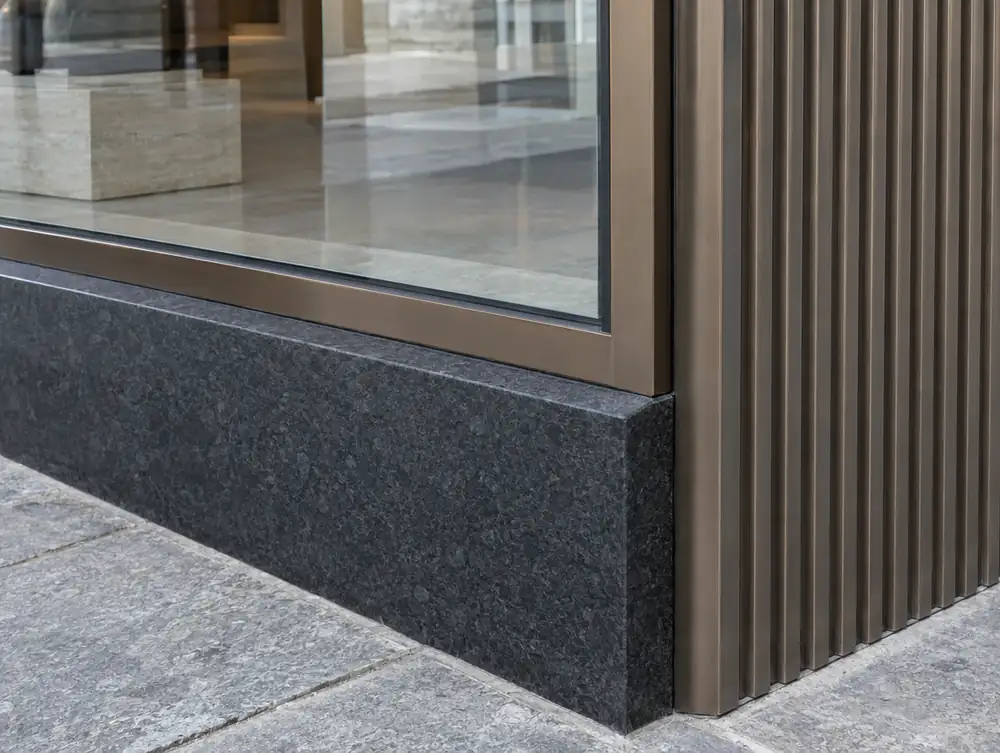
How should you approach stallrisers and cladding in West Yorkshire?
A pavement that falls along the frontage needs careful handling. Where your premises in West Yorkshire sit on a slope, the sill stays level and the stallriser takes up the difference.
A restaurant and a jeweller want very different stallrisers, even side by side. For premises in West Yorkshire we set the height around what people do behind the glass, whether that is sitting, browsing or studying a tray.
What consents apply to stallrisers and cladding in West Yorkshire?
For stallrisers and cladding at premises in the West Yorkshire area, the deciding question in England is whether the building work materially affects the external appearance. If it does, planning permission is needed, while a true like-for-like replacement usually needs none. The council confirms the position for each site.
How much do stallrisers and cladding cost in West Yorkshire?
We would budget £195 to £495 plus VAT per m². Scope sets most of the figure, so a clear brief at the start does more for the budget than any later change of detail.
| Area | West Yorkshire |
|---|---|
| Nation | England |
| Towns covered | 43 |
| Main town | Leeds |
| Planning regime | England: TCPA 1990 and the 2007 Advertisement Regulations |
| Building approval | Building Regulations (Approved Documents) |
| Survey | Free for new work, from our Great Barr base |
Does City of Bradford Metropolitan District Council publish shopfront guidance?
Yes, Bradford Shopfront Design Guide Supplementary Planning Document (2026). It tells applicants what the council expects from new and altered shopfronts. A few of the things it asks for:
- Stallrisers should ideally be no more than 20% of total shopfront height, and plastic is never acceptable for them.
- Cornice, fascia and architrave together should be no more than 20% of total height, with lettering no more than two-thirds of the fascia height.
- Solid and perforated roller shutters are strongly discouraged, and internal grilles, ideally set back at least 1m from the window, are the council's preferred approach.
Questions about stallrisers and cladding in West Yorkshire
How do I pick a stallriser finish for a unit in West Yorkshire?
Start with the brick, stone or render above the shop, then bring in the brand colour. Samples held against the building in daylight will tell you more than a screen, so try them in the morning and the evening.
Can stallriser work on premises around Leeds be done in a day?
A straightforward composite or painted panel often can, and fitting can be arranged on a closed day. Stone and tile take longer because of fixing and setting time, so we would agree a short phased plan.
Can you match an existing tiled stallriser on premises in West Yorkshire?
Often, yes, though an exact glaze match can be difficult. We take a sample tile, compare it with what is available, and suggest a specialist tile or a change at a natural break if the colour cannot be found.
Do I need listed building consent for a shopfront in the West Yorkshire area?
Usually yes, if the building is listed. In England the local planning authority decides, and Historic England is notified of Grade I and II* works and specified Grade II works. Like-for-like repair may not need consent, so ask the council before work starts.
Do roller shutters need planning permission in the West Yorkshire area?
Usually yes. Installing or replacing a security grill or shutter on a shopfront is expressly outside England's shop permitted development rights, so the only way to avoid an application is work that doesn't materially affect the appearance. Ask the council before ordering.