Looking for a front with more character on your Burnage premises? A painted timber frontage, built up in layers and proportioned to the building, has a warmth that reads from across the street.
Surveys for Burnage are booked with you directly. Tell us your quieter days and we'll work around them.
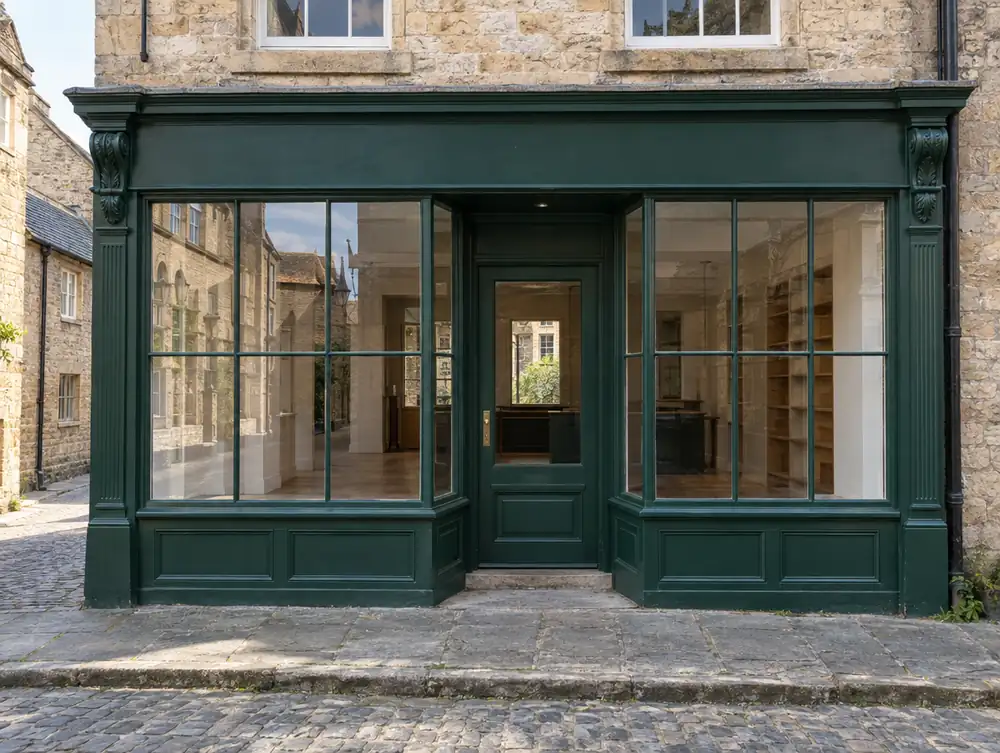
What makes timber shopfronts work well on Burnage premises?
If your Burnage premises have a deep recessed entrance, timber can make it feel like a welcome. We'd panel the returns, add a lit soffit and lay a hard-wearing threshold, keeping the end grain of every post clear of the wet.
Narrow units suit timber well, because mouldings add interest where there's little width to work with. On a slim Burnage frontage we'd keep one strong pane, a panelled door and a fascia that doesn't crowd them.
Where units share one long run of fascia, breaking the height makes you stand out for the wrong reason. If that describes your Burnage parade, keep the line and win attention with lettering, lighting and what's in the window.
How much should you set aside for timber shopfronts in Burnage?
Until the survey is done, plan on £3,995 to £13,995 plus VAT for a typical frontage. Unusual sizes, fine detail and phased working push the figure up, while a simple brief and clear access keep it toward the lower end.
Could timber shopfronts in Burnage need planning permission?
England has no permitted development route for changing a shopfront. Part 7 Class A of the General Permitted Development Order 2015 excludes creating, altering or replacing one, and it allows no alterations at all on article 2(3) land. That leaves two outcomes for timber shopfronts at premises in the Burnage area: a planning application, or work that doesn't materially affect the external appearance.
At survey we check how things stand for your building, although applications for planning permission or advertisement consent here normally go to Manchester City Council.
| Town | Burnage |
|---|---|
| Area | Greater Manchester |
| Postcode districts | M14, M19, M20, SK4 |
| Planning authority | Manchester City Council |
| Building approval | Building Regulations (Approved Documents) |
| Distance from Great Barr | About 62 miles |
| Survey | Free for new work |
Does Manchester City Council publish shopfront guidance?
Yes, Shopfront and Signage Design Guide. It tells applicants what the council expects from new and altered shopfronts. A few of the things it asks for:
- External shutters are generally not permitted, and any exceptional case must be at least 50% transparent, sit within the shopfront frame and hide its box behind the fascia.
- Internally lit lightbox signage is not permitted for new signs, and external lighting such as discreet spotlights is preferred.
- New signage is limited to one fascia or internal hanging sign per elevation, with a maximum depth of 30mm.
Questions about timber shopfronts in Burnage
Do you make the joinery for Burnage shops to order?
Yes. Every length is made to the signed-off drawings for your opening, then brought to Burnage from Great Barr by vetted teams working under S&K Glazing.
What should I budget for looking after a timber front in Burnage?
A repaint every 5 to 7 years, plus a yearly wash and touch-up of the cills. Door gear needs checking too, since seasonal movement can throw a door out of line.
Can a timber front take a modern sign in Burnage?
Yes. Hand-painted letters suit a timber fascia well, and raised letters or a concealed trough light work too. We draw the sign and the joinery together, so the fixings don't cut through a moulding.
Does a shop sign in the Burnage area need advertisement consent?
Not always. In England, an unlit sign within Class 5 of the 2007 Advertisement Regulations generally needs no application, and neither does a lit sign within Class 4B. Anything outside those classes needs consent, and Class 4B isn't available in conservation areas, so check before ordering.
What rules apply to a fire exit door through a shopfront in the Burnage area?
It must open in the direction of escape and can't be locked against immediate use, and a dedicated fire exit can't be a sliding or revolving door. In England that comes from article 14(2) of the Regulatory Reform (Fire Safety) Order 2005, and the duty sits with the responsible person, normally the employer or whoever controls the premises for a business, otherwise the owner. An outward door can clash with section 153 of the Highways Act 1980 where it opens onto the footway, so raise it early.