A well-made timber front should still look good in Deganwy long after the first coat of paint has gone. That comes from choosing a durable timber, sealing the end grain and keeping water away from the bottom of every member.
Your survey is where the price gets real, because widths, heights, levels and access are all taken on site in Deganwy.
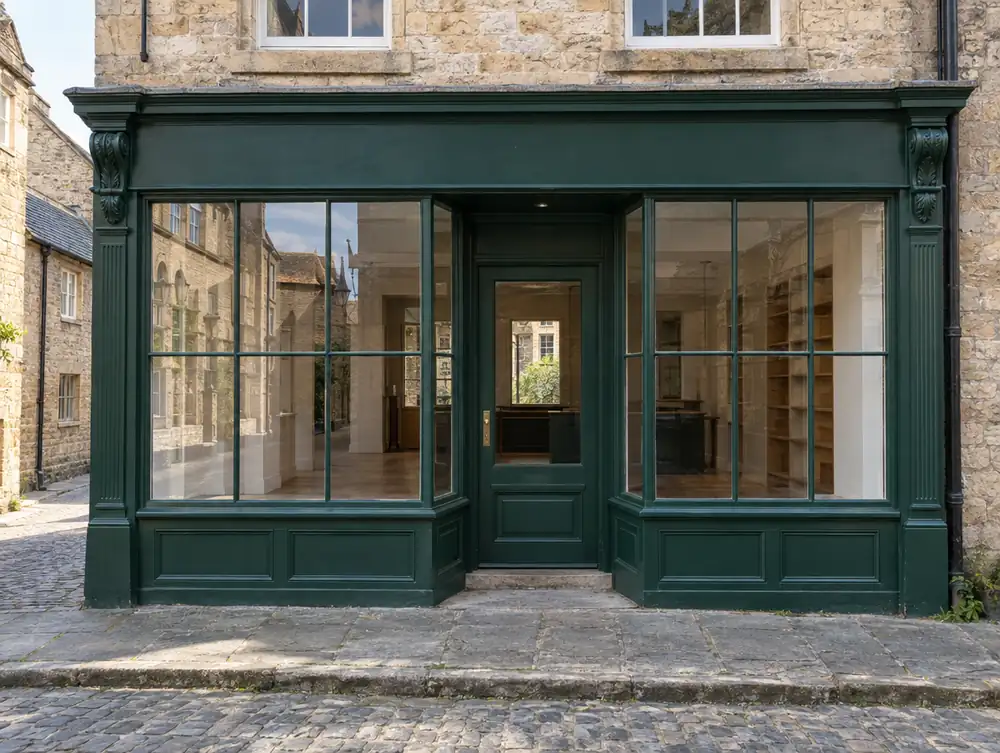
What should you think about before commissioning timber shopfronts in Deganwy?
Timber fits a night programme better than you'd think, since most of the joinery is made elsewhere. For a unit in Deganwy that can't close by day, we'd fit the frame in stages at night and leave painting until the end, once the dust has gone.
A corner plot gives a timber front two faces and one chance to get the turn right. For Deganwy premises on a corner, we'd use a pilaster or a canted bay at the angle, so the cornice wraps round without a clumsy mitre.
If the pavement falls across your frontage, let the stallriser take up the slope and keep the glass line dead level. The eye reads the long horizontal, so Deganwy premises on a slope look settled once that line is true.
What is a realistic budget for timber shopfronts in Deganwy?
Our guide band is £3,995 to £13,995 plus VAT for a typical frontage. Scope is the biggest lever, so a tighter brief for timber shopfronts brings the figure down faster than any change of detail.
Who approves timber shopfronts in Deganwy?
The existing rules still apply in Wales, because most of the Planning (Wales) Act 2026 is waiting for a commencement order. For timber shopfronts at premises in the Deganwy area, building work that materially affects the external appearance needs planning permission, while a true like-for-like replacement usually doesn't. The council confirms the current position.
Deganwy applications for planning permission or advertisement consent are normally handled by Conwy County Borough Council. Our survey includes a check of the position for your address.
| Town | Deganwy |
|---|---|
| Area | Clwyd |
| Postcode districts | LL31 |
| Planning authority | Conwy County Borough Council |
| Building approval | Building Regulations (Approved Documents for Wales) |
| Distance from Great Barr | About 95 miles |
| Survey | Free for new work |
Does Conwy County Borough Council publish shopfront guidance?
Yes, LDP36: Shop front design (2017). It tells applicants what the council expects from new and altered shopfronts. A few of the things it asks for:
- Stallriser height should not normally exceed 20% of the overall shopfront height.
- Fascia depth is restricted to the depth of the console, or one-fifth of the distance from cornice to pavement where there are no consoles.
- Illuminated box signs and vinyl or acrylic signs are not permitted in conservation areas or on historic buildings, with halo-lit or individually lit letters preferred.
Questions about timber shopfronts in Deganwy
Can you copy a timber shopfront I've seen in Clwyd?
We can work from your photo and borrow what makes it succeed, including proportions, moulding sizes and colour. The front is then drawn to your own Deganwy opening.
Will timber suffer on my Deganwy frontage if it gets a lot of rain?
Not if the details are right. Sloped cills, sealed end grain and plinth blocks keep water moving, and the paint system then only has to deal with the weather, not trapped damp.
Do you make the joinery for Deganwy shops to order?
Yes. Every length is made to the signed-off drawings for your opening, then brought to Deganwy from Great Barr by vetted teams working under S&K Glazing.
Can a shop fire exit in the Deganwy area use a sliding door?
No, a dedicated fire exit can't be a sliding or revolving door. In Wales, article 14(2) of the Regulatory Reform (Fire Safety) Order 2005 also says fire exit doors must open in the direction of escape and can't be locked against immediate use. The responsible person holds that duty, normally the employer or whoever controls the premises for a business, otherwise the owner.
What access duty applies to a shop in the Deganwy area?
The Equality Act 2010 applies, in Wales as across Great Britain, and it requires reasonable steps to remove, alter or avoid physical features that disadvantage disabled people. The duty is anticipatory, so it covers disabled people generally. A feature that meets a design standard is generally protected for 10 years.