A well-made timber front should still look good in Inverness long after the first coat of paint has gone. That comes from choosing a durable timber, sealing the end grain and keeping water away from the bottom of every member.
Measuring the opening is the easy part of a survey in Inverness. We also look at the beam above, the pavement fall and any meters or drains nearby.
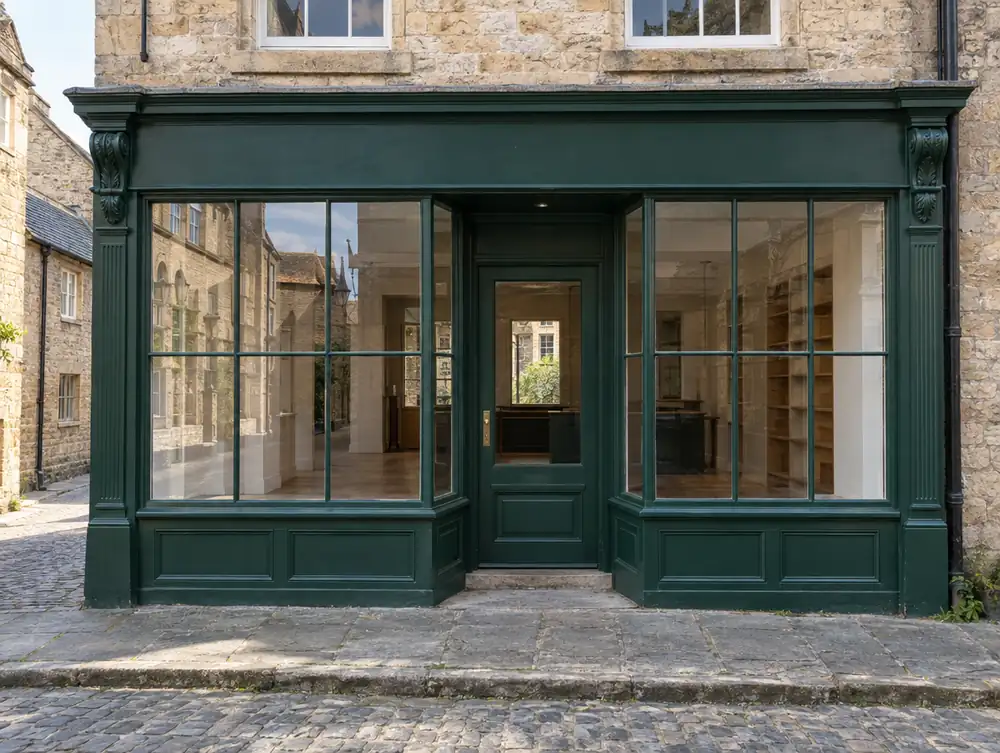
How would we approach timber shopfronts for your Inverness premises?
A brand rollout can include timber, as long as the details repeat. For a branch in Inverness we'd use the same mouldings, colours and sign panel as your other sites, adjusting only the widths and heights to fit the opening.
Where a landlord in Inverness has set rules for materials or colour, timber is usually an easy conversation. We'd prepare a drawing and paint reference for approval, and adjust the mouldings if the terms ask for something plainer.
Where the building has good brick or stone around the opening, set the frame back in the reveal so the masonry can be seen. On Inverness premises with a flat elevation, that deep reveal throws a shadow line that adds real depth in low sun.
What consents could affect timber shopfronts in Inverness?
Section 26 of the Town and Country Planning (Scotland) Act 1997 sets the test: work that doesn't materially affect the external appearance isn't development. For timber shopfronts at premises in the Inverness area, anything that does needs planning permission, and a true like-for-like replacement usually doesn't. The council confirms how that applies to each site.
Inverness applications for planning permission or advertisement consent are normally handled by The Highland Council. Our survey includes a check of the position for your address.
What should you budget for timber shopfronts in Inverness?
Until the survey is done, plan on £3,995 to £13,995 plus VAT for a typical frontage. Unusual sizes, fine detail and phased working push the figure up, while a simple brief and clear access keep it toward the lower end.
Do you cover Inverness?
We can take on work in Inverness, with the survey arranged directly with you once we understand the job. Travel and access appear as their own lines on the quotation, apart from the cost of the frontage.
| Town | Inverness |
|---|---|
| Area | Highlands and Moray |
| Postcode districts | IV1, IV3 |
| Planning authority | The Highland Council |
| Building approval | Building warrant (Technical Handbook) |
| Distance from Great Barr | About 353 miles |
| Survey | By arrangement |
Does The Highland Council publish shopfront guidance?
Yes, Shopfront Design Guide: Planning Guidance (2018). It tells applicants what the council expects from new and altered shopfronts. A few of the things it asks for:
- Stallrisers should be at least 400mm high, and glazing to ground level is generally not acceptable on traditional shopfronts.
- Fascias must not be internally lit or span more than one building, and lettering should fill no more than two-thirds of the fascia.
- Solid shutters are not supported, and external retractable shuttering is unlikely to be acceptable in conservation areas or on listed buildings.
Questions about timber shopfronts in Inverness
What should I budget for looking after a timber front in Inverness?
A repaint every 5 to 7 years, plus a yearly wash and touch-up of the cills. Door gear needs checking too, since seasonal movement can throw a door out of line.
Can a timber front take a modern sign in Inverness?
Yes. Hand-painted letters suit a timber fascia well, and raised letters or a concealed trough light work too. We draw the sign and the joinery together, so the fixings don't cut through a moulding.
Can you copy a timber shopfront I've seen in the Highlands and Moray?
We can work from your photo and borrow what makes it succeed, including proportions, moulding sizes and colour. The front is then drawn to your own Inverness opening.
Do I need planning permission to alter a shopfront in the Inverness area?
Usually yes, if the work materially affects the external appearance. Class 9A, Scotland's shop permitted development right, doesn't cover work that alters or extends beyond the existing front. A true like-for-like replacement usually needs no permission, and the council confirms the position.
Do roller shutters need planning permission in the Inverness area?
Usually yes, if they materially affect the external appearance. Class 9A doesn't name shutters, so in Scotland treat them as falling to the appearance test rather than assuming a permitted development route. Ask the council before ordering, as this is a reading of the rules and not an official statement.