Timber gives a shopfront in Kilburn something metal can't: real depth, cast shadows and mouldings you can run your hand along. We draw each front to the measured opening and make it to those signed-off dimensions.
It helps if you can be there when we visit Kilburn, since five minutes walking the frontage together answers more than a long email.
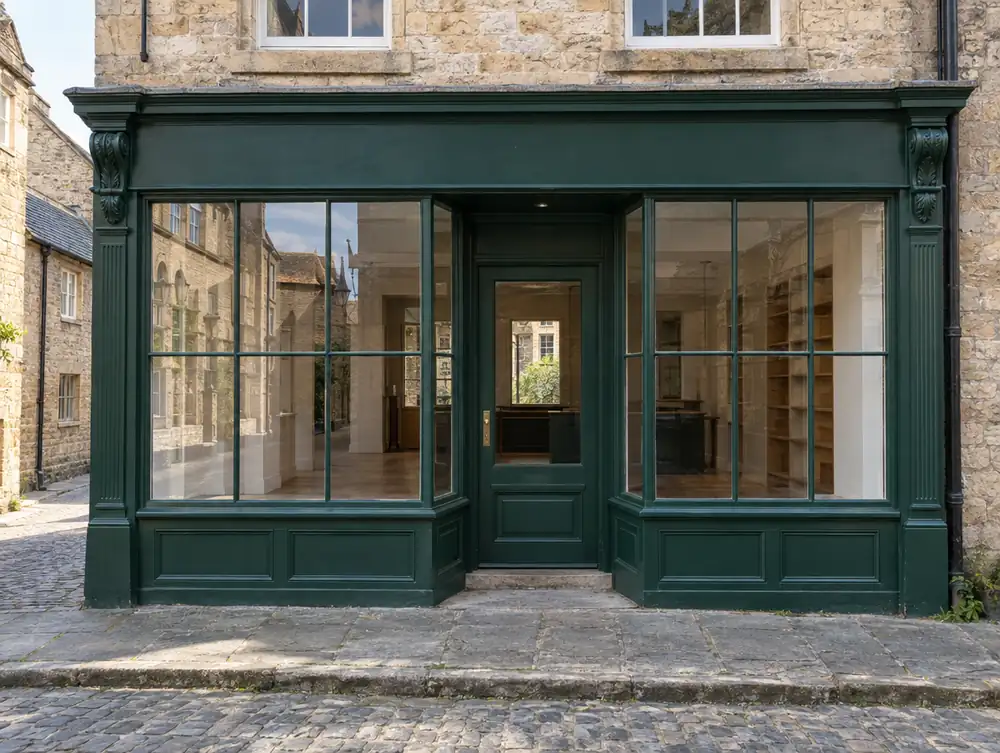
How would we approach timber shopfronts for your Kilburn premises?
A corner plot gives a timber front two faces and one chance to get the turn right. For Kilburn premises on a corner, we'd use a pilaster or a canted bay at the angle, so the cornice wraps round without a clumsy mitre.
In a parade of mixed fronts in Kilburn, painted timber can lift a unit without shouting. We'd take the height of the neighbouring cills and fascias, then let the depth of the mouldings and a considered colour do the talking.
Where a fascia has crept down over the years, lifting it back to its original line can add real height to the glass. Check what sits behind it first at Kilburn premises, since a shutter box or old beam may set the limit.
What should you budget for timber shopfronts in Kilburn?
We would budget £3,995 to £13,995 plus VAT for a typical frontage. Scope sets most of the figure, so a clear brief at the start does more for the budget than any later change of detail.
What consents could affect timber shopfronts in Kilburn?
For timber shopfronts at premises in the Kilburn area, the deciding question in England is whether the building work materially affects the external appearance. If it does, planning permission is needed, while a true like-for-like replacement usually needs none. The council confirms the position for each site.
Expect planning and advert applications here to go to London Borough of Camden in the normal way. We check what that means for your building when we survey it in Kilburn.
| Town | Kilburn |
|---|---|
| Area | Greater London |
| Postcode districts | NW2, NW3, NW6, NW8 |
| Planning authority | London Borough of Camden |
| Building approval | Building Regulations (Approved Documents) |
| Distance from Great Barr | About 100 miles |
| Survey | Free for new work |
Does London Borough of Camden publish shopfront guidance?
Yes, Camden Planning Guidance: Design (Chapter 6: Shopfronts) (2021). It tells applicants what the council expects from new and altered shopfronts. A few of the things it asks for:
- Existing stall risers should be kept, and new ones should be at least 300mm high or reach the top of the pilaster base or door panel.
- Solid shutters are only acceptable in exceptional circumstances, and internal security measures are strongly encouraged.
- Uncoated shutters, galvanised steel, milled finishes and anodised aluminium are not acceptable finishes.
Questions about timber shopfronts in Kilburn
What should I budget for looking after a timber front in Kilburn?
A repaint every 5 to 7 years, plus a yearly wash and touch-up of the cills. Door gear needs checking too, since seasonal movement can throw a door out of line.
Do you make the joinery for Kilburn shops to order?
Yes. Every length is made to the signed-off drawings for your opening, then brought to Kilburn from Great Barr by vetted teams working under S&K Glazing.
How much disruption will a timber front cause in my Kilburn shop?
Expect more time on site than an aluminium front, typically 3 to 7 days with the painting. Closed-day or out-of-hours fitting can be arranged, and the opening stays boarded and secure between stages.
Do I need listed building consent for a shopfront in the Kilburn area?
Usually yes, if the building is listed. In England the local planning authority decides, and Historic England is notified of Grade I and II* works and specified Grade II works. Like-for-like repair may not need consent, so ask the council before work starts.
Does the Equality Act apply to a shop entrance in the Kilburn area?
Yes. The Equality Act 2010 applies in England, as across Great Britain, and it requires reasonable steps to remove, alter or avoid physical features that disadvantage disabled people. The duty is anticipatory, so it looks at disabled people generally, and a new Services Code replaced the 2011 Code on 5 August 2026.