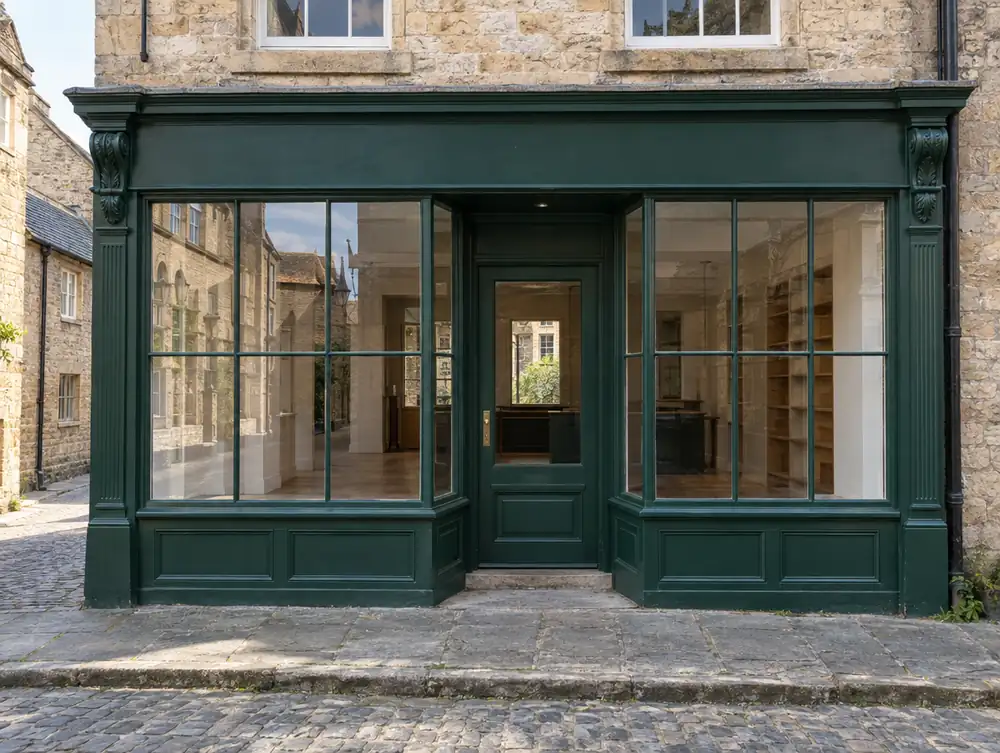
Timber gives a shopfront in Teddington something metal can't: real depth, cast shadows and mouldings you can run your hand along. We draw each front to the measured opening and make it to those signed-off dimensions.
Please have keys to any meter cupboards and shutter housings to hand when we survey in Teddington, because what sits behind them can change the drawing.
What should you think about before commissioning timber shopfronts in Teddington?
Timber fits a night programme better than you'd think, since most of the joinery is made elsewhere. For a unit in Teddington that can't close by day, we'd fit the frame in stages at night and leave painting until the end, once the dust has gone.
In a parade of mixed fronts in Teddington, painted timber can lift a unit without shouting. We'd take the height of the neighbouring cills and fascias, then let the depth of the mouldings and a considered colour do the talking.
If the pavement falls across your frontage, let the stallriser take up the slope and keep the glass line dead level. The eye reads the long horizontal, so Teddington premises on a slope look settled once that line is true.
Who approves timber shopfronts in Teddington?
For timber shopfronts at premises in the Teddington area, the deciding question in England is whether the building work materially affects the external appearance. If it does, planning permission is needed, while a true like-for-like replacement usually needs none. The council confirms the position for each site.
Planning and advert applications for Teddington premises normally go to London Borough of Richmond upon Thames. We check the position for your address at survey.
What is a realistic budget for timber shopfronts in Teddington?
A sensible starting budget is £3,995 to £13,995 plus VAT for a typical frontage. What shifts the figure is whatever can't be seen yet, such as the condition behind the old frontage or the services running through it.
| Town | Teddington |
|---|---|
| Area | Greater London |
| Postcode districts | KT1, TW11, TW12, TW2 |
| Planning authority | London Borough of Richmond upon Thames |
| Building approval | Building Regulations (Approved Documents) |
| Distance from Great Barr | About 103 miles |
| Survey | Free for new work |
Does London Borough of Richmond upon Thames publish shopfront guidance?
Yes, Shopfronts: Supplementary Planning Document (2010). It tells applicants what the council expects from new and altered shopfronts. A few of the things it asks for:
- The fascia should be no deeper than the cornice and architrave combined, and no more than one-fifth of total shopfront height.
- External roller shutters are unlikely to be permitted, and internal grilles are the only acceptable security form in conservation areas and on listed buildings.
- Internally lit box fascia signs will usually be resisted, with externally lit fascias generally preferred.
Questions about timber shopfronts in Teddington
Will timber suffer on my Teddington frontage if it gets a lot of rain?
Not if the details are right. Sloped cills, sealed end grain and plinth blocks keep water moving, and the paint system then only has to deal with the weather, not trapped damp.
Do you make the joinery for Teddington shops to order?
Yes. Every length is made to the signed-off drawings for your opening, then brought to Teddington from Great Barr by vetted teams working under S&K Glazing.
How much disruption will a timber front cause in my Teddington shop?
Expect more time on site than an aluminium front, typically 3 to 7 days with the painting. Closed-day or out-of-hours fitting can be arranged, and the opening stays boarded and secure between stages.
Does a new shopfront in the Teddington area need Building Regulations approval?
Assume yes until building control says otherwise. England has no like-for-like exemption, though registered installers can self-certify replacement windows and doors in non-dwellings. That route doesn't cover structural glass, curtain walling or revolving doors.
Does the Equality Act apply to a shop entrance in the Teddington area?
Yes. The Equality Act 2010 applies in England, as across Great Britain, and it requires reasonable steps to remove, alter or avoid physical features that disadvantage disabled people. The duty is anticipatory, so it looks at disabled people generally, and a new Services Code replaced the 2011 Code on 5 August 2026.