We make timber shopfronts for Wishaw premises, from plain painted frames to full cornice and console fronts. Every one starts with a measured survey and scale drawings.
Measuring the opening is the easy part of a survey in Wishaw. We also look at the beam above, the pavement fall and any meters or drains nearby.
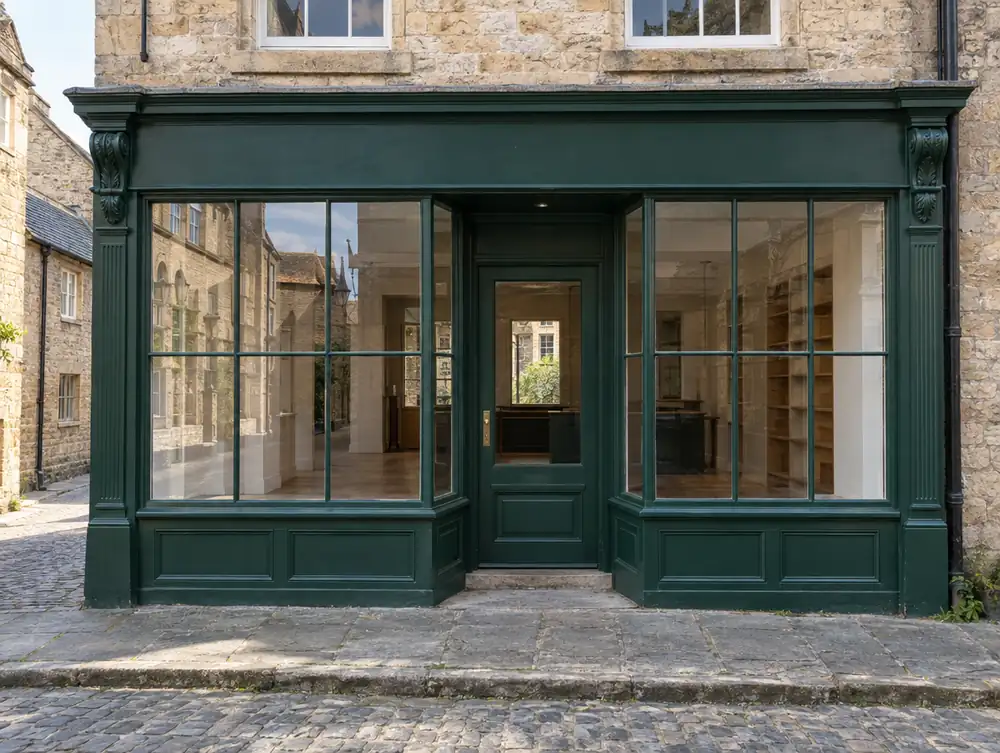
What should you think about before commissioning timber shopfronts in Wishaw?
Where a landlord in Wishaw has set rules for materials or colour, timber is usually an easy conversation. We'd prepare a drawing and paint reference for approval, and adjust the mouldings if the terms ask for something plainer.
In a parade of mixed fronts in Wishaw, painted timber can lift a unit without shouting. We'd take the height of the neighbouring cills and fascias, then let the depth of the mouldings and a considered colour do the talking.
A corner unit has two fronts to think about, and the return elevation often does as much selling as the main one. If that is your layout in Wishaw, carry the fascia and glass line round the corner and treat both faces as one composition.
Who approves timber shopfronts in Wishaw?
Scottish guidance says like-for-like windows need no permission, and a true like-for-like frontage replacement usually follows the same logic. Class 7A covers altering or replacing an existing window, but it doesn't mention shopfronts, so ask before relying on it for a display window. For timber shopfronts at premises in the Wishaw area, a material effect on the external appearance means planning permission, and the council confirms the position.
We confirm the position at survey, because a boundary or a special designation can change who handles the file, but applications from Wishaw premises normally go to North Lanarkshire Council.
What is a realistic budget for timber shopfronts in Wishaw?
Until the survey is done, plan on £3,995 to £13,995 plus VAT for a typical frontage. Unusual sizes, fine detail and phased working push the figure up, while a simple brief and clear access keep it toward the lower end.
| Town | Wishaw |
|---|---|
| Area | Lanarkshire |
| Postcode districts | ML2 |
| Planning authority | North Lanarkshire Council |
| Building approval | Building warrant (Technical Handbook) |
| Distance from Great Barr | About 237 miles |
| Survey | Free for new work |
Does North Lanarkshire Council publish shopfront guidance?
Yes, Shopfronts & Security (2011). It tells applicants what the council expects from new and altered shopfronts. A few of the things it asks for:
- Original stallrisers should be retained or reinstated, and new ones should be 450mm to 700mm high.
- Fascias should be horizontally proportioned and roughly 300mm to 450mm high.
- Demountable grilles are preferred, and externally stored roller shutters carry a high risk of refusal.
Questions about timber shopfronts in Wishaw
How much disruption will a timber front cause in my Wishaw shop?
Expect more time on site than an aluminium front, typically 3 to 7 days with the painting. Closed-day or out-of-hours fitting can be arranged, and the opening stays boarded and secure between stages.
Can a timber front take a modern sign in Wishaw?
Yes. Hand-painted letters suit a timber fascia well, and raised letters or a concealed trough light work too. We draw the sign and the joinery together, so the fixings don't cut through a moulding.
Will timber suffer on my Wishaw frontage if it gets a lot of rain?
Not if the details are right. Sloped cills, sealed end grain and plinth blocks keep water moving, and the paint system then only has to deal with the weather, not trapped damp.
Does a shop sign in the Wishaw area need advertisement consent?
Not always. Scotland's 1984 Regulations let an unlit sign within Class IV(1) go up without an application, and Class VI does the same for a lit sign with each character lit from within. Class VI isn't available in conservation areas, and one council says lit signs always need express consent, so ask first.
Do I need listed building consent for a shopfront in the Wishaw area?
Almost certainly, if the building is listed and windows or doors are changing, according to Historic Environment Scotland. The planning authority decides, and Historic Environment Scotland is consulted on some applications. Scottish Ministers are notified if it objects.