We travel from Great Barr to design and fit frameless glass shopfronts for Bethnal Green premises. One named contact runs the job from first measure to final clean.
Please have keys to any meter cupboards and shutter housings to hand when we survey in Bethnal Green, because what sits behind them can change the drawing.
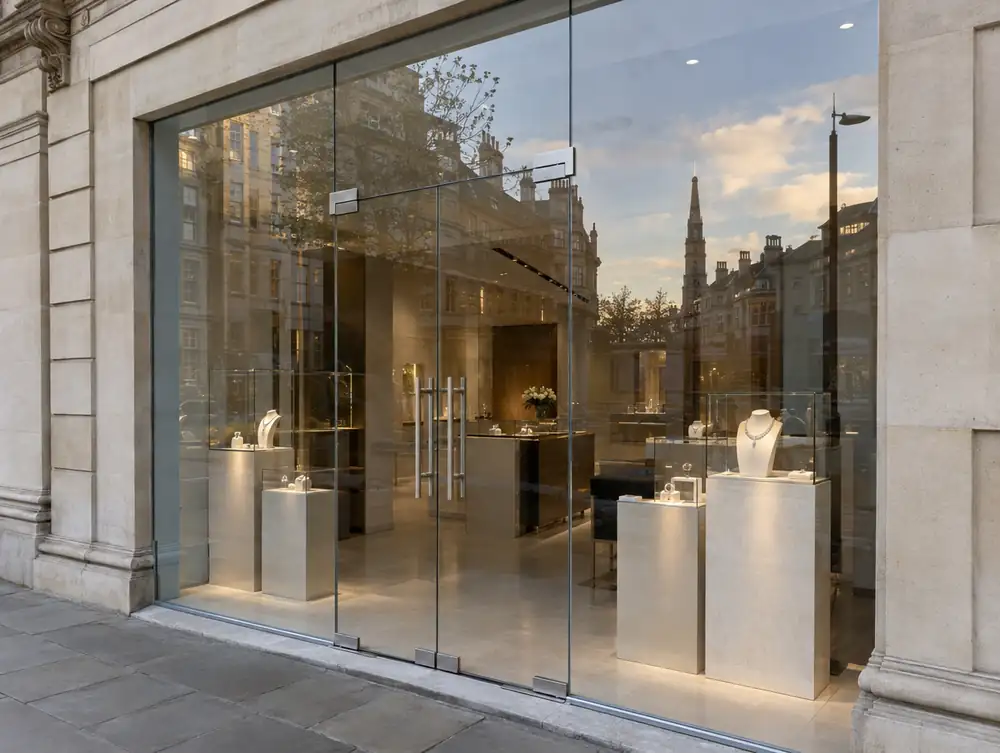
What goes into getting frameless glass shopfronts right in Bethnal Green?
A corner unit is where frameless glass earns its price, because a glass-to-glass corner dissolves the edge of the building. For a corner plot in Bethnal Green we'd check the structure above the missing pier first, then mitre the glass so the joint stays as fine as the panes allow.
Between two framed neighbours in a parade in Bethnal Green, a frameless front can look brilliant or bare. We'd hold the neighbouring fascia line and keep a slim plinth at their stallriser height, so the glass feels deliberate and the row still reads as a row.
If your Bethnal Green unit sits in a Victorian parade, the old pilasters usually set the rhythm, so a new front should land on them and not run past them. Keep that line and even a modern frame looks as though it belongs.
Which applications might frameless glass shopfronts in Bethnal Green involve?
For frameless glass shopfronts at premises in the Bethnal Green area, the deciding question in England is whether the building work materially affects the external appearance. If it does, planning permission is needed, while a true like-for-like replacement usually needs none. The council confirms the position for each site.
For Bethnal Green, the usual route for planning and advert applications is through London Borough of Tower Hamlets, and we confirm that when we visit.
How much could frameless glass shopfronts in Bethnal Green cost you?
As a working budget, use £4,995 to £15,995 plus VAT for a typical frontage. Your place inside that range for frameless glass shopfronts depends mostly on how much of the existing frontage can stay and how much has to be put right first.
| Town | Bethnal Green |
|---|---|
| Area | Greater London |
| Postcode districts | E1, E2, E8, EC2A |
| Planning authority | London Borough of Tower Hamlets |
| Building approval | Building Regulations (Approved Documents) |
| Distance from Great Barr | About 106 miles |
| Survey | Free for new work |
Does London Borough of Tower Hamlets publish shopfront guidance?
Yes, Shopfronts and Roller Shutter Grilles. It tells applicants what the council expects from new and altered shopfronts. A few of the things it asks for:
- Stallrisers are always required on traditional shopfronts.
- Fascias should normally be no more than 500mm deep and no higher than ground floor level.
- External roller shutter boxes will not be permitted, and shutters should wherever possible be an integral feature of the shopfront.
Questions about frameless glass shopfronts in Bethnal Green
Will a frameless front suit my Bethnal Green premises?
It depends on the structure overhead and the floor at the threshold. A survey tells us whether the head is stiff enough and whether a channel can be cut, and if not, we'd suggest slim framing at the edges instead.
How much cleaning will a glass front in Bethnal Green need?
More than a framed front, because glass shows every mark. A regular window cleaner using soft tools can handle it, and a yearly look at the silicone keeps the joints tidy.
Who fits frameless glass in Bethnal Green?
Glazing crews vetted by us and working under S&K Glazing handle the panes. They travel to Bethnal Green from Great Barr, and you keep one named contact throughout.
Do I need listed building consent for a shopfront in the Bethnal Green area?
Usually yes, if the building is listed. In England the local planning authority decides, and Historic England is notified of Grade I and II* works and specified Grade II works. Like-for-like repair may not need consent, so ask the council before work starts.
Does the Equality Act apply to a shop entrance in the Bethnal Green area?
Yes. The Equality Act 2010 applies in England, as across Great Britain, and it requires reasonable steps to remove, alter or avoid physical features that disadvantage disabled people. The duty is anticipatory, so it looks at disabled people generally, and a new Services Code replaced the 2011 Code on 5 August 2026.