Clear, open and lit from within, a frameless front can change how a shop reads after dark. We plan the glass and the lighting together for Parkstone premises, so the effect holds from the pavement as well as the shop floor.
Surveys for Parkstone are booked with you directly. Tell us your quieter days and we'll work around them.
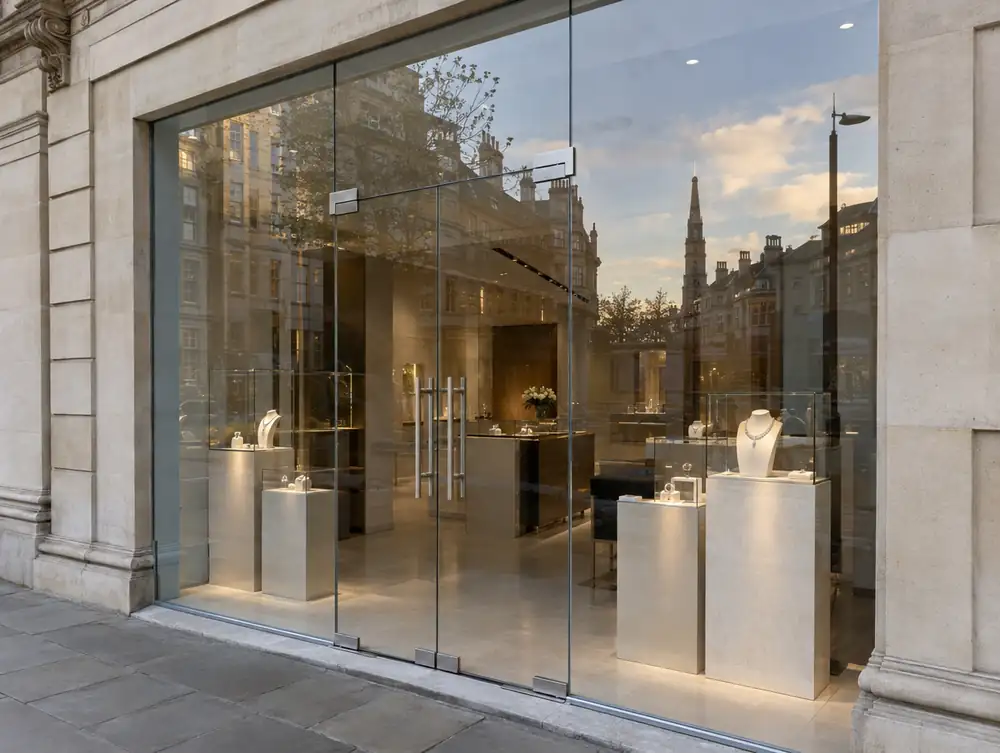
What makes frameless glass shopfronts work well on Parkstone premises?
A corner unit is where frameless glass earns its price, because a glass-to-glass corner dissolves the edge of the building. For a corner plot in Parkstone we'd check the structure above the missing pier first, then mitre the glass so the joint stays as fine as the panes allow.
If your Parkstone landlord wants the front reinstated at lease end, frameless glass needs thought now. We'd record the existing front in the drawings and keep the channels simple, so returning the opening later stays a straightforward job.
If your premises were once two shops, decide early whether the front should read as one or as two. One continuous fascia with a repeated bay width usually settles the elevation better than two mismatched halves, which is worth testing on any Parkstone unit of that kind.
How much should you set aside for frameless glass shopfronts in Parkstone?
Guide price: £4,995 to £15,995 plus VAT for a typical frontage. Materials, finish and the amount of drawing and coordination involved all move it, and your itemised quotation shows where the money goes on frameless glass shopfronts.
Could frameless glass shopfronts in Parkstone need planning permission?
Security grilles and shutters are named in England's rules: installing or replacing one on a shopfront sits outside the shop permitted development rights. The frontage itself is treated the same way, so for frameless glass shopfronts at premises in the Parkstone area, building work that materially affects the appearance needs planning permission. Confirm the position with the council before anything is ordered.
Parkstone applications for planning permission or advertisement consent are normally handled by Bournemouth, Christchurch and Poole Council. Our survey includes a check of the position for your address.
| Town | Parkstone |
|---|---|
| Area | Dorset |
| Postcode districts | BH12, BH14, BH15, BH17 |
| Planning authority | Bournemouth, Christchurch and Poole Council |
| Building approval | Building Regulations (Approved Documents) |
| Distance from Great Barr | About 126 miles |
| Survey | Free for new work |
Questions about frameless glass shopfronts in Parkstone
Will a frameless front suit my Parkstone premises?
It depends on the structure overhead and the floor at the threshold. A survey tells us whether the head is stiff enough and whether a channel can be cut, and if not, we'd suggest slim framing at the edges instead.
Who fits frameless glass in Parkstone?
Glazing crews vetted by us and working under S&K Glazing handle the panes. They travel to Parkstone from Great Barr, and you keep one named contact throughout.
Can frameless glass go above a cellar in Parkstone?
Often, yes, with some redesign. A cellar or thin slab can rule out a recessed channel, so we'd clamp the glass to a strengthened threshold or add a low plinth to hold it.
What rules apply to a fire exit door through a shopfront in the Parkstone area?
It must open in the direction of escape and can't be locked against immediate use, and a dedicated fire exit can't be a sliding or revolving door. In England that comes from article 14(2) of the Regulatory Reform (Fire Safety) Order 2005, and the duty sits with the responsible person, normally the employer or whoever controls the premises for a business, otherwise the owner. An outward door can clash with section 153 of the Highways Act 1980 where it opens onto the footway, so raise it early.
Do I need planning permission to change a shopfront in the Parkstone area?
Usually yes, if the work materially affects the building's external appearance. England's shop permitted development rights exclude creating, altering or replacing a shopfront, so there is no shortcut. A true like-for-like replacement usually needs no application, and the council confirms the position.