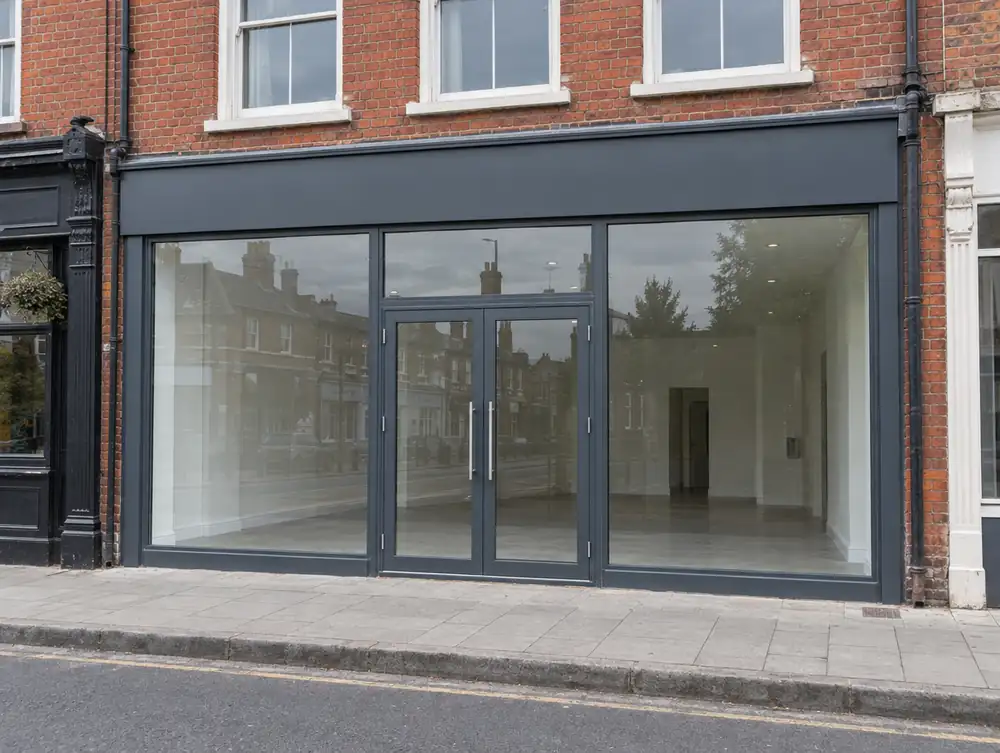
A new aluminium shopfront costs £2,495 to £11,995 plus VAT for a typical 3 to 7 m frontage, frameless glass £4,995 to £15,995 plus VAT for a typical frontage, and heritage joinery £8,495 to £24,995 plus VAT for a typical frontage. The final figure depends on the size of the opening, the glass, the door and what the survey finds behind the old fascia.
What does each type of shopfront cost?
Prices start from £2,495 plus VAT and climb to the top of the heritage band, with most premium frontages landing somewhere between the two. Every figure here is a guide price before VAT, and the table gives the full band for each type.
Treat a band as a budget and never as a quotation. The low end describes a simple opening with easy access, standard glass and one manual door. At the high end you are looking at a wider frontage with laminated glass, a better door set, a designed stallriser and work fitted around trading.
Figures published across the trade cluster at the budget end, and they are hard to compare. Some include VAT, some leave it out, and a few automatic door prices may exclude the glazed screen around the door. Before you set any number beside ours, ask what it covers.
| Frontage type | Guide price | Where the money goes |
|---|---|---|
| Aluminium | £2,495 to £11,995 plus VAT for a typical 3 to 7 m frontage | Section depth, coating colour, glass make-up |
| Frameless glass | £4,995 to £15,995 plus VAT for a typical frontage | Pane size, head and floor channels, door gear |
| Timber | £3,995 to £13,995 plus VAT for a typical frontage | Joinery detail, timber species, paint system |
| Bi-folding | £5,195 to £13,995 plus VAT for a typical opening | Panel count, track, weather seals |
| Heritage | £8,495 to £24,995 plus VAT for a typical frontage | Run mouldings, repair of original fabric |
| Bronze and metal | £7,995 to £24,995 plus VAT for a typical frontage | Metal, finish, protection on site |
| Curved glass | £6,995 to £19,995 plus VAT for a typical frontage | Templates, bending, careful handling |
What pushes a shopfront price up or down?
Glass size and door type move the price more than anything else. A frontage is paid for in lifting as much as in material, because 10mm glass weighs about 25kg per m². One 12mm pane at 3m by 2.5m comes in at around 225kg, which means vacuum lifters, a larger crew and often a glazing robot, where two smaller panes and a mullion could go in by hand.
That is the honest trade-off in design. Slimmer sightlines and bigger sheets look better from across the road, and they cost more to make, deliver and fit. A mullion on the right line is sometimes worth keeping, since it can pick up the windows above and take real money off the glass.
Fixing background matters more than most buyers expect. Bolting into sound steel is quick, while fixing into soft brick piers or a tired timber beam means extra steelwork, resin anchors and time. Hours count too: a job split across several nights costs more than one continuous run on site.
- Width and height of the opening, and how many panes it divides into
- Glass type: toughened, laminated, double-glazed or a combination
- Door: manual, frameless, powered or altered for access
- Stallriser: paint, tile, stone or metal cladding
- Access: loading, scaffold, hoarding, lifting gear
- Hours: normal working, closed-day or overnight
What hidden costs does a survey usually find?
The usual surprise sits behind the old fascia: a corroded steel, a rotten timber bressummer or a beam lower than anyone expected. Older frontages were often re-clad and never stripped back, so two or three generations of shopfront can be layered behind what you see from the pavement.
A careful surveyor opens up what can be opened up and prices the rest as a stated allowance. Common finds include a dead shutter box in the fascia void, live cables run through it, alarm contacts nobody has mapped, a floor that falls towards the door, and a stallriser holding up more than it should.
None of that can be read from a photograph, which is why every price here comes from a measure-up. Ask how a quotation treats what can't be seen. A sensible one names the allowance and the rate that applies if more is found, so the conversation happens before the old frame comes out and not while your shop is boarded up.
How much do doors, signs and shutters add?
Doors, signs and shutters are priced per item on top of the frontage, and together they can match the frontage itself. A plain aluminium front with a powered door, a lit sign and a shutter is a very different budget from the same front with a manual door and painted letters.
Buying them under one contract pays off in coordination more than in price. The shutter box has to sit behind the fascia, the sign needs its cable drop before the fascia closes, and a powered door needs its supply and floor fixing before the threshold goes in. Bought separately, each trade tends to undo part of the last one.
Council fees sit outside all of these figures. They vary by nation and change most years, so our planning and advertisement guides list them with their dates.
| Item | Guide price |
|---|---|
| Automatic sliding door | £3,895 to £11,995 plus VAT per entrance |
| Frameless glass door | £1,495 to £4,495 plus VAT per door set |
| Fascia sign | £395 to £1,995 plus VAT per sign |
| Illuminated sign | £895 to £3,995 plus VAT per sign |
| Canopy or awning | £1,495 to £9,995 plus VAT per canopy or awning |
| Perforated roller shutter | £1,695 to £4,495 plus VAT per shutter |
| Design drawings | £495 to £2,495 plus VAT per frontage |
| Planning application | £395 to £1,295 plus VAT per application, plus the council's fee |
How do I read a shopfront quote?
Read it from the drawing outward: check that it names the opening size, the glass make-up and the finish, then look for what has been left out. A single lump sum tells you very little. Itemised lines let you remove something, question it or set it against another price with confidence.
Ours arrive itemised and stay valid for 90 days, and nothing is ordered until you accept. Scale drawings follow before anything is made, so the dimensions you sign off are the ones that get built.
- Measured dimensions, and who took them
- Make-up of each pane, with thickness and type
- Frame finish by colour reference and coating type
- Door gear, closer and lock by function
- Removal, disposal and making good
- Exclusions, such as electrician's work or council fees
Why does the same frontage cost more in central London?
Access is the main reason, because materials cost much the same everywhere. A narrow street with loading bans can mean a night delivery, parking suspensions, a smaller vehicle and extra labour carrying glass from further away. Where the pavement is tight, scaffold and hoarding licences add further time and paperwork.
The same logic applies to any tightly controlled pitch, wherever it happens to be. Late finishes push labour up, and a closed road can decide when the glass arrives. If you can shut for a day or two, the saving may be worth more than the lost trade, so weigh one against the other with real numbers before choosing.
Common questions
Do your guide prices include VAT?
No, every guide price on this site excludes VAT. It is added on the itemised quotation, so you can see net and gross figures side by side.
Can you give me a firm price from photographs?
No. Photographs help us say whether a budget is realistic, but a firm figure needs a measured survey, because openings are rarely square and the fixing background can't be judged from the street.
Does the survey cost anything?
The site survey is free for new shopfronts, entrances, signs and glazing. Repairs are different: they are charged call-outs at £165 plus VAT for attendance and the first hour.
How long does a quotation stay valid?
Our written quotations stay valid for 90 days. Nothing is ordered until you accept, so holding a quote while you wait for a lease or a consent costs you nothing.