A car showroom needs tall clear glass, a safe way to move vehicles in and out, and a frontage that reads from the road. The vehicle opening is the hard part, because it has to vanish into the glazing when it's shut.
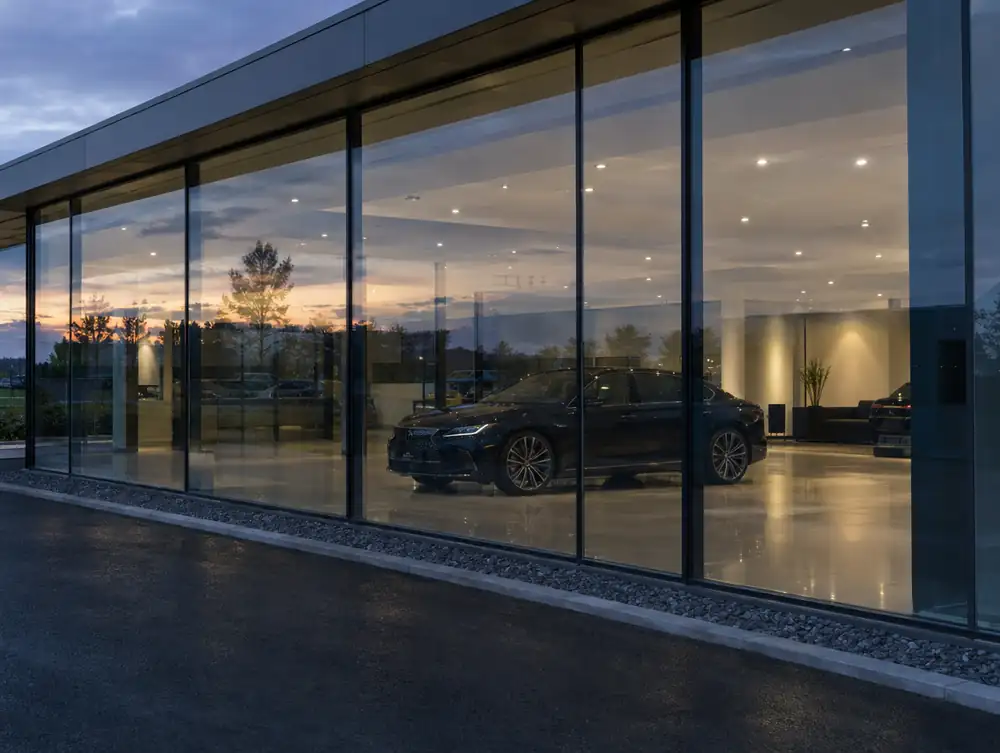
How do you get a car through a glass showroom front?
The usual answer is a wide glazed door in the glazing line, or a demountable panel where vehicles change only now and then.
Decide how often cars move before choosing. A showroom that swaps stock weekly needs a door one person can open in seconds, while a flagship display that changes twice a year can live with a panel.
- Sliding door: the cleanest look, but the leaf needs a clear run to park against
- Bi-folding door: a wider opening, with a visible stack of leaves
- Demountable panel: the slimmest line when shut, and a slow two-person job each time
Why does the threshold matter so much for cars?
Low front splitters catch on sudden changes of level, so the apron gradient needs drawing with the door. Bottom tracks have to carry wheel loads without flexing, and any channel set into the floor will hold grit.
Measure the opening with the mirrors out and room for someone walking alongside. A car clears a gap long before its driver feels comfortable.
Which standard applies to a vehicle door?
BS EN 13241 is the product standard for commercial doors and gates, so a door used mainly by vehicles will usually be looked at against it.
People need their own way in. BS EN 14351-1 covers external pedestrian doorsets, and BS EN 16005 covers power-operated ones, so keep a separate customer entrance beside the vehicle door. That second door is also the easier place to deliver the 15mm threshold limit used in guidance across all four UK nations.
How should mullions line up with the cars?
Mullions should fall between parking bays, so each car sits centred in clear glass from the road. Set the bays first and the frame second.
A stick system carries tall glass on slim sections, at £550 to £1,250 plus VAT per m². Structural glazing drops the outer cap for a flush look, at £950 to £1,850 plus VAT per m². Either way, the steel or slab above needs a structural check before the panes are sized.
Logos need a solid zone too. Tall glass leaves nothing to fix a built-up badge to, so settle the transom height and brand panel together.
How do you keep a glass showroom comfortable and safe?
Solar-control glass helps with heat, but view a sample first, because coatings shift the colour of paint seen through them.
Full-height glass is also low-level glass. Guidance in every UK nation asks for it to break safely, with markings at 850 to 1000mm and 1400 to 1600mm, and a discreet pattern can do that without spoiling the view. Cars move close to this glass, so an internal kerb or bollards are worth drawing in before the floor finish goes down.
Common questions
How big can a single pane be?
That depends on delivery and handling as much as the glass. We set the size at survey, after checking road access and lifting positions.
Do high-level showroom signs need consent?
Often, yes. Deemed consent stops at a top height of 4.6m in England, Wales and Scotland and 5m in Northern Ireland, or lower beside first-floor windows.
Can you work to a manufacturer's frontage standard?
Yes. Send it at the start, and we'll draw to it and flag anything this particular opening can't achieve.
Can a showroom stay open during the work?
Often, yes. Closed-day or out-of-hours installation can be arranged, and bays can usually be cleared in sequence.