A hotel or bar needs an entrance that feels like an arrival, holds the room's warmth and works as well at midnight as at noon. Doors here take heavy use, so the hardware matters as much as the look.
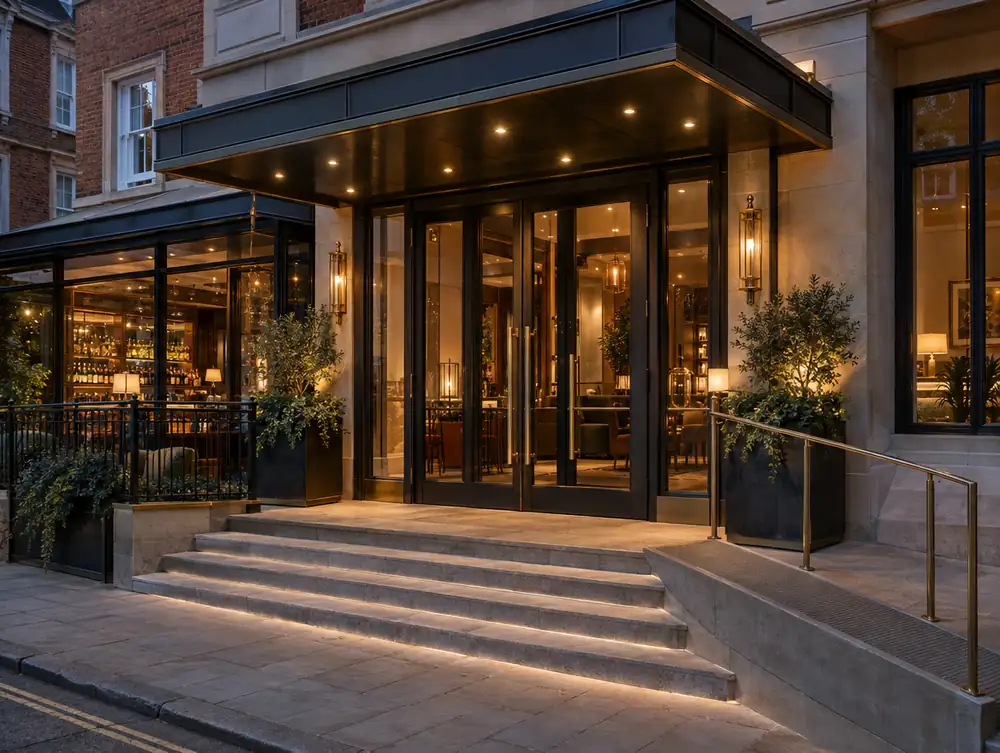
Does a hotel need a revolving door?
No, though it makes a strong draught barrier where a lobby opens straight onto the street. Guide prices are £19,995 to £59,995 plus VAT per door.
It can't stand alone. England's Approved Document M says revolving doors are not accessible, so an accessible door belongs beside it, and guests with luggage will prefer that door anyway. Dedicated fire exits can't be revolving doors in any UK nation, and Scotland's guidance asks for BS 7036 design and fail-safe conditions on escape.
How should a bar look after dark?
Low, warm and legible, with the back bar doing more work than the sign.
Once the street is darker than the room, the glass stops reflecting and the interior becomes the display. Put something worth seeing on the sightline from the pavement, and keep posters off that view. Halo-lit letters suit this trade, glowing without glare. England limits sign luminance to 600 cd/m² up to 10m² and 300 above, and a good evening sign usually sits well under that.
What door hardware stands up to a busy bar?
Floor springs usually cope better than surface-mounted closers, and they keep the door face clean.
Check the floor early. A floor spring needs a box set into the slab, so a thin screed over old services can rule it out. Where a surface closer is the only option, look for one tested to BS EN 1154, the standard for controlled door closing devices.
Hotels have a second concern, which is noise. A door slamming in a lobby at 2am carries upstairs, so ask for a closer with an adjustable latching speed.
Can a canopy project over the pavement?
Usually only with a licence, because a structure over the footway falls under highways law.
England and Wales use section 177 of the Highways Act 1980, and Northern Ireland uses Article 75 of its Roads Order. Each licence sets the headway. In Scotland, ask the council. Lit signs on the canopy bring their own limits, so draw both together and allow time for the licence in the programme. Rain matters too: a canopy should drain back to the building, away from guests stepping out of a taxi.
How do fire exits work through the frontage?
All four UK nations expect a dedicated exit to swing the way people escape, and to stay free of any lock that delays them.
The awkward part is the pavement. Section 153 of the Highways Act 1980 bars doors opening outward over a street in England and Wales, with public buildings by consent, and Northern Ireland needs Department consent. Escape doors can clash with that, so a recessed door is often the tidy answer. Check the plan with whoever holds the fire duty: the responsible person in England and Wales, or dutyholders in Scotland and Northern Ireland.
Common questions
Can a bar front open fully?
Yes, with a bi-folding front, subject to consent. Noise is the usual concern, so ask the council about conditions before committing.
What glass suits a busy bar?
Laminated glass, at least at low level. It stays in the frame if struck, and crowds lean on windows more than designers expect.
Can a hotel keep its old entrance doors?
Often, yes. Sound doors can be overhauled or automated, though works to a listed building may need consent first.
Do hotel frontages need CDM appointments?
Often. In Great Britain, a commercial client on a job with more than one contractor appoints a principal designer and principal contractor, and Northern Ireland has its own 2016 Regulations.