A pharmacy or clinic needs an entrance anyone can use unaided and glass that protects people's privacy. It also has to feel clean and calm, and be easy to find from along the street.
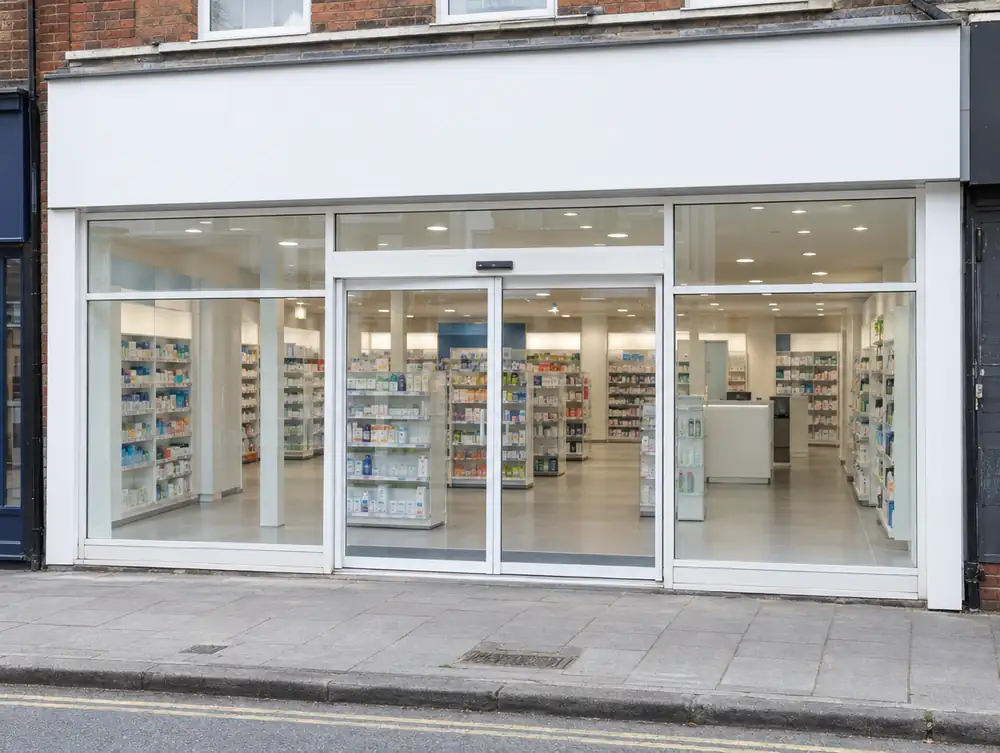
Does a pharmacy need an automatic door?
No rule names automatic doors, but they are often the simplest answer for a front used by older and disabled people. In Great Britain, the Equality Act 2010 asks for reasonable steps to remove, alter or avoid a physical feature, and the duty looks ahead to disabled people generally. The Disability Discrimination Act 1995 sets the duties in Northern Ireland.
A sliding leaf needs a wall or fixed glass to park against, which may cost you shelving. BS EN 16005 covers the door's safety in use, and England's Approved Document K says powered doors must not trap people and must open on power failure.
How do you keep a consulting room private on the frontage?
Move the room away from the glass if the plan allows. Where it has to sit on the front, use a solid or back-painted panel to above standing eye level, with clear glass over it for daylight.
Frosted film fails after dark: with the room lit, it throws a clear silhouette onto the street. Voices carry as well, so seal the frame and consider laminated glass, which dulls speech better than a single toughened pane. Blinds get left open, so don't rely on them.
What do you do with a window blocked by shelving?
Design for it, because most pharmacy windows end up with fixtures behind them and a raw shelf back on show.
- Full-height printed or back-painted panels, changed as campaigns change
- A shallow dressed shelf in front of the fixture, lit from above
- Clear glass kept around the door, so counter staff can see who is arriving
- Opening hours and services at a height people can read from a wheelchair
Can a pharmacy sign be lit?
Usually, within limits that differ by nation. England, Wales, Scotland and Northern Ireland each have a class for lit signs, with conditions such as a lowest point 2.5m up, and none of those classes is available in a conservation area.
Under the smaller Class 5, England and Wales allow illumination only for medical-type notices, while Northern Ireland allows none. Ask the council how that applies to a cross or hours panel before you order one.
How do you secure a pharmacy and keep it looking open?
Put the protection behind the glass. Laminated panes hold together after an attack, and a perforated shutter inside them leaves the shop looking cared for at night, when a lit window helps people find you.
Medicines make this a different risk from most retail, so talk to your insurer before the specification is fixed. A late-night hatch, if you run one, should be drawn into the screen as a lockable tray and never added as an afterthought.
Common questions
How much does an automatic entrance cost?
Guide prices are £3,895 to £11,995 plus VAT per entrance. The price moves with the glazed screen around it, the power supply and any change to the opening.
Can a clinic obscure its whole frontage?
It can, though a fully obscured front looks closed. A clear band above eye level, or a clear door into reception, keeps it approachable.
Is a ramp outside the shop allowed?
Ask the council first, because a ramp beyond your boundary is on land you don't control. Inside the shop line, a shallow slope is often the simpler route.
Can a consulting room be added later?
Yes, if the frontage allows for it. Ask for a solid panel option on the drawings, so one can be swapped in without touching the frame.