Colour is where an aluminium front in Lee earns its keep. We choose it against your actual brick, stone or render, then carry it through the frame, door, capping and fascia so the whole elevation reads as one.
Your survey is where the price gets real, because widths, heights, levels and access are all taken on site in Lee.
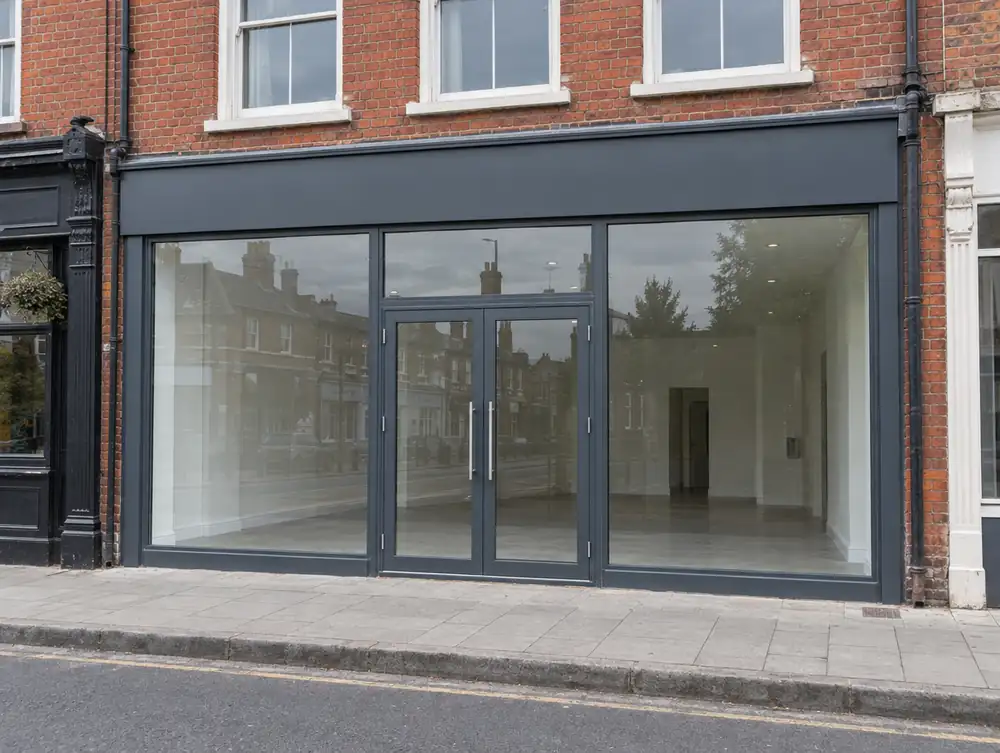
What should you think about before commissioning aluminium shopfronts in Lee?
If your unit sits in a parade in Lee, we'd start with the neighbours: the fascia line, cill height and pier rhythm of the row. Holding those lines lets a slimmer section stand out for the right reasons, rather than fighting everything beside it.
A narrow Lee unit gains from fewer parts. Under about 4m wide, we'd offset the door and use one large pane rather than a central door with two slivers of glass either side, which makes the front feel wider than it measures.
If the pavement falls across your frontage, let the stallriser take up the slope and keep the glass line dead level. The eye reads the long horizontal, so Lee premises on a slope look settled once that line is true.
What is a realistic budget for aluminium shopfronts in Lee?
Until the survey is done, plan on £2,495 to £11,995 plus VAT for a typical 3 to 7 m frontage. Unusual sizes, fine detail and phased working push the figure up, while a simple brief and clear access keep it toward the lower end.
Who approves aluminium shopfronts in Lee?
A true like-for-like replacement usually needs no planning permission in England, because the external appearance isn't materially affected. New materials, a different glass line or altered proportions usually do count as material, so for aluminium shopfronts at premises in the Lee area, an application is then likely. The council confirms which side of that line a job falls on.
At survey we check how things stand for your building, although applications for planning permission or advertisement consent here normally go to London Borough of Lewisham.
| Town | Lee |
|---|---|
| Area | Greater London |
| Postcode districts | SE12, SE13, SE3, SE6 |
| Planning authority | London Borough of Lewisham |
| Building approval | Building Regulations (Approved Documents) |
| Distance from Great Barr | About 111 miles |
| Survey | Free for new work |
Does Lewisham Council publish shopfront guidance?
Yes, Shopfront design guide, a supplementary planning document (2006). It tells applicants what the council expects from new and altered shopfronts. A few of the things it asks for:
- Fascias should generally be about 600mm high, never more than 900mm, and should not run unbroken across separate buildings.
- Solid external roller shutters are not acceptable, and open mesh or grille shutters should be powder coated with the box hidden behind the fascia.
- Internally lit fascia boxes are not allowed in conservation areas, with external lighting preferred.
Questions about aluminium shopfronts in Lee
Who carries out the work in Lee?
Vetted teams working under S&K Glazing carry it out, with one named contact from survey to handover. The contract is with S&K Glazing Limited, and we travel to Lee from Great Barr.
What happens to my old shopfront in Lee?
We strip it out and take it away, and that work appears as its own line on the quotation. If part of the old front is worth keeping, such as a stallriser or decorative ironwork, say so at survey and we'll draw around it.
Can I keep trading while my Lee shopfront is replaced?
Often, yes. The front can usually be replaced a section at a time, with temporary screens keeping the shop secure, and a closed-day or out-of-hours fit can be arranged if that suits you better.
Does a new shopfront in the Lee area need Building Regulations approval?
Assume yes until building control says otherwise. England has no like-for-like exemption, though registered installers can self-certify replacement windows and doors in non-dwellings. That route doesn't cover structural glass, curtain walling or revolving doors.
Does the Equality Act apply to a shop entrance in the Lee area?
Yes. The Equality Act 2010 applies in England, as across Great Britain, and it requires reasonable steps to remove, alter or avoid physical features that disadvantage disabled people. The duty is anticipatory, so it looks at disabled people generally, and a new Services Code replaced the 2011 Code on 5 August 2026.