We make timber shopfronts for Lee premises, from plain painted frames to full cornice and console fronts. Every one starts with a measured survey and scale drawings.
A survey in Lee usually starts outside, looking at the whole elevation before any tape comes out, because the frontage has to answer the building above it.
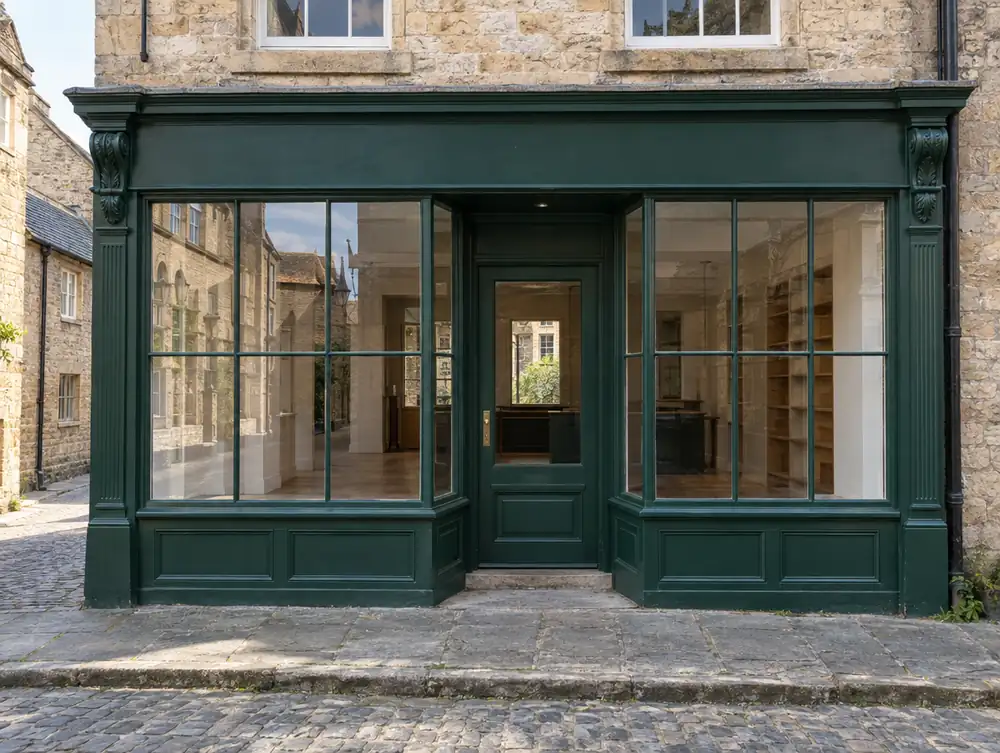
What goes into getting timber shopfronts right in Lee?
A corner plot gives a timber front two faces and one chance to get the turn right. For Lee premises on a corner, we'd use a pilaster or a canted bay at the angle, so the cornice wraps round without a clumsy mitre.
Timber fits a night programme better than you'd think, since most of the joinery is made elsewhere. For a unit in Lee that can't close by day, we'd fit the frame in stages at night and leave painting until the end, once the dust has gone.
If there are storeys above the shop, the frontage should feel like the base of the building and not a sign stuck on it. Lining up mullions with the windows overhead is a small move that settles the whole elevation at Lee premises.
How much could timber shopfronts in Lee cost you?
A sensible starting budget is £3,995 to £13,995 plus VAT for a typical frontage. What shifts the figure is whatever can't be seen yet, such as the condition behind the old frontage or the services running through it.
Which applications might timber shopfronts in Lee involve?
A true like-for-like replacement usually needs no planning permission in England, because the external appearance isn't materially affected. New materials, a different glass line or altered proportions usually do count as material, so for timber shopfronts at premises in the Lee area, an application is then likely. The council confirms which side of that line a job falls on.
For Lee, the usual route for planning and advert applications is through London Borough of Lewisham, and we confirm that when we visit.
| Town | Lee |
|---|---|
| Area | Greater London |
| Postcode districts | SE12, SE13, SE3, SE6 |
| Planning authority | London Borough of Lewisham |
| Building approval | Building Regulations (Approved Documents) |
| Distance from Great Barr | About 111 miles |
| Survey | Free for new work |
Does Lewisham Council publish shopfront guidance?
Yes, Shopfront design guide, a supplementary planning document (2006). It tells applicants what the council expects from new and altered shopfronts. A few of the things it asks for:
- Fascias should generally be about 600mm high, never more than 900mm, and should not run unbroken across separate buildings.
- Solid external roller shutters are not acceptable, and open mesh or grille shutters should be powder coated with the box hidden behind the fascia.
- Internally lit fascia boxes are not allowed in conservation areas, with external lighting preferred.
Questions about timber shopfronts in Lee
What should I budget for looking after a timber front in Lee?
A repaint every 5 to 7 years, plus a yearly wash and touch-up of the cills. Door gear needs checking too, since seasonal movement can throw a door out of line.
Can you fit a timber front around existing tiles in Lee?
Often, yes, and it's usually worth trying. If your stallriser or entrance has good original tile, we'd measure it carefully and scribe the new joinery to it.
How much disruption will a timber front cause in my Lee shop?
Expect more time on site than an aluminium front, typically 3 to 7 days with the painting. Closed-day or out-of-hours fitting can be arranged, and the opening stays boarded and secure between stages.
Does the Equality Act apply to a shop entrance in the Lee area?
Yes. The Equality Act 2010 applies in England, as across Great Britain, and it requires reasonable steps to remove, alter or avoid physical features that disadvantage disabled people. The duty is anticipatory, so it looks at disabled people generally, and a new Services Code replaced the 2011 Code on 5 August 2026.
What rules apply to a fire exit door through a shopfront in the Lee area?
It must open in the direction of escape and can't be locked against immediate use, and a dedicated fire exit can't be a sliding or revolving door. In England that comes from article 14(2) of the Regulatory Reform (Fire Safety) Order 2005, and the duty sits with the responsible person, normally the employer or whoever controls the premises for a business, otherwise the owner. An outward door can clash with section 153 of the Highways Act 1980 where it opens onto the footway, so raise it early.