A pharmacy, a showroom and a food shop each ask something different of a door. For Hampstead premises, we size the opening and set the sensors around how your customers arrive.
Bring whatever you have to the survey in Hampstead: brand guidelines, lease plans, old drawings or a photo of a frontage you admire.
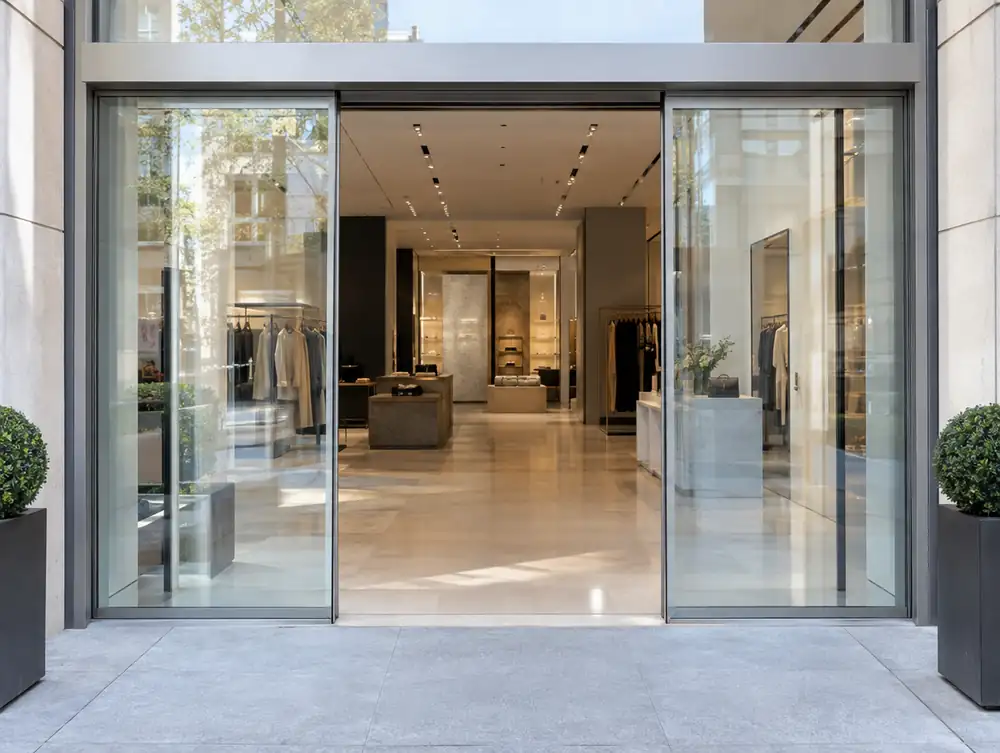
What goes into getting automatic sliding doors right in Hampstead?
If your Hampstead entrance catches low sun, infrared sensors can misread the light on the floor. We'd favour radar with a presence sensor set for those conditions, and consider solar control glass in the leaves.
Where a landlord in Hampstead wants the frontage kept looking the same, a slim slider can sit behind the existing line. We'd draw the operator inside the fascia and give the landlord a clear elevation to approve.
Where a fascia has crept down over the years, lifting it back to its original line can add real height to the glass. Check what sits behind it first at Hampstead premises, since a shutter box or old beam may set the limit.
Which applications might automatic sliding doors in Hampstead involve?
A true like-for-like replacement usually needs no planning permission in England, because the external appearance isn't materially affected. New materials, a different glass line or altered proportions usually do count as material, so for automatic sliding doors at premises in the Hampstead area, an application is then likely. The council confirms which side of that line a job falls on.
Hampstead applications for planning permission or advertisement consent are normally handled by London Borough of Camden. Our survey includes a check of the position for your address.
How much could automatic sliding doors in Hampstead cost you?
Our guide band is £3,895 to £11,995 plus VAT per entrance. Scope is the biggest lever, so a tighter brief for automatic sliding doors brings the figure down faster than any change of detail.
| Town | Hampstead |
|---|---|
| Area | Greater London |
| Postcode districts | NW3 |
| Planning authority | London Borough of Camden |
| Building approval | Building Regulations (Approved Documents) |
| Distance from Great Barr | About 101 miles |
| Survey | Free for new work |
Does London Borough of Camden publish shopfront guidance?
Yes, Camden Planning Guidance: Design (Chapter 6: Shopfronts) (2021). It tells applicants what the council expects from new and altered shopfronts. A few of the things it asks for:
- Existing stall risers should be kept, and new ones should be at least 300mm high or reach the top of the pilaster base or door panel.
- Solid shutters are only acceptable in exceptional circumstances, and internal security measures are strongly encouraged.
- Uncoated shutters, galvanised steel, milled finishes and anodised aluminium are not acceptable finishes.
Questions about automatic sliding doors in Hampstead
Will the door keep opening for passers-by in Hampstead?
Not if it is set up properly. We narrow the sensor field on site and test it against real footfall, so only people heading for the door trigger it.
Can you match the door to my existing front in Greater London?
Yes. Frames come in any RAL colour, and we'd line up the leaves with your existing mullions so the door doesn't look like an add-on.
What will people on the street see at my Hampstead entrance?
Ideally, very little. The drive sits behind the fascia, the leaves line up with the screens beside them, and the frame colour matches the rest of your front.
Does the Equality Act apply to a shop entrance in the Hampstead area?
Yes. The Equality Act 2010 applies in England, as across Great Britain, and it requires reasonable steps to remove, alter or avoid physical features that disadvantage disabled people. The duty is anticipatory, so it looks at disabled people generally, and a new Services Code replaced the 2011 Code on 5 August 2026.
Does a new shopfront in the Hampstead area need Building Regulations approval?
Assume yes until building control says otherwise. England has no like-for-like exemption, though registered installers can self-certify replacement windows and doors in non-dwellings. That route doesn't cover structural glass, curtain walling or revolving doors.