Many tired frontages are closer to good than they look. On Hampstead premises a new sign, fresh colour and better glass can do most of the work of a full replacement.
Your survey is where the price gets real, because widths, heights, levels and access are all taken on site in Hampstead.
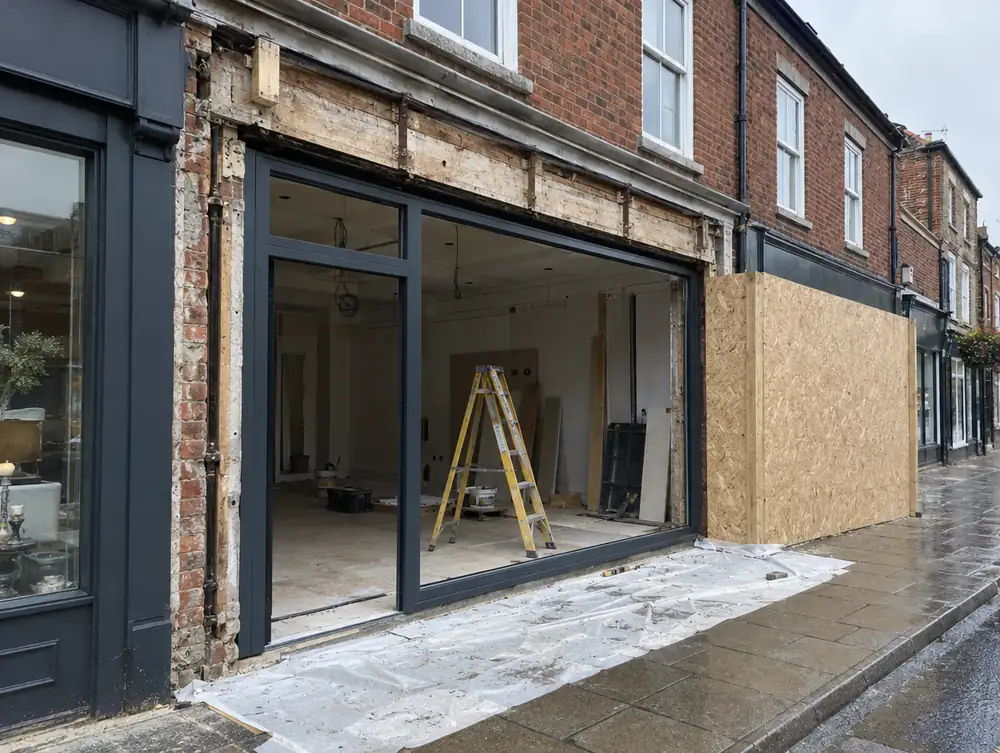
How do you design around the building when planning shopfront refurbishment in Hampstead?
If the glass is old, we look for the etched safety mark in the corner of each pane. Panes without one, in the door or at low level, should be replaced while the frontage is being worked on.
If your Hampstead shopfront is aluminium and the frame is sound, a recoat can change the whole look. We check for corrosion and old sealant first, because paint will not hide either for long.
Where a fascia has crept down over the years, lifting it back to its original line can add real height to the glass. Check what sits behind it first at Hampstead premises, since a shutter box or old beam may set the limit.
What might shopfront refurbishment cost in Hampstead?
The guide for shopfront refurbishment is £1,995 to £8,995 plus VAT depending on what is kept. Expect the lower end for simple work with clear access, and the upper end where detail, finish or awkward conditions add hours.
What permissions should you check for shopfront refurbishment in Hampstead?
England has no permitted development route for changing a shopfront. Part 7 Class A of the General Permitted Development Order 2015 excludes creating, altering or replacing one, and it allows no alterations at all on article 2(3) land. That leaves two outcomes for shopfront refurbishment at premises in the Hampstead area: a planning application, or work that doesn't materially affect the external appearance.
Hampstead applications for planning permission or advertisement consent are normally handled by London Borough of Camden. Our survey includes a check of the position for your address.
| Town | Hampstead |
|---|---|
| Area | Greater London |
| Postcode districts | NW3 |
| Planning authority | London Borough of Camden |
| Building approval | Building Regulations (Approved Documents) |
| Distance from Great Barr | About 101 miles |
| Survey | Free for new work |
Does London Borough of Camden publish shopfront guidance?
Yes, Camden Planning Guidance: Design (Chapter 6: Shopfronts) (2021). It tells applicants what the council expects from new and altered shopfronts. A few of the things it asks for:
- Existing stall risers should be kept, and new ones should be at least 300mm high or reach the top of the pilaster base or door panel.
- Solid shutters are only acceptable in exceptional circumstances, and internal security measures are strongly encouraged.
- Uncoated shutters, galvanised steel, milled finishes and anodised aluminium are not acceptable finishes.
Questions about shopfront refurbishment in Hampstead
Can a refurbishment make my Hampstead premises easier to enter?
Often, yes. Lighter door closers, better handles and a lower threshold can all be added without replacing the frontage. We check the door width and the step at survey.
Can you refurbish just the sign and door on my Hampstead frontage?
Yes. A new sign and door gear can make a big difference on their own. We would look at how they sit with the frame and suggest a colour to tie them together.
Can you repair a timber shopfront in Hampstead?
Yes. Decayed sections are cut out and spliced with new hardwood, then primed and painted. That keeps the joinery you have, and it usually costs far less than making a new frontage.
Do I need listed building consent for a shopfront in the Hampstead area?
Usually yes, if the building is listed. In England the local planning authority decides, and Historic England is notified of Grade I and II* works and specified Grade II works. Like-for-like repair may not need consent, so ask the council before work starts.
What rules apply to a fire exit door through a shopfront in the Hampstead area?
It must open in the direction of escape and can't be locked against immediate use, and a dedicated fire exit can't be a sliding or revolving door. In England that comes from article 14(2) of the Regulatory Reform (Fire Safety) Order 2005, and the duty sits with the responsible person, normally the employer or whoever controls the premises for a business, otherwise the owner. An outward door can clash with section 153 of the Highways Act 1980 where it opens onto the footway, so raise it early.